After 35+ days of a federal shutdown, America’s airports are becoming the latest warning sign of what happens when “essential” workers are told to protect the public without a paycheck.
Quick Take
- The 2026 shutdown has stretched past 35 days, matching the length of the 2018–2019 shutdown and putting visible strain on airport security and flight operations.
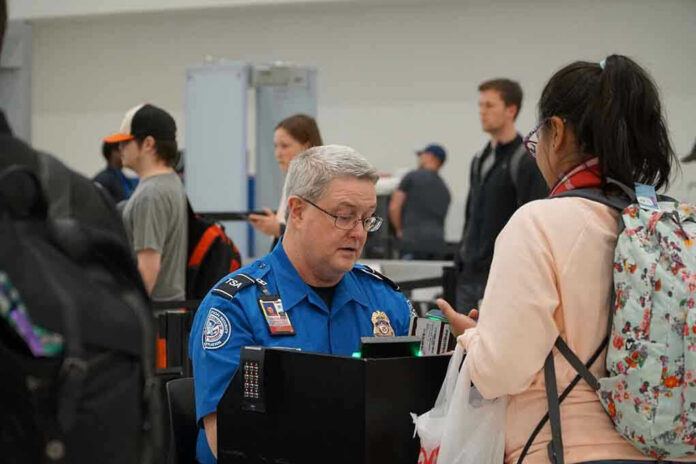
- TSA screeners and air traffic controllers are continuing to work without pay, and callouts have surged at key facilities, driving delays and long lines in several major hubs.
- Transportation Secretary Sean Duffy said staffing issues drove 84% of flight delays on March 9, as FAA facilities reported widespread shortages.
- Reports of three- to four-hour TSA checkpoint waits have hit airports such as Atlanta and Houston, even as national average waits were reported as low on some days.
Shutdown Hits Aviation Where Americans Feel It Fastest: Time, Safety, and Trust
The shutdown that began in late January 2026 has now run beyond 35 days, leaving large parts of the federal workforce in limbo while essential personnel keep showing up. Around 600,000 federal employees classified as essential continue working without pay, including TSA screeners and air traffic controllers. That arrangement is legal under shutdown rules, but it creates predictable stress on attendance, fatigue, and focus in roles that directly affect public safety and daily commerce.
FAA and airport reports describe a patchwork of disruption. Some airports have remained relatively stable, while others have seen major slowdowns tied to staffing gaps. The FAA reported callouts surging over a weekend, and it said half of the nation’s “Core 30” airports experienced air traffic controller shortages, with the New York region hit especially hard. The result for passengers is a familiar mix of delays, missed connections, and uncertainty that builds resentment quickly.
Long Security Lines Are Real in Some Hubs, Even If National Averages Look Better
Passengers at major hubs have reported security lines lasting three to four hours, including at airports in Atlanta and Houston, with Houston specifically cited for three-hour waits. At the same time, TSA statements have suggested that average wait times nationally can be far lower on certain days, including a five-minute national average on one Sunday. That contrast matters because it points to uneven staffing and uneven pain—one airport can look “normal” while another becomes a bottleneck.
Airports and local officials have tried to manage expectations with basic guidance: arrive earlier, plan for delays, and prepare for inconsistent throughput at checkpoints. Houston’s airport leadership, for example, emphasized support for TSA operations and asked travelers to anticipate longer lines. Those messages help, but they do not solve the underlying problem: when pay stops and bills continue, attendance becomes the first pressure point, and the traveling public becomes the first to notice.
Air Traffic Control Strain Drives Delays, and Leadership Is Framing It as Safety Risk
Transportation Secretary Sean Duffy tied the disruption directly to staffing, stating that 84% of flight delays on March 9 were attributed to staffing issues. That figure underscores how quickly the aviation system can degrade when controllers are short-staffed or facilities run below planned capacity. The FAA has indicated it will slow or stop traffic before emergencies develop, signaling that the system has safety guardrails—but also that disruption is the safety valve when manpower is stretched.
Duffy’s public comments also reflected a basic reality of human performance. He warned that financial stress can distract workers, especially when they are juggling side jobs or worrying about rent, food, and transportation. In aviation, where concentration and procedural discipline are the entire job, even small degradations in readiness can ripple outward. The research does not provide incident data linking shutdown stress to specific mishaps, so the safety concern remains a risk framing rather than a documented accident trend.
Unions Push for Funding While Urging Workers to Keep Showing Up
Labor groups representing TSA screeners and air traffic controllers have publicly pressed for a funding deal. The American Federation of Government Employees has backed a short-term spending bill approach, while the National Air Traffic Controllers Association has called for a “clean” continuing resolution. NATCA also told members it did not condone any collective callout action, a signal that leaders are trying to avoid coordinated absenteeism even as unpaid work drags on and morale erodes.
The shutdown also follows a previous 43-day shutdown that ended roughly four months earlier, compounding financial strain for employees who may have barely recovered. That “back-to-back” pattern is a workforce-retention problem even without hard resignation numbers in the research. The topic claim that “300 officers quit” is not substantiated in the provided sources, and TSA also acknowledged it lacks comparable callout data to the 2019 shutdown, limiting direct apples-to-apples comparisons.
TSA absences at airports double during shutdown, 300 officers quit – CBS News https://t.co/qjitbZObgw
— JOSEPH SAKOWSKI (@JOSEPHSAKOWSKI) March 10, 2026
For conservatives who believe government should function within constitutional boundaries and basic competence, this episode is a reminder that shutdown brinkmanship is not an abstraction. It lands on families, travel, and national infrastructure. The clear, verified facts here show disruptions growing as unpaid days accumulate; what remains unclear is the precise scale of TSA absenteeism and resignations. Until Congress restores funding, the system’s “normal” will stay uneven—and the public will keep paying in time.
Sources:
Airports are seeing a spike in shutdown impacts as TSA screeners, air traffic controllers call out
Wait Times at U.S. Airports Skyrocket as Shutdown-Related TSA Absences Climb
Thousands of airport workers on the job without pay