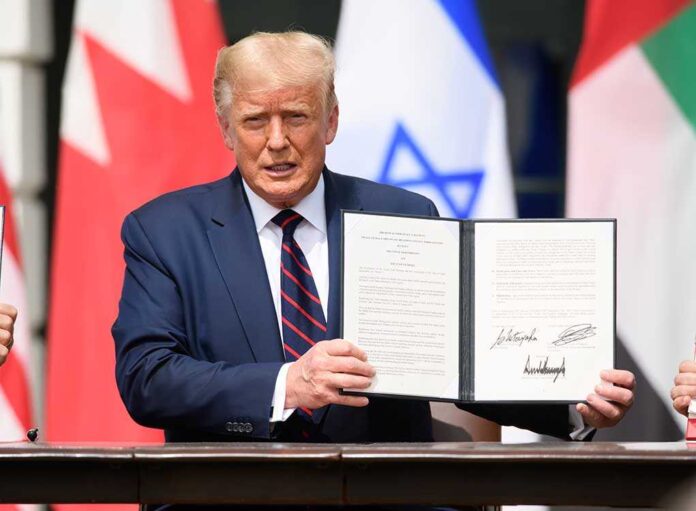
President Trump just reclassified the deadliest drug crisis in American history as an act of warfare, signing an executive order that treats fentanyl trafficking like a nuclear threat.
Story Highlights
- Trump signed executive order on December 15, 2025, designating illicit fentanyl as a weapon of mass destruction
- Order enables military, intelligence, and sanctions authorities against drug cartels and foreign adversaries
- Administration claims fentanyl has “plummeted” due to border security measures and recent strikes on trafficking operations
- Experts question whether symbolic gesture addresses root causes of America’s overdose epidemic
From Narcotic to National Security Threat
The executive order represents an unprecedented shift in how America confronts its deadliest drug crisis. Trump declared fentanyl “closer to a chemical weapon than a narcotic,” capable of enabling “concentrated, large-scale terror attacks by organized adversaries.” The synthetic opioid, 50 to 100 times more potent than morphine, kills with doses as small as two milligrams. This lethality makes it uniquely dangerous among illegal substances.
White House Border Czar Tom Homan credited the administration’s border security measures for dramatic reductions in fentanyl trafficking. The order builds on recent military strikes targeting boats near Venezuela, though experts note these vessels typically carry cocaine to Europe rather than fentanyl to the United States. Attorney General Pam Bondi previously claimed the administration saved 258 million lives through drug interdiction efforts.
Bipartisan Precedent for Unprecedented Action
The classification wasn’t without precedent in political circles. Bipartisan attorneys general had previously pressured the Biden administration to designate fentanyl as a weapon of mass destruction. House Resolution 128, introduced in the current Congress, mandates the Department of Homeland Security’s Countering Weapons of Mass Destruction Office treat fentanyl trafficking as a WMD threat. This legislative backing provided Trump political cover for the dramatic escalation.
The order expands executive powers to combat trafficking networks through military and intelligence channels previously reserved for terrorist organizations and hostile nations. Drug cartels now face the same enforcement mechanisms used against foreign adversaries possessing actual chemical, biological, or nuclear weapons. This framework bypasses traditional law enforcement limitations and congressional oversight typically required for military operations.
Expert Skepticism on Substance Versus Symbolism
Regina LaBelle, former drug policy advisor under Obama and Biden administrations, dismissed the order as political theater designed to “look like you’re doing something” without addressing underlying causes. She argued the move appeals to grieving families devastated by overdose deaths but lacks substantive policy changes needed to save lives. The classification may heighten stigma around addiction while militarizing what many experts consider a public health crisis.
Drug policy experts questioned whether treating narcotics as weapons of mass destruction addresses the complex supply chains spanning China’s precursor chemical production and Mexico’s cartel operations. The order enables rapid sanctions and intelligence operations against trafficking networks, but critics worry it escalates rhetoric without corresponding increases in treatment funding or harm reduction programs that have proven effective in other nations.
Reshaping America’s War on Drugs
The executive order fundamentally reshapes America’s approach to drug enforcement by applying counter-terrorism and weapons proliferation frameworks to narcotics trafficking. Short-term impacts include expanded surveillance, sanctions, and potential military actions against cartel operations. Long-term implications may strain relationships with China over precursor chemicals and Mexico over cross-border enforcement operations.
Trump’s base strongly supports the militarized approach to border security and drug trafficking, viewing fentanyl as a foreign attack on American communities. The classification enables rapid response capabilities against trafficking networks while sending a clear message to cartels and state sponsors that fentanyl production will be treated as an act of war. Whether this rhetorical escalation translates into measurably fewer overdose deaths remains the ultimate test of the policy’s success.
Sources:
Trump declares fentanyl a ‘weapon of mass destruction.’ Experts question the move
Trump signs order classifying fentanyl as ‘weapon of mass destruction’
Designating Fentanyl as a Weapon of Mass Destruction
H.R.128 – Fentanyl Eradication and Narcotics Deterrence Act
BREAKING: President Trump Just Declared Fentanyl a Weapon of Mass Destruction