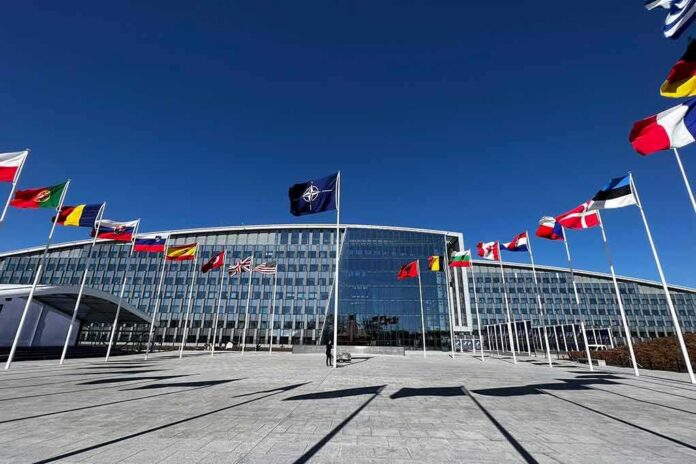
Russia told NATO in writing that it is ready to use nuclear weapons if the alliance tries to cut off Kaliningrad, its Baltic exclave wedged between Poland and Lithuania.
Quick Take
- Russia sent NATO a formal warning on September 30 threatening nuclear weapons use over Kaliningrad.
- President Vladimir Putin repeated the threat days later at a public forum in Moscow.
- NATO leaders, including Secretary-General Mark Rutte, dismissed the warning as not credible.
- Experts say the bigger danger is miscalculation, not a planned Russian nuclear strike.
Russia’s Written Warning Reaches NATO Capitals
Russia sent a diplomatic note to NATO headquarters in Brussels on September 30. The message said Moscow “will be ready to use the entire arsenal of forces and capabilities at its disposal, including nuclear weapons,” if NATO tries to isolate Kaliningrad from the rest of Russia. The document, often called a “non-paper” in diplomatic terms, was an informal but direct warning sent to NATO member states.
Putin followed up two days later at the Valdai Discussion Club in Moscow. He said Russia is prepared to use “all weapons” in its arsenal, including nuclear ones, if Kaliningrad comes under attack. Kaliningrad sits between Poland and Lithuania, both NATO members. It hosts Russia’s Baltic Fleet and serves as a base for nuclear-capable missile systems, making it one of the most militarized spots in Europe.
Why Kaliningrad Is a Flashpoint
Kaliningrad is cut off from mainland Russia by land. It can only be reached by sea, by air, or through a narrow strip of NATO territory called the Suwalki Gap. That makes the region both a strategic asset for Russia and a vulnerable pressure point. A Kyiv Post analysis called Kaliningrad “one of the most dangerous pressure points” in the standoff between NATO and Russia, pointing to military buildups, airspace incidents, and sabotage reports in the region.
Russia’s embassy in Ireland echoed the warning in blunt terms, saying “there should be no mistake” that Russia would use its full arsenal if NATO tried to isolate the exclave. The Kremlin’s spokesman, Dmitry Peskov, later said the warning should not be seen as confrontational, framing it instead as a restatement of long-standing Russian policy.
NATO Pushes Back, Calls Threat Not Credible
NATO rejected the warning quickly. Spokesperson Allison Hart said NATO is “a defensive alliance” and that “none of our activities or exercises pose a risk to any part of Russia.” She condemned what she called “irresponsible nuclear rhetoric”. Rutte went further, saying he does not take the threat seriously and that “Putin knows that he can never win” in a direct clash with NATO. In a separate transcript of his remarks, Rutte said there is “no imminent threat to NATO territory”.
Officials closer to the exclave sounded calmer than the headlines suggested. Latvian Defense Minister Raivis Melnis said he does not “see an imminent threat at this point”. Analysts quoted by Radio Free Europe/Radio Liberty said NATO does not appear to be preparing any military action to isolate Kaliningrad in the first place, which undercuts the premise behind Russia’s warning.
Experts Warn Signaling Still Carries Real Risk
Researchers who study nuclear threats say Russia has issued many warnings like this since its 2022 invasion of Ukraine. A Carnegie Endowment review found that most of these statements were symbolic, not backed by actual moves like redeploying forces or changing alert levels, the usual signs of real preparation for nuclear use. That pattern suggests the Kaliningrad warning is aimed at deterring NATO action, not announcing an actual plan to launch weapons.
Still, experts caution that repeated nuclear threats carry their own danger. Analyst Kimball, quoted by Radio Free Europe/Radio Liberty, warned that any real confrontation over Kaliningrad “could trigger retaliation, escalation, and potentially catastrophic consequences” if weapons were ever used. The International Campaign to Abolish Nuclear Weapons condemned Russia’s message outright, calling it a nuclear threat against NATO. A Washington Examiner opinion piece described the warning as “a bluff — and a nuclear trap,” arguing Russia wants the West to overreact.
What This Means for Ordinary Americans
For a public already worn down by years of overseas conflicts and government dysfunction at home, this episode fits a familiar pattern. Foreign powers test boundaries, officials trade statements, and nothing is resolved while tensions simmer. The risk here is not a planned attack, based on current reporting, but the chance that a drone incident, sabotage act, or miscommunication near Kaliningrad could spiral into something nobody intended.
🇷🇺☢️ Russia warns NATO it would use "all weapons," including nuclear, if Kaliningrad is cut off or attacked
Russia delivered a diplomatic note to NATO, publicized by Russian embassies including in Ireland, saying it "will be ready to use the entire arsenal of forces and… pic.twitter.com/4eZoA8IRqe
— 🔥🗞The Informant (@theinformant_x) October 2, 2026
No clash has happened. No weapons have moved. But the exchange shows how fragile the balance remains between a nuclear-armed Russia and a NATO alliance that includes the United States. Watching whether Moscow backs its words with actual military changes, rather than just statements, will tell observers whether this is posturing or something more serious.
Sources:
theamericanconservative.com, reuters.com, cnn.com, icanw.org, abcnews.com, washingtonexaminer.com, dw.com, kyivpost.com, aljazeera.com, foxnews.com, eng.globalaffairs.ru
© patriotsunited.org 2026. All rights reserved.