The swift removal of a statue depicting Donald Trump and Jeffrey Epstein from the National Mall—despite a valid permit—turns America’s most iconic protest space into a battleground over who gets to shape public memory, and for how long.
Story Snapshot
- A permitted Trump-Epstein statue was removed four days early from the National Mall by Park Police, igniting nationwide debate on protest art and censorship.
- The artwork, created by anonymous artists, spotlighted Trump’s past association with Epstein and tested the limits of political dissent in federal spaces.
- The National Park Service cited permit violations for the removal, but has yet to clarify specifics, fueling speculation over political motivations.
- This episode exposes fault lines in America’s ongoing struggle over free speech, the power of public art, and the enduring legacy of controversial figures.
National Mall Transformed: Protest, Provocation, and Power
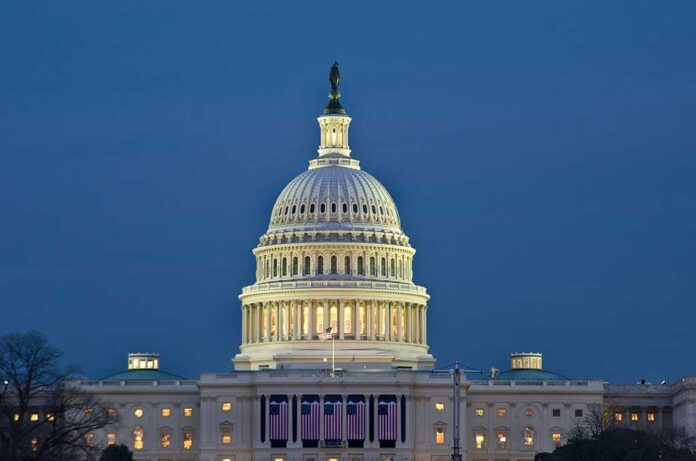
Before sunrise, the National Mall was a stage for an old American drama: A statue of Donald Trump and Jeffrey Epstein—hands clasped, notoriety interlocked—stood in front of the U.S. Capitol. Installed by anonymous artists with official paperwork, the piece was legally sanctioned until September 28. Yet, under the shadow of dawn, Park Police and National Park Service workers swept it away, citing “non-compliance” with permit terms. A piece meant to provoke vanished overnight, but the questions it raised refused to disappear.
That statue was not just bronze and stone; it was a bombshell lobbed into the heart of Washington. Its target: the unresolved, uncomfortable intersection of politics, criminality, and public accountability. Trump’s past socializing with Epstein in the 1990s and 2000s—decades before Epstein’s death in a jail cell—remains a touchstone for critics and conspiracy theorists alike. Recent attempts to link Trump more closely to Epstein, including a disputed birthday letter, have only heightened the spectacle. For the artists, the Mall was the ultimate gallery—federal turf where American ideals of speech and assembly must contend with bureaucracy and political sensitivities.
The Permit, the Police, and the Politics of Removal
The National Park Service, arbiter of public space on the Mall, faces a delicate balancing act. Permits allow for protest and art, but come with strings: security requirements, time limits, on-site presence. According to official statements, the Trump-Epstein statue fell short—perhaps lacking round-the-clock security or failing to meet other undisclosed obligations. The Park Police moved quickly, yet their reticence about the exact violation has unleashed a torrent of speculation. Did the removal reflect neutral enforcement, or was it a quiet response to political pressure and public discomfort?
The White House, for its part, called the statue “a waste of money,” but denied any hand in its ouster. In the court of public opinion, however, such denials rarely quell suspicion. With a presidential campaign looming and Congressional Democrats seizing on every Trump-Epstein headline, the stakes for both art and political messaging have never been higher. In the wake of the removal, the Mall’s history as a protest haven now collides with a new era of scrutiny and surveillance.
Art as Provocation: The Legacy of Protest Installations
This was not the first Trump-themed artwork to test the boundaries of federal tolerance. Previous installations—a golden Trump with Bitcoin, a deposed “emperor” in his underwear—have come and gone, each sparking debate over taste, legality, and the meaning of protest. Yet, the Trump-Epstein statue struck a rawer nerve, directly referencing allegations and public anxieties that continue to fester. Its abrupt disappearance sends a warning to would-be provocateurs: federal permission is not the same as federal protection.
Activists and legal scholars see the removal as a bellwether. Artists may now face heightened scrutiny, more restrictive permit conditions, or even outright denials. For the government, the episode is a case study in the limits of tolerance for controversial speech—especially when that speech hits too close to home for those in power. The Mall’s status as a free speech zone now stands at a crossroads, forced to navigate between order and openness, dissent and decorum.
The Fallout: Free Speech, Political Memory, and the Next Battle
Media coverage has amplified both support and outrage, cementing the incident as a touchpoint in debates over public art and political accountability. For Trump, the event revives unwanted scrutiny of his Epstein ties, a narrative his opponents eagerly embrace. For the anonymous artists, the removal may be the point—a demonstration of power’s discomfort with dissent.
Long-term, the removal threatens a chilling effect on protest art in federal spaces. If controversial installations are subject to swift, opaque enforcement, fewer artists may risk the attempt. Public spaces could become blander, less confrontational, and more tightly controlled. And yet, history suggests that creative dissent rarely yields quietly. The Mall has witnessed everything from antiwar protests to civil rights marches; this latest skirmish merely reaffirms the space’s central role in the American story of struggle, spectacle, and the never-ending negotiation over whose voices are heard.