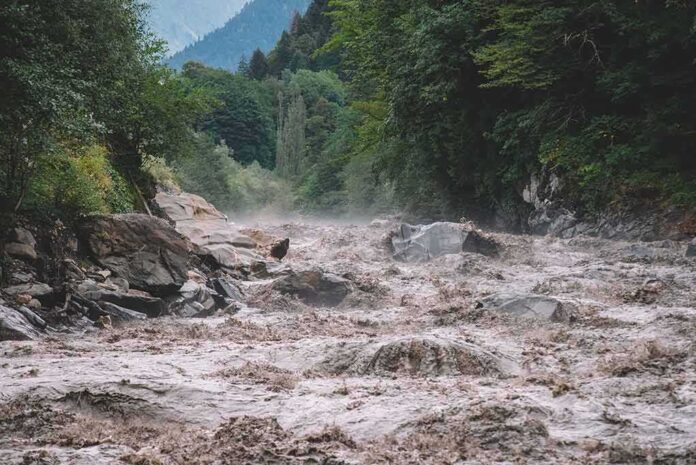
A pre-dawn surge on Nepal’s Budhi Gandaki River swept away houses and bridges, forcing riverside villages to evacuate.
Story Highlights
- Officials reported at least 35 houses destroyed across several Gorkha settlements.
- Authorities warned residents to move to higher ground as the river stayed dangerous.
- Bridges linking key villages were washed away, cutting road and foot access.
- A landslide blocking the river likely set off the sudden flood surge.
What happened along the Budhi Gandaki River
Early Sunday, a debris-filled flash flood tore through parts of northern Gorkha, Nepal. Water rushed downstream through the Budhi Gandaki River and swept away homes, markets, and bridges. Journalists and local officials described heavy damage in Chumnubri and Dharche rural municipalities. The Associated Press said residents left riverside areas as the water rose and carried buildings away. Nepal News reported a tally of 35 destroyed houses based on a local official’s statement.
Police and local leaders urged people in low-lying stretches to evacuate. Reports mentioned warnings for Sirdibas and parts of Dharche. People in Chumling and Lokpa moved after hearing the roar of the stream. The Hindu BusinessLine said more than 35 houses and several bridges were swept off their banks, with the river level staying unstable during the day. These early counts came as responders tried to reach remote sites with limited communications.
Damage to homes, bridges, and roads
Local media listed destroyed houses in Paiyu, Bagar, Dobhan, Ghettekhola, Jagat, and Salleri, with the 35-house figure credited to the vice chair of Chumnubri Rural Municipality. The Himalayan Times noted the river remained above danger level, keeping risks high for downstream areas. Khabarhub detailed the loss of three bridges, including links between Nyakchet and Sirdibas, Kerauja and Machhakhola, and Soti and nearby Arughat wards, severing travel and relief routes.
Reports did not cite a final, unified damage count. Different outlets described “more than 35” houses or “several” in certain wards. That spread likely reflects separate tallies for different settlements reported at different times. Nepal News said there were no reported human casualties at the time of its update, though search and assessment work continued in difficult terrain. The lack of full road access and power made verification slower than usual.
Why a landslide can trigger a flash flood
Nepal’s steep valleys and loose slopes can produce sudden surges. A landslide can block a river like a dam. Water then pools and breaks through, sending a wave of water, mud, and rocks downstream. Khabarhub reported a landslide likely blocked the Budhi Gandaki between Lokpa and Chumling before the surge. When the blockage gave way, the flow destroyed homes and bridges in narrow river bends and floodplains downstream.
🚨🇳🇵 BREAKING: DEVASTATING FLASH FLOODS HIT #NEPAL !
A massive flash #flood in the Budhi Gandaki River has swept away more than 35 houses and several bridges in #Gorkha district today, October 11. 🌊 pic.twitter.com/nKwNfR6LnU
— World_Breaking_News03 (@Breaking2003) October 11, 2026
Authorities and local media said the river’s level kept shifting after the first surge. The Himalayan Times warned that danger remained and urged residents to stay on higher ground. This pattern is common in such events. After an initial outburst, debris can form new jams that release again. That is why police and ward leaders kept people away from the banks while teams checked bridges, slopes, and damaged hamlets.
The human impact and the road ahead
Families along the Budhi Gandaki lost homes, shops, and key bridges. Evacuations scattered people to nearby high ground and public buildings. Local leaders called for lists of damaged and destroyed structures to guide relief. Nepal News attributed the 35-house figure to the rural municipality’s vice chair, offering an early snapshot for aid planners. The Associated Press described widespread evacuations and uncertain access, which can slow both rescue and repair.
For Americans watching from afar, this is a reminder that fragile infrastructure and slow disaster response can turn a bad day into a lost season. Mountain communities rely on a few bridges and roads for food, fuel, and medicine. When they fail, people suffer. Clear warning systems, sturdy crossings, and fast damage checks save lives and money. That is true in Nepal’s high valleys and in flood-prone towns across the United States.
Sources:
youtube.com, thehindubusinessline.com, apnews.com, news.abplive.com, english.khabarhub.com
© patriotsunited.org 2026. All rights reserved.