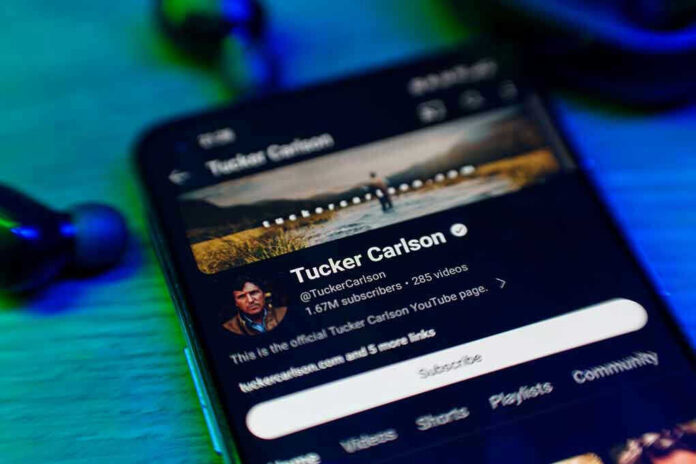
Few moments in modern media spark a battle over free speech and journalistic ethics quite like a prime-time host telling his critics to “buzz off” after interviewing one of America’s most infamous white nationalists.
Quick Take
- Tucker Carlson defends his interview with Nick Fuentes amid a firestorm of criticism, doubling down on his commitment to open dialogue.
- Media and advocacy groups reignite the debate over whether giving extremists a platform normalizes their views or exposes them to scrutiny.
- Both Carlson and Megyn Kelly, now independent media figures, leverage the controversy to highlight the changing landscape of news and commentary.
- The episode underscores deep divides over the responsibilities of journalists and the boundaries of public discourse in the digital age.
When Carlson Says “Buzz Off,” the Media World Listens
Tucker Carlson’s November 2025 interview with Nick Fuentes, a figure widely labeled a white nationalist, reignited a perennial debate: does interviewing extremists shed light on dangerous ideology, or does it confer legitimacy? Carlson’s subsequent appearance on Megyn Kelly’s show was less an apology tour and more a declaration of independence. He brushed aside critics—advocacy groups, commentators, even fellow journalists—by insisting that understanding all viewpoints, no matter how repugnant, is the true mark of independent journalism. In Carlson’s words, critics could simply “buzz off,” a phrase that landed with the finality of a gavel strike.
Calls for accountability poured in rapidly. Carlson’s justification was unapologetic: platforming controversial figures, he argued, does not equate to endorsement. He maintained that airing Fuentes’ views on a widely watched program was a necessary, if uncomfortable, exercise in transparency. This stance, while galvanizing his core audience, drew ire from those who believe that any exposure for extremists risks normalizing hate speech. The lines between exposing, amplifying, or legitimizing dangerous rhetoric became the flashpoint of the controversy.
The Perennial Question: Does Interviewing Extremists Cross a Line?
Platforming extremists is not a new dilemma. Legacy media and new independent platforms alike have long grappled with the consequences of giving airtime to figures like Alex Jones and Richard Spencer. Supporters of such interviews often invoke free speech, contending that sunlight is the best disinfectant. Critics counter that media exposure, even under the guise of scrutiny, can transform fringe voices into mainstream actors. The Carlson-Fuentes episode unfolded against a backdrop of growing polarization, with both sides warning of slippery slopes—either toward censorship or toward the normalization of hate.
Megyn Kelly’s role in the episode was more than that of a neutral facilitator. As a fellow former mainstream anchor operating in the wild west of independent media, she provided a sympathetic platform for Carlson’s rebuttal. Their conversation was less about interrogating Fuentes’ ideology and more about defending journalistic autonomy. This approach, while lauded by some for its candor, left others questioning whether the true responsibilities of journalism—exposing, challenging, and contextualizing—were being sidelined in favor of the spectacle of controversy.
Who Benefits From the Spotlight—and Who Pays the Price?
Nick Fuentes, already a lightning rod for controversy, gained unprecedented visibility from the interview. Carlson and Kelly, meanwhile, reinforced their reputations as unfiltered commentators willing to defy media orthodoxy. Critics, including advocacy groups and rival journalists, seized on the moment to pressure advertisers and shape public opinion about the ethics of “platforming.” The power dynamics were stark: independent media titans with loyal followings versus fragmented watchdogs struggling to set boundaries in a digital age where attention is currency.
The episode’s immediate impact was to intensify scrutiny on Carlson and Kelly, while reigniting debates in newsrooms and living rooms alike. Long-term, however, the ripple effects could be far more significant. If audience polarization deepens and independent platforms continue to sidestep traditional editorial guardrails, the lines between journalism, activism, and entertainment may blur even further. The question for conservative audiences—and the wider public—is whether open inquiry justifies any guest, or if some ideas are simply too toxic for prime time.
What the Experts Say: Scrutiny, Sunlight, and the Slippery Slope
Media ethicists warn that interviewing extremists can, even unintentionally, legitimize hate. The distinction between “platforming” and “interrogating” is subtle and often lost on audiences. Academic voices highlight that while rigorous questioning can expose dangerous ideas, a “softball” interview risks granting a veneer of credibility. Carlson’s defenders cite American traditions of free speech and robust debate, arguing that suppressing voices only drives them underground. Critics respond that history is littered with examples where exposure, not censorship, led to the mainstreaming of radicalism.
For now, the fallout from the Carlson-Fuentes interview continues to unfold—on air, online, and in the halls of media power. Whether this episode sets a new precedent for independent journalism or becomes a cautionary tale about the perils of controversy for controversy’s sake remains an open question. What is certain is that the battle lines over who gets a microphone—and at what cost—are only growing sharper in America’s fragmented media landscape.
Sources:
The Megyn Kelly Show podcast (Apple Podcasts)