
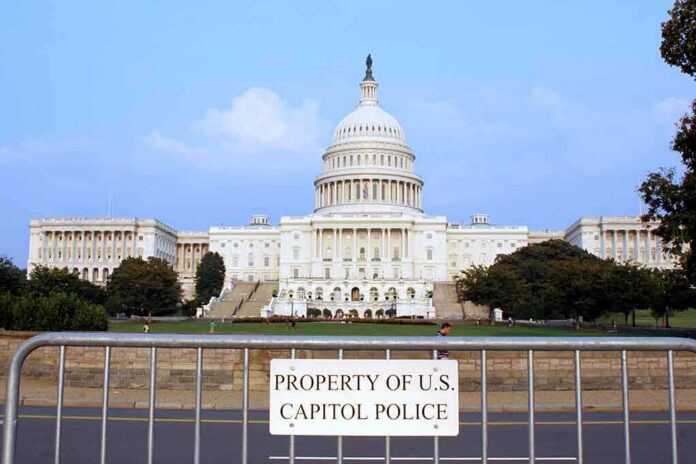
A new report claims threats against lawmakers spiked after Meta loosened its rules, and both sides are already using it to push their favorite narratives about “safety” versus “free speech.”
Story Snapshot
- Meta ended third-party fact-checking in the United States and relaxed some speech rules while saying it would still police “high-severity” harms.
- A watchdog now claims threats against United States lawmakers jumped after these rollbacks, but has not released a public, lawmaker-specific dataset to prove direct causation.
- Critics say Meta’s shift to crowd-powered “community notes” is weaker than real fact-checking and will leave more dangerous content online.
- Meta insists its new policy reduced enforcement “mistakes” and kept serious violations in check, leaving Americans to sort out whose metrics to trust.
Meta Rolled Back Fact-Checking And Relaxed Some Speech Limits
In January 2025, Meta, the parent company of Facebook and Instagram, announced it would end its third-party fact-checking program in the United States and instead move to a “Community Notes” system where users add and rate context on posts.[3][6] Meta said it would “allow more speech” by lifting some restrictions and would focus its automated enforcement on “illegal and high-severity violations,” which means more borderline content is likely to stay up unless it clearly crosses a legal line.[6] Critics warned this rollback could let more hateful or misleading content spread faster, including posts that dance right up to the edge of direct threats.[1][2][5]
Meta framed the change as a correction after years of overreach, arguing that its earlier system produced “too many mistakes and too much censorship” and that the company should not act as the “arbiter of truth.”[1][6] The new approach also ends Meta’s practice of demoting fact-checked posts and covering them with full-screen warning labels, replacing those with lighter-touch labels that users can choose to ignore.[6] For many conservatives, this looked like a long-overdue retreat from heavy-handed policing of political content, but for many activists and legacy media, it was treated as a dangerous rollback of “safety” protections.[2][3][5]
Watchdog Claims Threats Against Lawmakers Spiked, But Data Gaps Remain
A watchdog group now claims that after Meta’s moderation rollback, violent or abusive threats against United States lawmakers became easier to post and harder to catch, leading to a spike in threatening content on the platforms.[3][5] Their argument leans on Meta’s own policy shift: once third-party fact-checking and stronger demotion tools were removed, one layer of detection and friction disappeared, which could allow more threatening rhetoric to stay visible longer.[3][6] Civil rights advocates had already warned that moving from professional fact-checkers to community notes would fail to keep up with harmful posts, pointing to X, formerly Twitter, where only a small share of proposed notes on election content ever went public while misleading posts continued to rack up far more views.[2]
The watchdog, however, has not put forward a public, lawmaker-specific dataset that counts threats before and after January 2025 on Facebook and Instagram.[3][5] None of the cited sources provide a detailed log that ties individual threats to Meta’s platforms and shows a clear rise after the policy change.[1][3][5] That means their spike claim currently rests on a plausible mechanism and broader concern about harmful content, rather than hard numbers that show how many lawmakers were targeted, what kind of threats were made, and how Meta handled those posts over time.[3][5]
Meta Points To Fewer “Mistakes” And Ongoing High-Severity Enforcement
Meta answers critics by saying its January 2025 changes were not a shutdown of moderation but a refocus on serious harms and an effort to improve accuracy.[6] The company reported a roughly 50 percent drop in United States enforcement “mistakes” from late 2024 to early 2025 after it shifted to more confidence-based enforcement, added system audits, and brought in more human review and large language model “second opinions” for certain calls.[6] Meta says that the amount of low-prevalence violating content in most problem areas stayed largely flat across this period, which it offers as proof that serious rule-breaking did not explode under the new rules.[6]
From Meta’s view, critics are ignoring that the company still enforces against “illegal and high-severity” content, including direct threats of violence, while simply pulling back from gray-area political speech and heavy-handed fact-checking.[6] Meta argues that community notes can reduce bias because the company itself will not write or pick the notes, and that its move aligns with a broader free-speech-friendly approach already seen on X.[3][6] Yet this defense depends heavily on Meta’s own metrics and framing, and outside groups do not have access to the internal logs needed to independently verify whether lawmaker-directed threats are being caught as quickly and consistently as the company claims.[3][5][6]
Free Speech, Safety, And What Conservatives Should Watch Next
This fight over threats to lawmakers sits inside a much wider culture war over who controls speech online and how far Big Tech should go in filtering political content.[3][5][8] For years, many conservatives watched their posts about elections, public health, and cultural issues get labeled or suppressed while left-wing narratives went unchecked, all under the banner of “safety” and “fact-checking.”[2][3] Now, when Meta finally steps back from that model and claims to restore more open debate, many of the same activist groups and media outlets that cheered on past crackdowns insist that the change will unleash chaos, violence, and even “genocide.”[3][4]
Biggest strategic upgrade
Your current post says:
Meta’s AI moderation is out of control.
Stronger framing:
Meta appears to be experiencing a false-positive account-integrity enforcement incident affecting legitimate personal, creator, and business accounts.
That wording is… https://t.co/7zbcBIs4Y4
— shinyufoguy2222 (@ollobrains) June 8, 2026
For Trump supporters and other constitutional conservatives, the key is to separate two questions: first, do we want private companies acting as gatekeepers for lawful political speech; and second, are they still doing their basic duty to remove true threats of violence, no matter who they target.[3][6] The current public record does not show a clear, lawmaker-specific data trail proving that Meta’s rollback directly caused a measurable spike in threats, but it does show that Meta narrowed its enforcement to clear, high-severity violations and walked away from third-party fact-checkers.[3][6] As this debate continues, conservatives should demand real transparency from Meta, resist any push to let government control online speech, and insist that serious threats are punished without turning social media into another tool to silence dissent.[3][5][6]
Sources:
[1] Web – Threats to US lawmakers spiked after Meta eased moderation: watchdog
[2] Web – Meta’s content moderation rollback draws concerns from advertisers
[3] Web – Meta’s Fact-Checking Rollback: Governance, Free Speech, and …
[4] Web – Meta’s new content policies risk fueling violence and genocide
[5] YouTube – Senate Hearing on Meta’s Foreign Relations and Representations to …
[6] Web – Analysis: Meta’s fact-checking pullback will have global consequences
[8] Web – Meta announces end to its fact-checking program in the US
© patriotsunited.org 2026. All rights reserved.