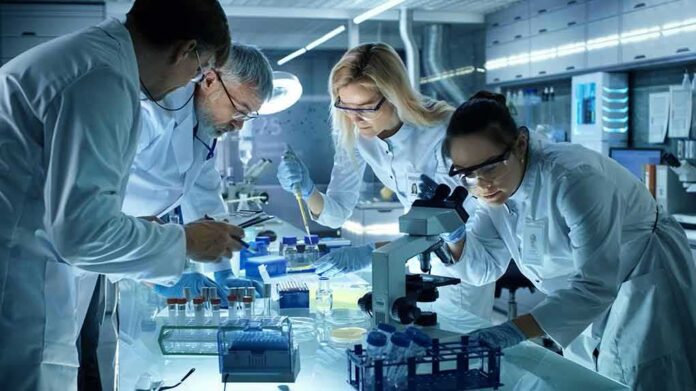
Anthropic has built a Bay Area wet lab where its Claude AI will guide robots to run real biology experiments, moving artificial intelligence from the screen into the lab bench.
Story Highlights
- Anthropic confirmed a Bay Area wet lab for physical biology work.
- Company says the lab is not specifically for drug discovery.
- Goal is to test Claude directing robotic systems with limited human help.
- Shift reflects a broader push to link AI models with automated labs.
Anthropic Confirms New Bay Area Wet Lab
Reuters reported that Anthropic has set up a wet lab in the San Francisco Bay Area to conduct hands-on biology research. The company’s head of life sciences, Eric Kauderer-Abrams, confirmed the lab’s existence. A company spokesperson later said the lab is not specifically for drug discovery. These points establish that the lab is real, located in the Bay Area, and focused on physical experiments rather than only computer simulations.
Reuters and syndication partners described how the lab will let Claude, Anthropic’s artificial intelligence system, direct robotic units to perform lab tasks with limited staff on site. Yahoo Finance, citing the same reporting, said Anthropic is testing whether Claude can instruct robotic systems to run experiments with minimal staffing. The move shifts the company’s biology work beyond “in silico” research into real-world testing that generates its own data, not just predictions.
What “Claude-Led” Experiments Likely Mean in Practice
Public reports say Claude will issue instructions to lab robots, then review results and adjust steps, with people still in the loop. That type of workflow mirrors broader “agentic” approaches discussed across life sciences, where artificial intelligence agents help plan, execute, and analyze experiments across both dry-lab and wet-lab settings. This is not unique to one company; it reflects a wider movement to close the loop between models and automated experimentation in biology.
Analysts have stressed that artificial intelligence does not erase the wet-lab bottleneck. Even with strong computer models, teams must synthesize molecules, run assays, and check toxicity and behavior in living systems. Many early hits do not hold up in cells or animals. That is why more artificial intelligence groups are building or renting automated labs. They want faster feedback from real experiments to improve models and cut wasted work.
Drug Discovery Confusion and the Company’s Clarification
Some outlets framed the news as drug research. However, Anthropic told Reuters the lab is not specifically for drug discovery. That does not rule out biology work that supports drug science, but it sets a boundary around the lab’s stated mission. Reuters emphasized the nuance, yet syndication often blurs distinctions between lab automation, early discovery, and clinical work. Readers should separate these terms when judging what this facility is designed to do today.
Reporting does not include an address, staffing numbers, or a budget. The company did not release a detailed public memo on lab scope or governance. That leaves open questions about exact workflows, organisms used, and how safety checks are handled. Those details may come later through local permits, technical talks, or partner disclosures. For now, the confirmed facts cover the lab’s existence, location region, purpose, and the company’s denial of a drug-discovery label.
Why This Move Matters for Main Street
This development shows how fast big tech is pushing into biology research space. Companies now link artificial intelligence to robots to run experiments with fewer people and more speed. Supporters say this can cut costs and speed breakthroughs. Critics worry about who sets the rules, who benefits, and how risks are managed. The public often feels shut out while powerful firms and institutions set the agenda far from daily life and local accountability.
Anthropic has moved its life sciences research out of pure computer simulation and into a real physical wet lab, according to a Reuters exclusive.
The lab, set up quietly in the San Francisco Bay Area, is designed to let Claude direct laboratory robots with limited human… pic.twitter.com/U9is6UTAqE
— AGTP (@AGTPinsights) September 19, 2026
Clear rules can help. Many research groups urge strong documentation, human oversight, and transparency when artificial intelligence touches lab work. Those steps do not slow progress; they build trust and reduce mistakes. If more biology moves into automated loops, the country will need firm guardrails so speed does not outrun safety. That balance matters to families, workers, and patients who will live with the results of choices made in labs they never see.
Sources:
insiderpaper.com, reuters.com, finance.yahoo.com, techmymoney.com
© patriotsunited.org 2026. All rights reserved.