
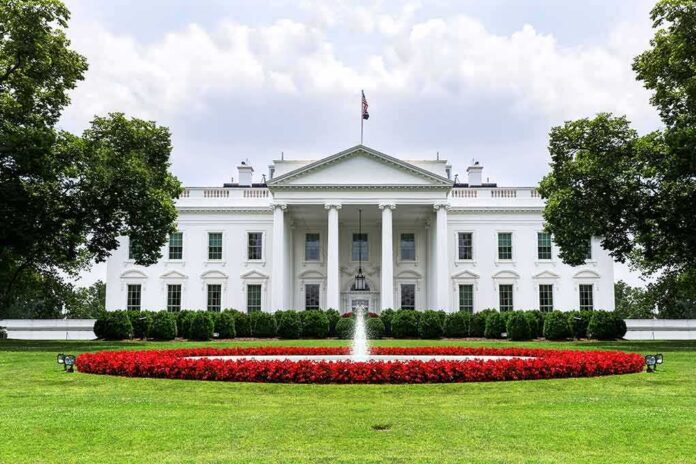
The White House has mapped out ways to keep governing by executive action if Congress flips, testing how far presidential power now reaches.
Story Snapshot
- White House lawyers and policy aides identified moves on immigration, tariffs, housing, and spending that rely on executive power.
- Recent Supreme Court rulings shifted power toward the presidency in key areas, while limiting others.
- Democratic leaders warn the executive branch cannot dismantle agencies Congress created, citing the Education Department fight.
- Both parties see a system where Washington power centers protect themselves more than the public.
What the White House Planned and Why It Matters
Reuters reported that President Trump’s team spent months preparing executive actions to drive policy if Democrats gain Congress. Senior aides, including Stephen Miller and Russell Vought, worked with the White House Counsel’s Office since April. They scoped options on immigration rules, tariffs on key minerals and wind turbines, and steps to tackle housing and construction costs. Officials also planned for legal defense of these moves in court. The goal was to keep the agenda moving without new laws.
Axios noted that the Supreme Court’s recent term weakened Congress and boosted the power of the presidency and the Court. Decisions narrowed tools that lawmakers use to control agencies and the executive branch. That shift makes executive action a more attractive path when Congress stalls. Yet power did not move in only one direction. Court rulings still set real limits, so each White House step must match a statute or risk being blocked.
Where the Courts Drew New Lines
A 2026 decision held that the President cannot use the International Emergency Economic Powers Act to impose tariffs. That undercuts one fast track to broad trade moves. The case reminded both parties that Congress designs the scope of executive tools, and courts will enforce those lines. Other rulings adjusted removal power over agency leaders, but left independence for some posts, like Federal Reserve Governors, in place.
Another shift came as the Court curbed nationwide injunctions. Federal judges now face tighter rules on blocking policies across the whole country. That change could let more executive actions take effect while lawsuits play out. Agencies may move faster, but the legal fights will still test the reach and reasoning behind each order. Speed rises, certainty does not, and the final word still rests with the courts.
Congress Pushes Back on Agency Power Plays
House Democratic leaders argued the executive branch cannot unilaterally close or dismantle the Department of Education. They said Congress created the agency, so only Congress can eliminate it. Representatives Hakeem Jeffries and Jamie Raskin framed efforts to defund or reorganize the department by fiat as unlawful. Their filings cast such moves as a breach of separation of powers and Congress’s control over federal spending.
Senator Chris Van Hollen also warned that Congress has ceded too much ground to presidents over time. He pointed to war powers as one area where lawmakers must reassert their role to restrain executive action. His view reflects a larger worry shared by many voters: both branches chase short-term wins and partisan advantage, while core checks and balances erode. That drift leaves the public stuck with policy whiplash and few lasting fixes.
What This Means for People Outside Washington
If the White House leans on executive action, policies may change faster on items like visas, tariffs on critical minerals, and building rules tied to housing costs. Faster movement can cut red tape or close gaps when Congress is gridlocked. But rules made this way are easier to reverse, and legal fights can delay relief on prices or jobs. Businesses, workers, and homeowners face more policy swings that make planning harder.
20 (Good) Reasons to vote for Republicans Tomorrow
1) TRUMP ACCOUNTS: Created investment accounts for American children, including a $1,000 federal contribution for eligible babies born from 2025–2028.
2) HISTORICALLY LOW ILLEGAL BORDER CROSSINGS: Border Patrol encounters at…
— Trump and Vance (@Trump_Vance) November 3, 2026
For voters on the right and left, the pattern looks familiar. Leaders in Washington stretch their authority when it suits them, then blame the other branch when things stall. Courts now play an even bigger role in deciding who wins. That makes power feel distant and unaccountable. The stakes are simple: if big choices keep shifting to executive orders and court rulings, the public’s say through Congress keeps shrinking, and trust in the system falls further.
Sources:
axios.com, reuters.com, supreme.justia.com, cambridge.org, latimes.com, congress.gov, npr.org, levernews.com, ici.radio-canada.ca
© patriotsunited.org 2026. All rights reserved.