

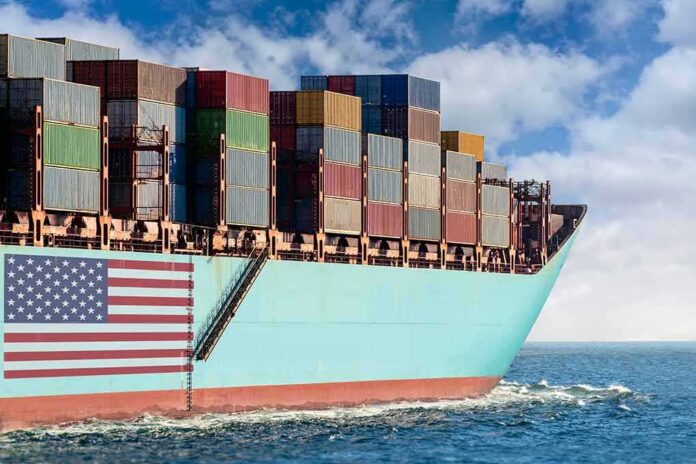
Russian diesel tankers are approaching U.S. ports under a new Treasury license, colliding with a 2022 law that banned such imports.
Story Snapshot
- Congress banned Russian energy imports in 2022; diesel is covered under that law.
- Treasury’s General License 135 authorizes Russian diesel imports through April 7, 2027.
- Bipartisan lawmakers say the license violates the statute and want it reversed.
- The administration says the move is legal and aims to ease fuel prices.
What the 2022 Law Actually Says
Congress passed the Ending Importation of Russian Oil Act in 2022. The law bans all Russian products in chapter 27 of the tariff schedule, which includes petroleum products like diesel. The statute sets a clear off-ramp. It allows an end to the ban only if the President certifies to Congress, after consultation, that specific conditions about Russia’s war and Ukraine’s rights are met. There is no general waiver written into the law for fuel shipments.
The statute’s design matters because it sets the baseline. Congress chose a hard ban and wrote its own method to lift it. That method requires formal steps and a certification record. If those steps did not happen, the ban remains the default rule. This is the core legal friction now driving headlines, port questions, and nervous energy traders who fear penalties if they guess the law wrong.
What the New Treasury License Does
On October 9, 2026, the Treasury Department’s Office of Foreign Assets Control issued General License 135. The license authorizes transactions tied to the sale, delivery, offloading, and importation of Russian-origin diesel, including into the United States, through April 7, 2027. Treasury’s sanctions pages explain that general licenses allow activities that would otherwise be barred under sanctions rules without a case-by-case approval.
Treasury officials defend the license as legal. They argue it fits within existing sanctions authority and aims to help bring down fuel prices. Supporters say this does not erase the 2022 statute but operates inside the sanctions framework. Critics answer that a license cannot override a direct import ban passed by Congress. That clash sets up a test between executive licensing and a statutory embargo.
Congressional Pushback and Possible Penalties
Seven senators—four Republicans and three Democrats—publicly warned that the diesel arrangement violates U.S. law and urged President Trump to reverse course. They pointed to the 2022 law’s explicit import ban to argue that Treasury cannot greenlight these shipments by license alone. Their reaction signals rare bipartisan resistance when energy, Russia, and separation of powers intersect so directly.
Representative Jamie Raskin, the top Democrat on the House Judiciary Committee, told the oil industry that the license offers no shield from liability if the statute controls. He flagged civil penalties up to twice the transaction value and criminal penalties up to $1 million and 20 years in prison for sanctions violations. He also noted a ten-year statute of limitations, which raises the risk for companies betting on the license if courts later reject it.
What We Know—and What We Don’t
Public records establish three firm points. First, the 2022 law bans Russian energy imports unless the President completes a detailed certification. Second, Treasury’s General License 135 authorizes Russian diesel imports into the United States until April 2027. Third, the administration claims lawful authority to issue that license to ease prices. What remains unclear is whether the required certification occurred, and whether any court will uphold or reject the license’s reach.
The dispute lands at a common fault line in American governance. Congress writes bright-line bans, while the executive branch uses sanctions tools to manage exceptions. Courts often decide who has the stronger hand when statutes and licenses collide. Until a judge rules or the administration releases its full legal analysis, companies, ports, and consumers live with uncertainty that can raise costs and erode trust in how Washington makes and enforces the rules.
Why This Matters Beyond D.C.
Truckers, farmers, and small businesses care about diesel prices, not footnotes in a license. If the imports arrive, any price relief may be small and uneven, according to analysts who doubt the volumes can move the market much. If the shipments stall amid legal fights, supply could tighten again. Either way, the fight feeds a wider belief that rules bend for the powerful while ordinary Americans pay at the pump and watch leaders argue over process, not outcomes.
Both left and right see a pattern. Leaders promise cheaper energy, then deliver confusion, loopholes, and finger-pointing. If the government wants public trust, it must show its work. That means releasing the legal basis for the license, stating whether the 2022 certification steps were done, and disclosing who is moving this fuel and on what terms. Clear answers, not secret memos, will tell the country whether this deal serves the people—or only the insiders.
⛽🇷🇺🇺🇸 Sanctioned Tankers Carry Russian Diesel to America
Three tankers carrying around 140,000 tonnes of Russian diesel are crossing the Atlantic to the US East Coast, and two of them are under Western sanctions. ⚠️
📌 The key facts
🤝 On 9 October, President Trump agreed a… https://t.co/gtugIIsttr
— Miss Lara B. 🏳️⚧️ (@RealLaraBridge) October 28, 2026
Sources:
foxnews.com, congress.gov, atlanticcouncil.org, bbc.com, democrats-judiciary.house.gov, doggett.house.gov, abcnews.com
© patriotsunited.org 2026. All rights reserved.