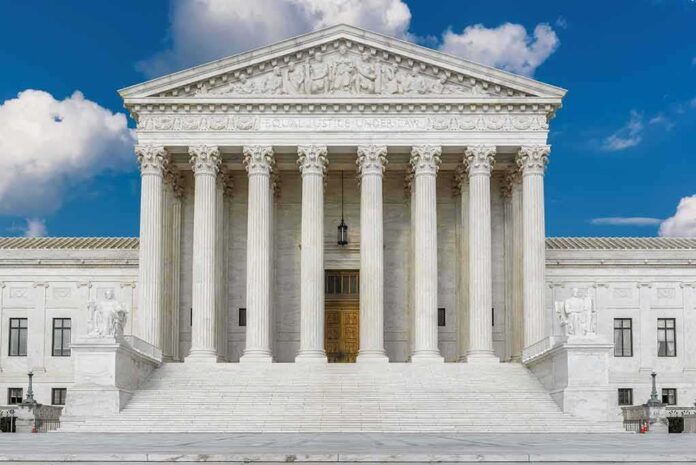
Justice Samuel Alito delivers a scorching rebuke to Ketanji Brown Jackson’s “baseless and insulting” dissent, defending the Supreme Court’s move to enforce constitutional redistricting in Louisiana ahead of the 2026 midterms.
Story Highlights
- Supreme Court conservative majority strikes down Louisiana’s race-based SB8 map as unconstitutional racial gerrymander, rejecting VRA Section 2 mandates for additional majority-Black districts.
- Court grants expedited judgment in 8-1 order, allowing immediate implementation despite ongoing primaries, with only Jackson dissenting solo.
- Alito’s concurrence dismantles Jackson’s “chaos” claims as groundless, noting Louisiana’s non-opposition and her own concession that new maps remain feasible.
- Decision upholds Equal Protection Clause over expansive racial entitlements, aligning with color-blind constitutional principles conservatives champion.
Supreme Court Strikes Down Racial Gerrymander
Louisiana’s SB8 congressional map created a second majority-Black district, drawing strict scrutiny under the Equal Protection Clause. Justice Alito’s majority opinion in Louisiana v. Callais ruled the Voting Rights Act Section 2 did not require this race-based district. The state failed to prove a compelling interest, rendering SB8 an unconstitutional racial gerrymander. The 6-3 decision applies an updated Gingles framework, focusing on facts over presumptions.
Justice Thomas concurred, rejecting any VRA interpretation entitling racial groups to proportional representation. This stance prioritizes constitutional limits on race in districting, countering liberal expansions of the 1965 law. The ruling fits a pattern where conservative majorities invalidate race-driven maps in 70% of appealed cases since 2020.
Expedited Order Enables Timely Compliance
The Supreme Court issued an unsigned 8-1 order on May 4, 2026, in Callais v. Louisiana, shortening the standard 32-day Rule 45.3 period to “forthwith.” This allows immediate remand to lower courts for new maps before November midterms. Louisiana did not oppose the plaintiffs’ acceleration request, and no rehearing petition loomed, mooting delay purposes.
Justice Elena Kagan’s dissent, joined by Sotomayor and Jackson, labeled the April 29 ruling the “latest chapter in the majority’s now-completed demolition” of the VRA. Yet the broad 8-1 consensus on timing underscores procedural propriety amid active elections.
Alito Rebukes Jackson’s Solo Dissent
Justice Jackson dissented alone, claiming the expedited order “spawned chaos” in Louisiana, citing scheduled primaries, early voting, and suits by voters and candidates over submitted ballots. She invoked Chief Justice Roberts’ Rucho v. Common Cause warning against courts assuming political responsibility for redistricting.
This lady was chosen because she was
FEMALE &
BLACK
••••••••
Ketanji Brown Jackson is making headlines after a fiery dissent in a major SCOTUS voting rights case tied to Louisiana redistricting.@kayleighmcenany @EmilyCompagno @IngrahamAngle @FoxNews@JesseBWatters— The Labrador Retriever (@OnielRichards) May 6, 2026
Alito’s concurrence, joined by Thomas and Gorsuch, called Jackson’s charges “baseless and insulting,” “utterly irresponsible,” and “groundless.” He noted her concession that new constitutional maps remain feasible, undermining her chaos narrative. Alito highlighted Louisiana’s non-opposition and argued rigid Rule 45.3 adherence would itself create partiality by delaying constitutional enforcement.
Jackson accused the majority of diving into political fray, ignoring standard procedures for “appearance of partiality.” Alito countered that her “unthinking compliance” with defaults favored those benefiting from delay. This exchange exposes liberal frustration with limits on race-based entitlements, while conservatives celebrate color-blind victories.
Victory for Constitutional Principles
The rulings reinforce strict scrutiny for race in redistricting, rejecting VRA as a tool for guaranteed minority districts. Amid 2026 midterms, expedited implementation ensures elections under constitutional maps, not racial gerrymanders. Conservative justices upheld individual rights over group quotas, a win against woke demands for proportional outcomes.
Louisiana Republicans now pursue compliant maps, potentially securing fair representation. Jackson’s dissent, lacking quantified disruption evidence, draws Alito’s sharp defense of judicial restraint. This 6-3 substantive and near-unanimous procedural outcome bolsters trust in the Court’s conservative guardians.
Sources:
[1]
[2] The Supreme Court’s Callais decision sets new framework for racial …
[3] Samuel Alito Had No Answers For Ketanji Brown Jackson’s Latest …
[4] [PDF] 25A1197 Callais v. Louisiana (05/04/2026) – Supreme Court
[5] [PDF] 24-109 Louisiana v. Callais (04/29/2026) – Supreme Court
[6] CALLAIS v. LOUISIANA | Supreme Court – Cornell Law School
[7] Louisiana v. Callais – Wikipedia