

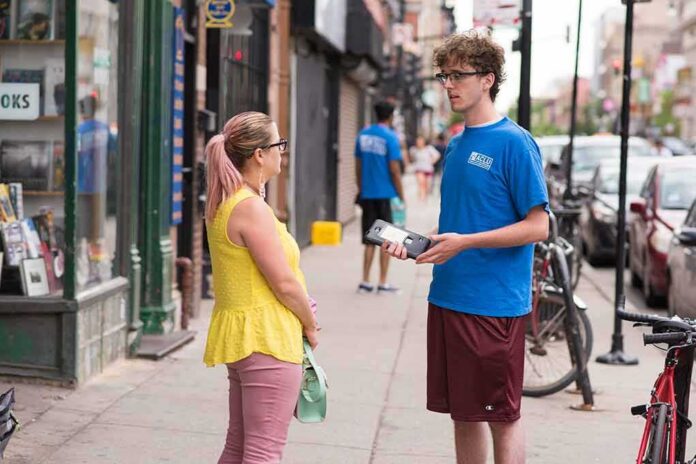
A conservative writer is urging Americans to rebuild political trust the old-fashioned way: one porch conversation at a time, instead of through cable news or social media fights.
Story Snapshot
- Writer Jennifer Rust published a PJ Media piece calling on conservatives to build real friendships with neighbors before talking politics.
- Her method centers on listening first, staying calm, and backing up beliefs with facts and personal experience.
- The push comes as civic groups like bowling leagues, PTAs, and town halls keep losing members nationwide.
- Published research on door-to-door persuasion shows mixed results, with some studies finding listening alone does not boost persuasion.
- No data yet shows whether neighbor-to-neighbor outreach actually changes votes or turnout.
A Writer’s Call to Reconnect With Neighbors
Jennifer Rust laid out her case in a November 4 column for PJ Media titled “Let’s Win Our Country Back One Neighbor at a Time.” She argues that conservatives should step outside their comfort zones, enter their neighbors’ lives, and talk politics face to face instead of online. Rust admits she can count the neighbors she knows well enough to really talk to “on one hand.”
Her advice is not to lecture. Rust writes that people should listen to friends’ and neighbors’ concerns first, because “we can’t just yell at them” into agreeing. She says the real path to persuasion starts with understanding what worries people already have, before trying to change their minds.
Listening Before Persuading
Rust’s standard is specific. She tells readers to stay calm, avoid reinforcing stereotypes about conservatives, and support their beliefs with facts and lived experience. She argues that even a single calm, respectful conversation can “plant a seed” that grows over time, rather than demanding instant agreement.
This is not a one-time idea for Rust. In an earlier column published in late December, she described introducing herself to new neighbors she met while walking her dog and inviting neighbors into her home every two months. That piece framed repeated, low-key socializing as a New Year’s resolution for rebuilding community ties.
A Broader Pattern of Vanishing Civic Life
Rust’s appeal lands inside a much bigger national trend. Civic groups that once brought neighbors together, including bowling leagues, lodge halls, and parent-teacher meetings, have steadily lost members for decades. City council meetings now often draw empty rooms, while people vent frustrations into social media feeds instead of talking across the street.
That decline cuts across party lines. Both conservatives and liberals have voiced the same complaint for years: elected officials feel distant, institutions feel hollow, and ordinary people feel unheard. A grassroots push to simply know your neighbor speaks to that shared frustration, regardless of who is promoting it.
What Research Says About Door-to-Door Persuasion
Academic studies on this kind of outreach show a complicated picture. One large field experiment involving nearly 1,500 video conversations about immigration policy found that sharing a personal, persuasive story changed people’s attitudes in a lasting way. But adding high-quality listening on top of that story did not make the persuasion any stronger.
Other research suggests shared backgrounds between the person doing the persuading and the person being persuaded do not meaningfully increase success, based on eight separate experiments covering more than 6,000 participants across four political topics. That challenges the idea that a neighbor is automatically a more effective messenger than a stranger.
There is also a cautionary finding. A study of a 2008 presidential campaign found that in-person persuasion attempts aimed at 56,000 registered voters sometimes backfired, reducing people’s willingness to respond to political contact afterward. That risk is not addressed in Rust’s columns.
What Remains Unanswered
Rust’s columns describe her own neighborhood experience and her own recommended approach, not a tested program with measured results. There is no data in her writing on how many conservatives have tried this method, how neighbors have responded, or whether any conversations have changed a vote.
The idea still speaks to something real. Americans on both sides increasingly say their communities feel fractured and their leaders feel out of touch. Whether neighborhood conversations can repair that trust, or simply add another layer of politics to everyday life, is a question no one has answered yet.
Sources:
© patriotsunited.org 2026. All rights reserved.