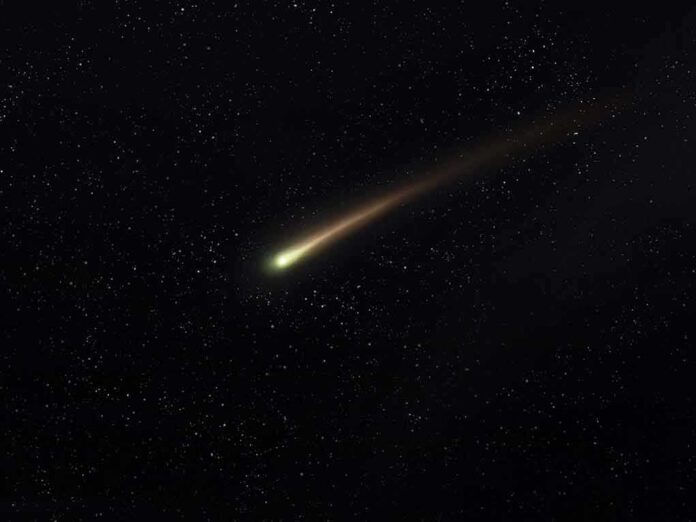
Interstellar comet 3I/ATLAS carries water with deuterium levels 30 times higher than any in our solar system, revealing a birthplace in extreme cosmic cold that challenges assumptions about universal planetary formation.[3][5]
Story Highlights
- Atacama Large Millimeter/submillimeter Array (ALMA) detects deuterated water (HDO) in 3I/ATLAS at ratios 30 times solar system comets and 40 times Earth’s oceans.[3][5]
- High deuterium-to-hydrogen (D/H) ratio requires formation below 30 Kelvin, far colder than our solar system’s conditions.[3][5]
- Observations conducted November 4, 2025, using advanced modeling since ordinary water fell below detection.[3]
- Study published in Nature Astronomy with NASA and National Science Foundation support, marking first such measurement in interstellar object.[1][3]
ALMA Detects Unprecedented Deuterium Levels
Astronomers using the Atacama Large Millimeter/submillimeter Array (ALMA) measured deuterated water in interstellar comet 3I/ATLAS on November 4, 2025. The comet sat 1.37 astronomical units from the Sun and 2.24 from Earth. Direct detection of HDO occurred alongside methanol, while ordinary water stayed below threshold. Luis Salazar Manzano, lead author from University of Michigan Astronomy, noted the deuterium-to-ordinary hydrogen ratio exceeds all prior records.[1][3]
The D/H ratio in 3I/ATLAS reached at least 30 times that of solar system comets, where one HDO molecule appears per 10,000 H2O molecules. It stands 40 times Earth’s ocean value. Salazar Manzano stated this marks the highest seen in planetary systems or comets. The finding stems from the comet’s home system, preserved through interstellar travel.[2][3][5]
Evidence Points to Ultra-Cold Formation Environment
Chemical processes enriching deuterated water demand temperatures below 30 Kelvin, or minus 406 degrees Fahrenheit. Salazar Manzano explained these reactions prove highly temperature-sensitive. 3I/ATLAS formed in conditions vastly colder than our solar system’s protoplanetary disk. The ratio, set during formation, endured ejection into space.[3][5]
Team inferred water production via Bayesian modeling of methanol lines, confirming high D/H even in conservative analyses. ALMA’s sensitivity separated faint HDO signals from ordinary water. This provides direct chemical insight into distant systems, unmatched by complex molecules since deuterium abundances trace to the Big Bang.[3][5]
Implications and Lingering Scientific Questions
The peer-reviewed Nature Astronomy paper received federal backing from the National Aeronautics and Space Administration (NASA), U.S. National Science Foundation, and Chile’s National Research and Development Agency. As the third confirmed interstellar object after 1I/’Oumuamua and 2I/Borisov, 3I/ATLAS highlights galactic diversity in planetary births.[1][3]
The interstellar comet 3I/ATLAS has water with deuterium levels 30x higher than any solar system comet. It formed somewhere far colder than our solar system.
Full article: https://t.co/Q8cPtsb9hm#technology #space #astronomy #science pic.twitter.com/9r9mJIbcTN
— TechnologyOrg (@TechnologyOrg) May 4, 2026
Challenges persist since ordinary water evaded direct detection, relying on indirect methods with modeling assumptions. Observations probed outer layers, potentially altered by cosmic rays over billions of years. No parent star system identified, and small interstellar sample limits broad claims. Follow-up before 2028 detectability loss remains critical.[3]
Sources:
[1] The Interstellar Comet 3I/ATLAS Was Born Somewhere Much …
[2] Comet 3I/ATLAS was born in a region of the Galaxy vastly different …
[3] ALMA Reveals Interstellar Comet 3I/ATLAS Formed in a Far Colder …
[5] 3I/ATLAS Contains 30X More Semi-Heavy Water Than Comets In …