

As Russia rains hundreds of missiles and drones on Kyiv with little warning, the gaps in modern air defense are being exposed in a way that should worry every taxpayer who is told the system is under control.
Story Snapshot
- Russia’s latest mass strike on Kyiv used hundreds of missiles and drones and killed at least a dozen civilians, with some reports putting the toll closer to 30.
- Ukrainian and Western reports say all 29 ballistic missiles in one wave hit their targets, revealing how even a heavily backed capital can be left wide open.
- Moscow insists it hit military and energy sites in “retaliation,” while damage on the ground includes collapsed apartment blocks and other civilian buildings.
- The attack fits a grinding pattern of tit-for-tat long‑range strikes that raise costs for ordinary people while distant leaders talk in summit halls.
Russia’s most intense Kyiv strike of the year
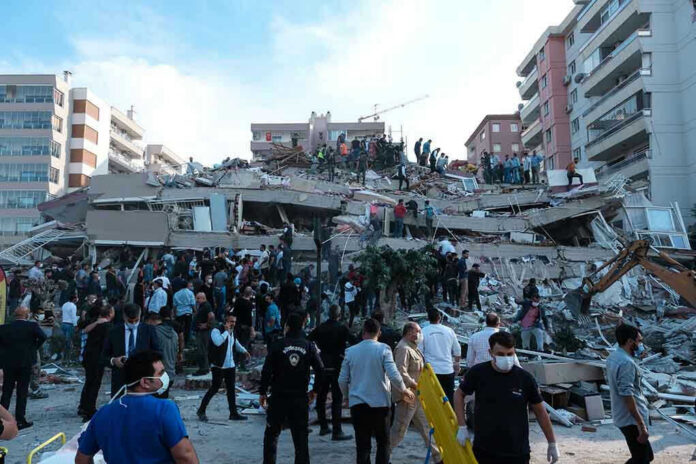
During the night of July 1–2, Russian forces launched what Ukrainian officials called the deadliest air attack on Kyiv this year, using a mix of missiles and armed drones that kept air raid sirens wailing for more than eleven hours. Ukraine’s Air Force reported 74 missiles and 496 drones involved in the wider strike, most of them aimed at the capital and its region. By the end of the day, emergency crews reported at least 30 people killed and more than 90 injured across Kyiv. A large residential building in the Darnytskyi district collapsed, and damage was reported in every district of the city, forcing Kyiv’s mayor to declare a day of mourning.
Ukrainian officials and outside trackers describe this attack as part of a broader campaign that has turned Kyiv into a repeated target since 2022, with hundreds of air raids and more than a thousand explosions recorded in the region over earlier phases of the war. Public data suggest Russia has launched more than ten thousand missiles at Ukraine since 2022, often in large mixed waves of cruise missiles, ballistic missiles, and attack drones designed to overwhelm defenses in big cities like Kyiv. That scale helps explain why local residents now talk about “another night, another barrage” as a grim routine rather than a shock.
Ballistic missiles hit while defenses strain
In a separate but closely related wave of attacks on July 6, Ukrainian authorities said Russia fired 351 drones and 68 missiles at the country overnight, again focusing mainly on Kyiv. In that barrage, all 29 ballistic missiles reportedly struck their targets, underscoring how hard it is for Ukraine to stop high‑speed weapons without more advanced Western systems. Officials said at least 22 people were killed nationwide, including 15 in the capital and more in the surrounding region. Newsrooms and wire services carried slightly different death counts as rescue work continued, showing how casualty numbers can jump as bodies are pulled from rubble and hospitals update their lists.
These strikes did not come out of the blue. Russia’s Defense Ministry stated that the targets included weapons factories in Kyiv, sites it says build drones and armored vehicles, repair air defense systems, and support fuel and energy supplies. Moscow framed the operation as a “response” to Ukrainian attacks on Russian civilian and energy infrastructure, including oil refineries hit by long‑range Ukrainian drones in the Nizhny Novgorod region and elsewhere. Ukrainian leaders do not deny hitting fuel facilities inside Russia, and have argued those sites feed the Russian war machine. But for families in Kyiv, these back‑and‑forth blows show up as shattered windows, power cuts, and funerals, not as neat talking points about “retaliation.”
Civilian damage and the fog around “legitimate targets”
While Russia claims it is striking only military and energy infrastructure, images and reports from the ground in Kyiv show wrecked apartment blocks, damaged hotels, and blown‑out streets, including in the city’s historic quarter. Ukrainian officials say more than 130 buildings were damaged in the July 1–2 assault, many of them clearly civilian. The United Nations has counted more than 16,000 Ukrainian civilians killed since the full‑scale invasion began, with repeated Russian air attacks on cities a major cause. So far, there is no independent outside study that confirms Moscow’s specific claim that its July strikes hit only weapons plants or dual‑use facilities rather than homes and offices.
Russia launched another overnight missile strike on Ukraine's capital, Kyiv, killing at least one person and injuring two others, according to local authorities.
The attack triggered massive fires across the city, with missiles striking warehouse complexes on opposite sides of… pic.twitter.com/GWFWHVgkgq
— Ocean News (@OceanNewsUK) July 8, 2026
This gap in verification cuts both ways and feeds public distrust. Most of what the world knows about each new strike comes from Ukrainian authorities, Russian statements, and Western media, all of which have their own pressures and blind spots. There is no widely shared satellite trail, intercepted order, or forensic report for every missile. That leaves room for leaders and pundits to lean on dramatic language, calling attacks “terror” or “most massive ever,” while often giving less attention to how Ukrainian drone strikes inside Russia helped set the stage. For Americans on the left and right who already suspect that elites shape narratives to suit their goals, this war coverage can feel like one more example of selective truth—real violence, but filtered through someone else’s agenda.
Sources:
theatlantic.com, apnews.com, reuters.com, nbcnews.com, npr.org, pbs.org, euronews.com, en.wikipedia.org, facebook.com
© patriotsunited.org 2026. All rights reserved.