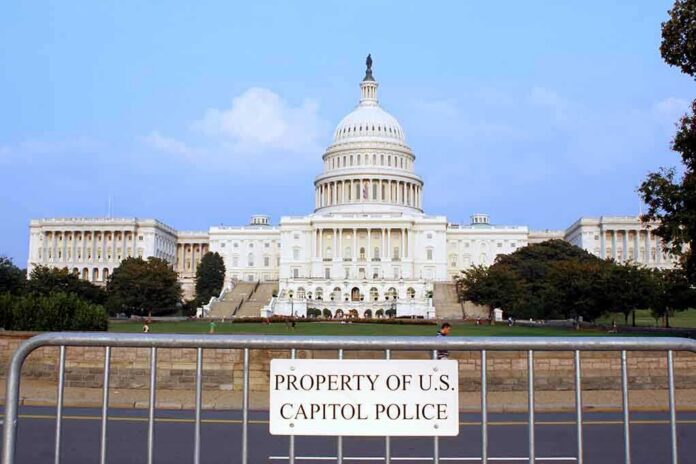
For the first time in decades, Congress has united to tell a wartime president to stand down, and the media is cheering a “symbolic” slap at Donald Trump while everyday Americans still worry about debt, borders, and power in Washington.
Story Snapshot
- Both chambers passed a war powers resolution ordering President Trump to halt the Iran war or get approval from Congress.
- The measure is a concurrent resolution, so it does not become law and is likely not enforceable.
- Four Senate Republicans joined Democrats, while one Democrat broke ranks, showing mixed signals inside both parties.
- The White House has dismissed the move as unconstitutional and “no significance,” and continues pursuing its own Iran strategy.
What Congress Just Did On Trump’s Iran War
The United States Senate voted 50–48 to adopt a House-passed war powers resolution that tells President Donald Trump to halt military action against Iran unless Congress signs off on it.[1] This follows a close 215–208 vote in the House earlier in June, where all Democrats and a handful of Republicans backed the measure.[15] The conflict began in late February after joint United States and Israeli strikes on Iran, and it has become unpopular as costs and risks grow.[1] Supporters say Congress is reclaiming its duty to decide on war.[5]
The resolution invokes the War Powers Resolution of 1973, which says a president must notify Congress within 48 hours of using troops and cannot keep them in hostilities past roughly 60 to 90 days without approval.[17] Lawmakers behind this new measure argue Congress never authorized a war with Iran at all.[8] They say presidents from both parties have stretched their commander-in-chief role for years, and that this vote is meant to restore the Constitution’s “declare war” power to the legislative branch.[19]
Why This “Rebuke” May Be More Theater Than Law
There is a big catch: this is a concurrent resolution, not a bill, so it does not go to the president’s desk and does not become law.[1] Legal experts point back to a 1983 Supreme Court decision saying Congress usually needs the president’s signature for actions to have binding legal force outside Capitol Hill.[1] Because of that, even sympathetic outlets call this move “largely symbolic” and “non-binding,” and note there is no clear way to force the president to obey.[9] Courts have rarely agreed to referee war powers fights.[22]
The White House has leaned on that legal doubt and brushed the resolution aside as having “no significance,” calling it unconstitutional.[6] Officials argue that the president has broad authority as commander in chief to use force to protect the United States and to keep Iran from gaining nuclear weapons.[11] A long line of administrations, Republican and Democrat, has made similar claims of strong Article II powers when sending troops abroad without a formal declaration of war.[16] That long history makes it hard for Congress to draw a new red line now.
How Republicans And Democrats Split On Trump And War Powers
The Senate vote broke mostly along party lines, but not perfectly.[6] Four Republicans—Susan Collins of Maine, Rand Paul of Kentucky, Bill Cassidy of Louisiana, and Lisa Murkowski of Alaska—joined Democrats to support the resolution.[6] These senators have split with party leaders before on Trump’s Iran policy.[2] At the same time, Democrat John Fetterman of Pennsylvania voted no, arguing in past debates that cutting off authority in the middle of a fight sends the wrong signal.[8] Two Republicans, Mitch McConnell and David McCormick, missed the vote.[6]
House Republicans also showed some division. Several crossed over to back the war powers measure even as party leaders warned it would “weaken the president’s hand” with Iran.[15] Many conservative voters may share a similar tension. They respect Trump’s tough stance against the Tehran regime and its terror networks. But they are also tired of endless wars, trillions in debt, and Washington insiders who never seem to be the ones paying the price when conflicts drag on.
What It Means For The Constitution, War, And Regular Americans
Under the Constitution, Congress has the power to declare war and to raise and fund the military, while the president serves as commander in chief.[19] Most scholars agree that Congress has the exclusive power to initiate war.[19] Yet modern presidents have often used force abroad based on older authorizations or on their own reading of self-defense powers.[23] The War Powers Resolution of 1973 was supposed to check that trend, but presidents from both parties have largely treated it as a suggestion, not a leash.[22] History shows that most war powers resolutions end as political messages, not enforceable orders.[22]
Senate for first time approves a war powers resolution in a rebuke to Trump over Iran conflict https://t.co/dxyItqknWy
— Chicago Breaking News (@ChicagoBreaking) June 24, 2026
For conservatives, this latest clash raises hard questions. On one side, many want strong borders, strong defense, and a president who does not bow to global bullies in Tehran or anywhere else. On the other side, they see a Congress that rarely fights this hard to stop runaway spending, protect the Second Amendment, secure the southern border, or shield families from radical school agendas, yet suddenly musters itself to undercut a president from its own party over war.[1] The pattern feeds anger at a Washington class that seems more focused on theater than on fixing everyday problems.
Sources:
[1] Web – Senate joins House in rebuke of Trump over his war in Iran
[2] Web – Senate Votes to Check Trump’s War Powers, Rebuking Him on Iran
[5] YouTube – Trump’s war powers rebuked by GOP-led House & Senate
[6] Web – US Senate votes to halt Iran war in latest rebuke of Trump
[8] YouTube – Senate approves war powers resolution in symbolic move rebuking Trump …
[9] YouTube – In rare rebuke, Senate votes to limit Trump’s war powers in Iran
[11] Web – Senate advances resolution to limit Trump’s Iran war powers
[15] Web – Senate shoots down attempt to curb Trump’s Iran war powers
[16] Web – House votes to rebuke Trump over war with Iran – NBC News
[17] Web – War Powers and the Return of Major Power Conflict
[19] Web – The U.S. Senate on Tuesday approved a war powers resolution …
[22] Web – The U.S. Senate has approved a war powers resolution passed …
[23] Web – Findings and Analysis | War Powers Resolution Reporting Project
© patriotsunited.org 2026. All rights reserved.