

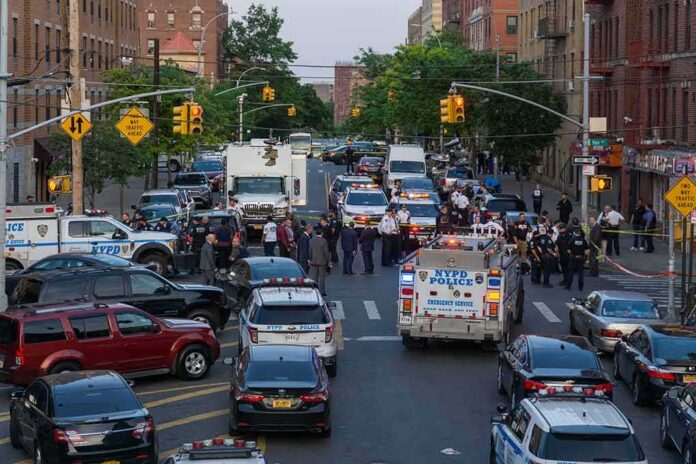
Federal marshals say they caught the driver who struck an on-duty New York Police Department officer in the Bronx and sped away, turning a neighborhood gathering into a crime scene and a test of public safety promises.
Story Snapshot
- Federal authorities arrested a suspect in a Bronx hit-and-run that injured a New York Police Department officer.
- A criminal complaint described repeated vehicle movements before the officer was hit, suggesting intent if proven in court.
- The officer suffered significant leg injuries and received trauma care at Lincoln Hospital.
- Reports say the suspect was arrested in September in a separate assault case, raising release-policy questions.
Arrest After Violent Hit-and-Run Injures Officer
The United States Marshals Service reported that officers arrested a man accused of hitting an on-duty New York Police Department officer with a white Honda sport utility vehicle in the South Bronx on October 19, 2026. The agency said the driver accelerated from the scene, leaving the officer with “significant leg injuries.” The officer was taken to Lincoln Hospital for emergency trauma care. The New York and New Jersey Regional Fugitive Task Force assisted in the arrest less than two days after the collision.
The federal release named the event a violent hit-and-run and identified the suspect as the target of a manhunt tied to the incident. The statement did not publish video or body-camera files but placed the suspect behind the wheel and described a quick, coordinated capture effort. Officials credited task force work across jurisdictions in tracking the vehicle and the individual. The release used “allegedly” for the act descriptions, as charges are pending and guilt must be proven in court.
Complaint Alleges Repeated Movements Before Impact
A New York Post report, citing the criminal complaint, described a sequence that, if confirmed in court, would show more than a single accidental strike. According to that report, the driver allegedly reversed after being told to stop, then turned the front wheels toward the officer and accelerated again before the officer was struck by the rear wheels. The reporting framed the case as an attempted murder allegation based on those movements, while noting the driver fled the scene.
The same report detailed the officer’s injuries, including pain, bruising, redness, and swelling across the legs, ankles, knees, hips, and back. Those descriptions track with the United States Marshals Service account of “significant leg injuries,” and they support the claim that the collision had a strong physical impact. The Post article relied on attributed law-enforcement sources and the complaint summary rather than video or full court filings released to the public.
Prior Arrest Raises Release and Detainer Questions
The New York Post also reported that the same suspect had been arrested about a month earlier, on September 14, after a parking-lot altercation that led to an assault charge. The report said immigration officials placed a detainer, and that the suspect was undocumented, though it did not publish a detainer document or a court docket number for that earlier case. These details, if validated, will fuel debate about release decisions and coordination between courts and immigration authorities.
This arrest-and-release thread sits inside a long fight about how cities handle people with pending immigration issues and local charges. Supporters of strict enforcement argue that ignoring detainers lets dangerous people cycle back onto the street. Critics counter that detainers are civil requests, not criminal warrants, and can keep people jailed longer without a judge’s order. The facts of this case, once documented in records, will shape that argument more than slogans will.
How Prosecutors Build Vehicle-as-Weapon Cases
New York prosecutors have brought cases before where drivers fleeing police injured officers and faced serious charges, including assault. Outcomes depend on evidence of intent, injury, and the driver’s actions. In a Queens case, a defendant was convicted of first- and second-degree assault, reckless driving, and leaving the scene after causing injuries during flight. Courts weigh driver choices, warnings from officers, vehicle direction, and risk to bystanders when deciding charges and penalties.
In the Bronx case, investigators will likely gather street-camera video, body-camera files, witness accounts, and vehicle data to test the complaint’s description. Prosecutors will need to show what the driver saw, heard, and decided in the moments before impact. Defense lawyers may argue panic, confusion, or poor visibility. Judges and juries look for clear proof when intent is charged. For now, authorities have an arrest, an injured officer, and a fast-moving case that has seized public attention.
Why This Matters Beyond One Case
New Yorkers want streets where officers and neighbors are safe from reckless drivers. They also expect clear, fair rules about arrest, release, and immigration holds. This case sits at that crossroad. People on the right see a system that fails to hold dangerous offenders. People on the left see a system that can overreach and miss root causes. Most agree on one point: when government systems do not coordinate, the public pays the price in fear and harm.
Sources:
nypost.com, usmarshals.gov, nydailynews.com, bronx.news12.com
© patriotsunited.org 2026. All rights reserved.