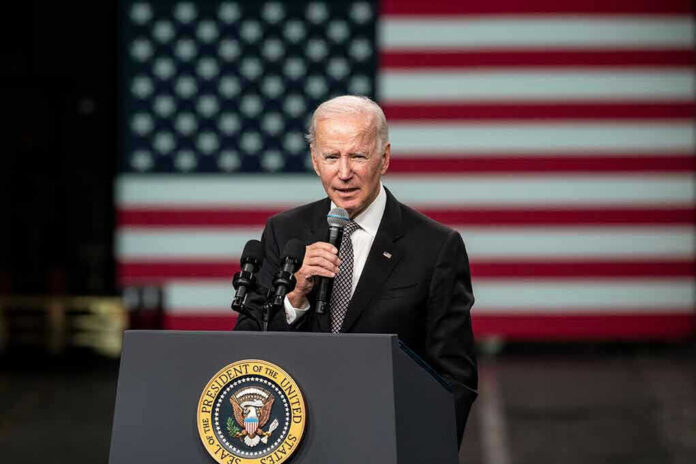
As America celebrates 250 years of independence, Trump’s promise that “Americans will never stop winning” collides with deep public doubt about whether the country is truly entering a golden age or just being sold one.
Story Snapshot
- Trump casts America 250 as the start of a new “golden age” where “Americans will never stop winning.”
- His speeches blend real policy moves and patriotic themes with big, sometimes shaky claims about money, safety, and war.
- Fact-checkers and mainstream media challenge several key numbers and victories, raising questions about spin versus reality.
- Many Americans on the right and left hear the same speeches and see proof that elites are still not fixing everyday problems.
Trump’s Golden Age Promise at America 250
President Donald Trump used the 250th anniversary of American independence to promise a “golden age of America” and declare that “Americans will never stop winning.” Speaking at Mount Rushmore in 2023 and again on the eve of America 250 in 2026, he tied this idea to huge economic gains, strong borders, and renewed national pride. He told supporters that the country was entering a historic turnaround, with a new wave of jobs, investment, and military strength lifting ordinary citizens.
The White House backed this message with official branding like “Freedom 250” and a presidential task force on celebrating America’s 250th birthday, chaired by Trump himself. A Presidents’ Day release claimed inflation had fallen to its lowest level in years and that stock markets hit record highs, creating “trillions in new wealth for American families.” Supporters saw this as proof that America First policies were finally paying off, promising cheaper living costs, safer streets, and more respect for American power in the world.
Big Wins, Bigger Claims, and the Fact-Check Gap
Trump’s golden age story leans heavily on dramatic numbers and vivid victories, which speak to people who feel the country has been badly managed for decades. He claimed that $19.2 trillion “poured into the United States” in just 12 months and said previous leaders delivered “lesser gains.” He also boasted of beating Venezuela “in one day” and “knocking Iran hard,” and of restoring safety in Washington, D.C., as signs that America was strong and feared again by its enemies.
Independent checks tell a more mixed story. Fact-checkers reviewing similar investment claims found about $9.6 trillion in deals, including pledges and old projects, only about half of Trump’s headline number. Analysts also challenged his habit of saying wars were quickly ended or foreign threats crushed; an NPR review of his State of the Union address labeled some “war-ending” claims as exaggerated, noting conflicts and strikes continued. These gaps feed a growing sense that many leaders, not just Trump, use huge promises and cherry-picked data instead of full, honest accounting.
Communism, Division, and Competing Visions of America
Trump’s America 250 speeches did not just talk about money and jobs; they painted communism as “the greatest threat to our country,” even above World War I, World War II, Pearl Harbor, and the September 11 attacks. At Mount Rushmore and later events, he warned that radicals and “destroyers of monuments” wanted to wipe out history and end America itself. This hard line fits his broader America First stance, but it also sharpened fears among many that the government and political class are fighting their own culture war instead of fixing housing, health care, and wages.
Major outlets like the Associated Press and PBS said his Independence Day remarks “veered into darkly political” territory and swerved away from the more unifying tone used by presidents such as Gerald Ford or Ronald Reagan. On social media, former President Barack Obama marked the same anniversary by stressing self-government and equal rights, offering a very different picture of what makes America strong. Together, these speeches show how even a national birthday becomes a stage for competing stories about who owns the future and whether ordinary people still have a real voice.
Why Many Americans Still Feel They Are Not Winning
For many conservatives over 40, Trump’s talk of endless winning echoes real anger at past decades of woke agendas, globalism, illegal immigration, and rising energy costs. For many liberals the same age, his golden age theme clashes with worries about cuts to social programs, fossil fuel expansion, and a growing gap between rich and poor. Both sides increasingly share one core belief: the federal government is failing to solve deep problems and seems more focused on staying in power than serving the people.
After a weather-related delay, President Donald Trump took the stage on the National Mall to mark America's 250th anniversary with a campaign-style speech.
Despite storms, extreme heat, and heightened security, thousands gathered for the high-profile Independence Day celebration… pic.twitter.com/SC4xo5z3qG
— The UAE Times (@theuaetimes) July 5, 2026
Historical studies comparing today’s politics to the old Gilded Age note familiar patterns of huge wealth, bitter party fights, and distrust of elites. Some conservative thinkers even argue that Trump’s second term could open a new golden age by breaking the “ruling class” and pushing jobs back to American soil. But others, including historians, warn that calling any moment a golden age can hide hard truths — about corruption, inequality, and the many citizens still locked out of the American Dream. As America turns 250, the real test is whether “never stop winning” becomes more than a slogan for rallies and instead marks a government finally serious about fixing life for everyone, not just the well-connected.
Sources:
youtube.com, whitehouse.gov, pbs.org, instagram.com, news.sky.com, bbc.com, iperstoria.it, theconversation.com, heritage.org, rbhayes.org
© patriotsunited.org 2026. All rights reserved.