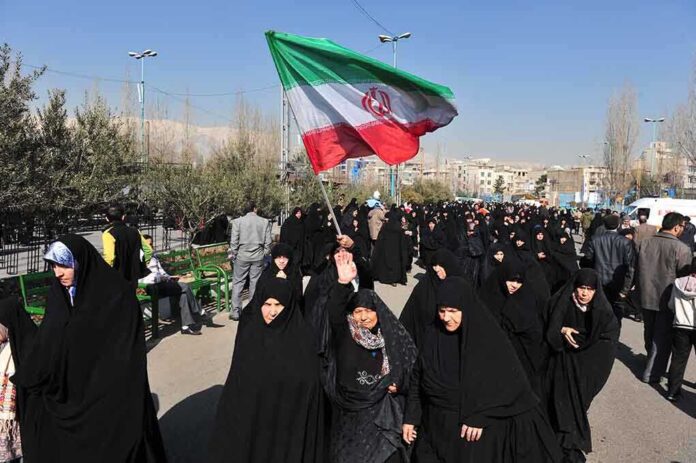
Iran’s currency collapse has triggered what may become the Islamic Republic’s most dangerous domestic crisis since 1979, as protesters abandon economic grievances for explicit calls to overthrow the regime.
Story Snapshot
- Nationwide protests erupted after Iran’s rial plunged to 1.42 million per US dollar, sparking inflation fury
- Demonstrators evolved tactics from static gatherings to mobile, decentralized actions across 348 sites in 111 cities
- Security forces killed at least 42 protesters and detained over 2,270 while cutting internet nationwide
- Supreme Leader Khamenei ordered protesters be “put in their place” as chants of “Death to Khamenei” echo nationwide
Economic Crisis Becomes Political Revolution
Tehran’s Grand Bazaar merchants closed their shops on December 28, 2025, after watching their currency become worthless overnight. Within hours, what began as fury over bread prices transformed into something far more threatening to Iran’s theocratic system. By January 8, 2026, protesters were no longer asking for economic relief—they were demanding the complete overthrow of the Islamic Republic.
The progression from market strikes to regime-change chants represents a fundamental shift in Iranian dissent. Unlike previous economic protests that remained focused on specific grievances, this movement crossed into explicitly political territory with remarkable speed. Supreme Leader Ali Khamenei recognized the threat, declaring on January 3 that “rioters must be put in their place”—widely interpreted as authorization for lethal force.
Tactical Evolution Confounds Security Forces
Iranian protesters learned hard lessons from previous crackdowns, particularly the brutal 2019 suppression that killed hundreds. This time, they abandoned large, static gatherings that security forces could easily surround and crush. Instead, demonstrators adopted fluid, decentralized tactics that stretched security resources thin across the country’s 31 provinces.
The new approach includes rapid-forming flash protests, coordinated market strikes, nighttime rooftop chanting, and simultaneous university demonstrations. When authorities shut down internet access to prevent coordination, protesters adapted by using pre-arranged signals and word-of-mouth networks. The Islamic Revolutionary Guard Corps and Basij militia, accustomed to confronting concentrated crowds, found themselves playing an exhausting game of whack-a-mole.
Iran Witnesses Biggest Protests So Far As Demonstrators Change Tactics https://t.co/aWp1CGRH07 Iran Protests Enter Twelfth Day as Deadly Crackdown, Internet Blackout, and Nationwide Strikes Intensify https://t.co/ZfCnVw7QCG
— 'ℳ' .。.:*・🦋®︎ (@Quincampoix_jp) January 9, 2026
International Stakes Rise as Violence Escalates
President Trump escalated international pressure on January 2, warning Iran that America stands “locked and loaded and ready to go” if the regime “violently kills peaceful protesters.” This direct threat came after recent U.S. strikes on Iranian nuclear facilities, adding a dangerous international dimension to what began as domestic economic grievances.
The regime’s response has followed its established playbook: internet blackouts, mass arrests, and increasingly violent suppression. However, the protests’ geographic spread and tactical sophistication suggest this wave may prove more resilient than previous movements. Human Rights Activists News Agency documented protest activity in 348 locations across 111 cities by January 7, with 45 universities actively participating—a scope that dwarfs previous Iranian uprisings.
Sources:
A timeline of how the protests in Iran unfolded and grew
Iran News in Brief – January 7, 2026
Iran’s new wave of protests prompt hospital raids, internet cuts