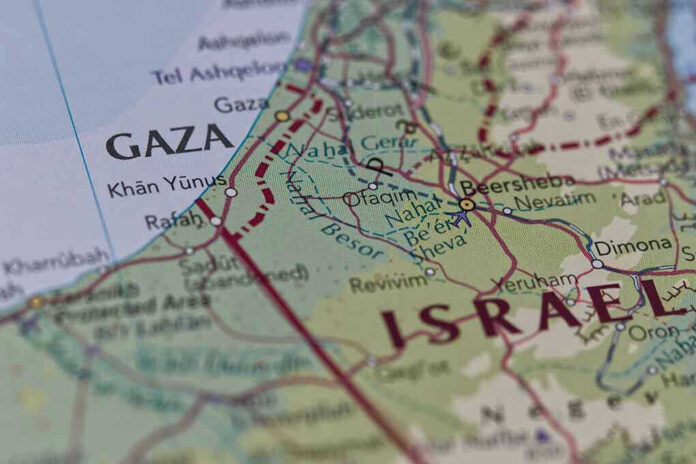
America is orchestrating the first peace in Gaza in decades—without a single US soldier setting foot inside the territory, but with a level of behind-the-scenes military supervision that could change the region’s fate for a generation.
Story Snapshot
- The US military will oversee, but not directly participate in, a Gaza peacekeeping force after the 2025 ceasefire.
- No American boots on the ground in Gaza; the mission relies on multinational, likely Arab-led troops.
- This approach balances American influence with regional sensitivities and avoids direct US entanglement.
- The success depends on regional cooperation, humanitarian priorities, and a fragile security environment.
America’s Unprecedented Role: Architect, Not Actor, in Gaza’s New Chapter
After two years of relentless conflict and humanitarian catastrophe, the US has stepped into Gaza’s future with a strategy as bold as it is calculated. Washington will direct an initial peacekeeping force from afar—leveraging its global military command and diplomatic muscle—while keeping its own troops outside Gaza’s borders. This model is not mere symbolism; instead, it reflects the realities of a region where the presence of foreign soldiers, especially Americans, could ignite more chaos than calm. The Pentagon’s message is clear: American oversight, not occupation, sets the tone for the next act in Gaza’s tortured history.
American military to oversee initial Gaza peacekeeping force — but ‘no US troops are intended to go into Gaza’ https://t.co/ulKyfmlYPF pic.twitter.com/TpEfrWIGYa
— New York Post (@nypost) October 9, 2025
The peacekeeping force itself will be a tapestry of international participants, with Arab states like Egypt and Jordan likely to take leading roles. The US, acting as the master conductor, will provide supervision, coordination, and logistical expertise. This division of labor is designed to soothe the anxieties of both regional partners—who fear direct Western intervention—and a war-weary American public, who have little appetite for another Middle Eastern quagmire. The plan, shaped by lessons from Lebanon and the Sinai, is to avoid the pitfalls of occupation while still wielding enough influence to maintain order and humanitarian access in post-war Gaza.
Why No American Boots Will Touch Gaza’s Sand
Concrete security and political calculations drive the US decision to keep troops out of Gaza. American officials have repeatedly stated that the presence of US soldiers inside the enclave could trigger backlash not just among Palestinians, but across the entire Arab world, feeding extremist narratives and complicating already delicate alliances. Instead, about 200 US military personnel will coordinate from Israel and regional bases, focusing on intelligence, communications, and oversight. This approach preserves American leverage without exposing troops to direct risk or inflaming local resentments.
Israel’s government, for its part, insists on rigorous vetting for all peacekeeping personnel and ironclad security guarantees. Israeli leaders welcome international stabilization efforts but remain wary of any force that might constrain their operational freedom or inadvertently empower hostile actors. Arab states are cautiously willing, with Egypt and Jordan signaling openness to participation—so long as the mission has a clear mandate and regional buy-in. The Palestinian Authority eyes an opportunity to reassert governance in Gaza, while Hamas, battered but not eradicated, lurks as a potential spoiler.
Fragile Opportunities: Humanitarian Relief in a War-Scarred Territory
For the over two million residents of Gaza, the immediate priority is survival. The devastation of the past two years—over 30,000 dead, infrastructure in ruins, generations traumatized—has created a humanitarian emergency of staggering proportions. The new peacekeeping mission, overseen by the US, is tasked with more than just keeping the peace; it must secure aid corridors, support reconstruction, and facilitate a fragile return to normal life. International agencies, led by the UN, are ramping up efforts to deliver food, medical care, and shelter, but the security situation remains volatile, with sporadic violence and deep mistrust on all sides.
American oversight is meant to reassure donors and humanitarian groups that aid will not be siphoned off or manipulated by local factions. At the same time, the arrangement gives Israel confidence that its security concerns are respected, while allowing Arab states to lead on the ground. The hope is that, by threading this diplomatic needle, the international community can stabilize Gaza long enough to plant the seeds of political and social recovery. Yet, experts warn, the risk of mission drift and renewed violence looms large if local legitimacy and coordination falter.
Strategic Gamble: Can Supervision Without Soldiers Succeed?
American think tanks and policy experts are divided on the durability of this model. The Brookings Institution calls US supervision without boots on the ground a “pragmatic compromise,” striking a balance between influence and risk. The International Crisis Group cautions that success hinges on Arab buy-in, a robust mandate, and nimble adaptation to Gaza’s unique urban and political landscape. RAND analysts argue that peacekeeping in a densely populated, politically fragmented territory like Gaza faces obstacles far greater than those in previous missions, such as Lebanon or the Sinai. The absence of US troops may boost regional legitimacy, but it also limits the US’s ability to enforce order if events spiral.
Palestinian civil society offers a mix of hope and skepticism. Some welcome any respite from war and the prospect of international protection, while others view foreign oversight—American or otherwise—with suspicion. Israeli analysts echo the desire for international engagement but worry the force will lack the teeth to deter spoilers. Arab commentators stress the need for regional ownership, wary of any arrangement that smacks of Western domination. In the end, the US is betting that its unique blend of distant control and diplomatic clout can stabilize Gaza where previous interventions have failed. Whether this gamble pays off will shape not just Gaza’s future, but the entire Middle Eastern security landscape.