U.S. Navy pilots boldly reject advanced autopilot for carrier landings, insisting human skill trumps machine precision in life’s ultimate high-stakes test.
Story Highlights
- Navy’s JPALS and “Magic Carpet” systems can autoland jets on pitching carriers, yet pilots refuse routine use.
- Former pilot Adam Daymude declares “Hell, no!” citing autopilot failures in turbulence, wind, and deck motion.
- Manual control preserves irreplaceable “seat-of-the-pants” intuition essential for combat readiness.
- Decision underscores caution against over-relying on AI amid Washington’s push for tech-driven military “efficiencies.”
Autopilot Capabilities Meet Pilot Resistance
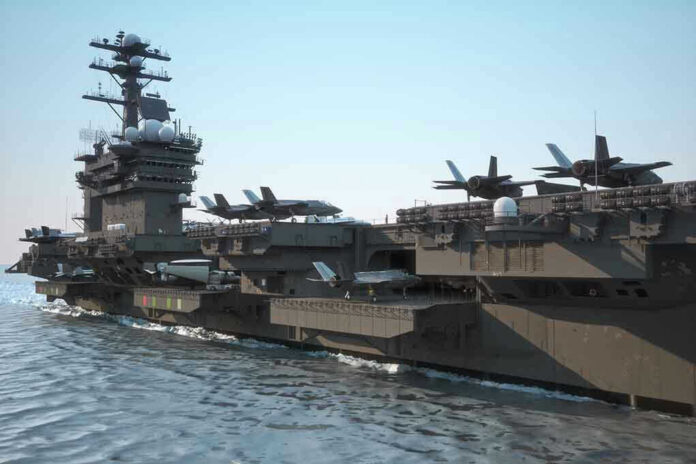
U.S. Navy pilots operating F/A-18 Super Hornets and EA-18G Growlers from carriers like USS Harry S. Truman reject autopilot for routine landings. Systems such as Joint Precision Approach and Landing System (JPALS) and Precision Landing Modes (“Magic Carpet”) enable hands-off approaches using tailhooks and arresting wires. These tools predict deck motion for precise 3-degree glideslopes even in wind. Yet pilots prioritize manual “traps” guided by landing signal officers (LSOs) and optical systems. This stance preserves skills vital in unpredictable combat scenarios.
Expert Testimony: “Hell, No!” to Automation
Former EA-18G pilot Adam Daymude explains the refusal bluntly: “Hell, no!” Autopilot performs in 25-knot calm winds but fails spectacularly amid turbulence, pitching decks, or wake turbulence. Pilots read non-repeatable cues like airflow and deck roll through “seat-of-the-pants” feel. Simulator efforts to model this intuition fall short. Daymude, who collaborated on simulations, stresses machines cannot replicate human adjustments for power or throttle in stress. Navy mandates manual proficiency, with about 90% of landings done by hand.
Historical Roots and Operational Realities
Autopilot traces to 1912, when Lawrence Burst Sperry demonstrated a pilotless biplane at a Paris air show, standing on the wing as it stabilized. Carrier operations evolved with arresting wires for jets on moving decks in rough seas. Modern aids like Magic Carpet assist but defer to pilots amid turbulent airflow and non-ideal conditions. Ongoing operations, as seen in 2024 recoveries on USS Harry S. Truman, reinforce manual standards. No full adoption occurred by April 2026 publications.
Implications for Military Readiness and National Security
Pilot choice upholds aviator mastery, ensuring readiness in contested environments where AI falters. Short-term, it boosts training rigor but raises workload and fatigue risks for squadrons like VFA-11 “Red Rippers.” Long-term, it limits automation, prioritizing human judgment amid drone debates. Economically, manual focus sustains higher training costs over tech savings. Politically, it signals distrust in elite-driven tech solutions, echoing frustrations with federal overreach. Both conservatives wary of globalist AI agendas and liberals skeptical of “deep state” experiments find common ground here. Human initiative remains America’s edge.
‘I Won’t Use It’: The U.S. Navy’s Autopilot Can Land a Jet on an Aircraft Carrier. Pilots Won’t Use It.https://t.co/bzMVEtOpEl
— Harry J. Kazianis (@GrecianFormula) April 13, 2026
Sources:
Why U.S. Navy Pilots Refuse to Use Autopilot for Aircraft Carrier Landings
US Navy Aircraft Carrier Jet Landing Autopilot
US Navy Pilots Training No Longer Need Land Aircraft Carrier Graduate