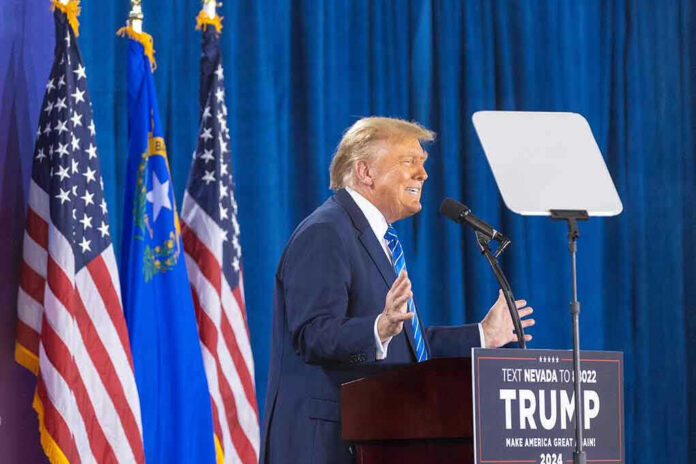
As America marked its 250th birthday, President Trump stepped out of the White House to honor Freedom 250 Grand Prix drivers while his family quietly sold high-priced “Freedom 250” coins bearing his image to fans at home and online.
Story Snapshot
- President Trump greeted Freedom 250 Grand Prix drivers near the White House and presented commemorative challenge coins as part of the 250th anniversary celebrations.
- The Trump family and the Ultimate Fighting Championship (UFC) launched “Freedom 250” medallions featuring Trump’s image, priced from about $250 to nearly $12,000.
- These coins are marketed as patriotic keepsakes tied to both America’s 250th anniversary and a UFC fight card hosted at the White House.
- The initiative adds to long‑running controversy over living presidents putting themselves on coins, and raises new questions about profit, politics, and public trust.
Trump Honors Freedom 250 Drivers With Challenge Coins
President Donald Trump hosted Freedom 250 Grand Prix drivers at the White House as part of the nation’s 250th anniversary celebrations, drawing cheering crowds near the National Mall. In social videos from the event, Trump walks out to applause and hands what are described as Presidential Challenge Coins to the assembled drivers, treating the group much like military units or first responders that presidents have honored in the past. These brief clips show the ceremony as a feel‑good moment for motorsports and a public symbol of recognition from the Oval Office.
Presidential Challenge Coins have long been used to thank individuals for special service or notable contributions, often in quiet, personal ceremonies rather than televised rallies. According to numismatic historians, these coins are not official currency but custom tokens linked to the presidency, meant to carry symbolic weight rather than financial value. Trump’s decision to use such coins for private‑sector race drivers fits a broader pattern in his administration of extending traditional honors to new groups, blending entertainment, sports, and politics on the South Lawn.
“Freedom 250” Medallions Turn a Celebration Into a Sales Pitch
At the same time, Trump’s family and the Ultimate Fighting Championship promoted a separate line of “Freedom 250” commemorative medallions tied to the first‑ever UFC fight card at the White House. Reports describe four coins, two silver and two gold, branded with Trump’s image and sold through a “Trump Coins” website in collaboration with the Trump Organization. Prices start around $249.99 and climb to $11,999.99 for the highest‑tier one‑ounce gold medallion packaged with portraits of Trump and UFC president Dana White.
The marketing language presents these medallions as a way for buyers to “celebrate the road to America’s 250th” while owning a piece of a historic White House sports event. Coverage notes that the Trump Organization appears to license Trump’s name and image to a separate company that actually produces the coins, blurring the line between official presidential celebration and private merchandise. For many Americans who already feel politics is a business for the powerful, the sight of five‑figure “patriotic” coins only reinforces doubts about who really benefits from national milestones.
A Clash With Long‑Standing Rules on Living Presidents on Coins
Legal and history experts point out that the United States has long discouraged putting living people, especially sitting presidents, on official money. A 19th‑century rule called the Thayer Amendment bars the likeness of any living person from appearing on United States securities and currency, after a past official tried to slip his own face onto a note. That tradition helped shape today’s expectations that presidents are honored on coins only after they leave office or have passed away, not while they control the federal government and its symbols.
NOW: President Trump walks out of the White House to a roaring crowd and hands Presidential Challenge Coins to Freedom 250 Grand Prix drivers before delivering remarks on the Freedom 250 Grand Prix Showcase. pic.twitter.com/akrLtnS3yj
— Alhaji Mobola Ajagbe (@alhajimobola2) July 13, 2026
Trump has pushed hard against that norm. A federal arts commission composed of members he appointed approved a separate 24‑karat gold commemorative coin featuring his image for the 250th anniversary, paving the way for the United States Mint to produce it as part of an anniversary series. Fact‑checkers and legal analysts have warned that placing a living president on a United States Mint coin tests the limits of these rules and raises conflict‑of‑interest concerns, especially when the design is cleared by Trump’s own appointees.
Why This Coin Story Matters to Frustrated Americans
For many conservatives and liberals alike, the Freedom 250 coin ventures feel less like patriotism and more like branding. Working families seeing $11,999.99 “Freedom 250” medallions may view them as another reminder that major celebrations in Washington often double as VIP fundraisers and luxury product launches. The same government that struggles to control debt, inflation, and health costs appears eager to put the sitting president’s face on high‑priced gold, deepening a sense that national milestones serve elites first.
Critics worry that tying the presidency so closely to commercial products—especially during a taxpayer‑supported anniversary year—turns public trust into a revenue stream. Supporters may see the coins as harmless souvenirs, but skeptics across the spectrum see a pattern: official events, private partnerships, and little transparency about who profits. Against a backdrop of anger over “deep state” politics, the mix of White House honors, cage fights, and luxury medallions makes it harder for many citizens to believe Washington still puts the public interest ahead of personal gain.
Sources:
facebook.com, usatoday.com, bbc.com, instagram.com, kesq.com, theguardian.com, washingtonpost.com, pbs.org, govinfo.gov, politifact.com, govmint.com, js-pins.com
© patriotsunited.org 2026. All rights reserved.