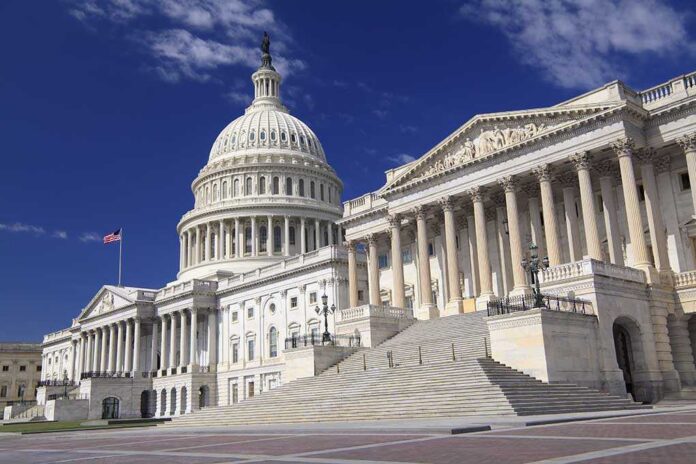
For the first time since Vietnam, Congress just told a sitting president to stop a war he started, and now both parties are arguing over whether that order even matters.
Story Snapshot
- The Senate passed a concurrent Iran war powers resolution 50–48 after the House approved it earlier, marking a rare bipartisan rebuke of President Trump.
- Four Republican senators joined Democrats, while two GOP leaders skipped the vote and one Democrat opposed, highlighting deep splits inside both parties.
- Supporters say the War Powers Resolution of 1973 requires Trump to end or seek approval for the Iran conflict, but the White House claims the law is not binding.
- The administration points to an April ceasefire and a new interim agreement with Iran, while still seeking $80 billion in extra war funding.
Congress Moves to Rein In Trump’s Iran War
The United States Senate approved a House-passed Iran war powers resolution by a narrow 50–48 vote, directing President Donald Trump to stop military operations in Iran or obtain approval from Congress.[4] The House had already passed the same concurrent resolution 215–208, with a handful of Republicans joining Democrats.[8] This is the first time since the War Powers Resolution of 1973 that both chambers have agreed on such a directive aimed at ending an ongoing conflict.[8] Many lawmakers describe it as a sharp institutional rebuke to Trump’s handling of the Iran war.[4]
The vote exposed divisions inside the Republican Party and, to a lesser degree, among Democrats.[1] Four Republican senators—Rand Paul, Lisa Murkowski, Susan Collins, and Bill Cassidy—broke with their party to support the resolution.[1] One Democrat, Senator John Fetterman, voted against it, warning about tying the president’s hands.[1] Two key Republican senators, Mitch McConnell and Dave McCormick, were absent, which helped the measure pass but fueled criticism that it lacks full party backing.[1] Outside Congress, voters on both sides see the fight as another sign that Washington is serving itself, not the public.
War Powers Law and the Fight Over Who Decides on War
The War Powers Resolution of 1973 was passed after Vietnam to stop presidents from sending troops into combat without clear approval from Congress.[18] It requires the president to notify Congress within 48 hours of introducing U.S. forces into hostilities and to end those operations within 60 days unless lawmakers authorize them.[18] Supporters of the new Iran resolution argue that the conflict began on February 28, 2026 and has run far past that 60-day limit, triggering a legal duty to halt or seek authorization.[1] They say Congress is finally using the tools it gave itself over fifty years ago.
Backers also point to section 5(c) of the War Powers Resolution, which lets Congress direct removal of U.S. forces from hostilities through a concurrent resolution.[17] In their view, because both chambers passed such a resolution, the president must comply even without signing it.[2] Critics, including Trump’s team, counter that the War Powers law intrudes on presidential powers as commander in chief and may be unconstitutional.[6] Past presidents from both parties have often sidestepped or narrowly interpreted the law, continuing military operations without clear votes in Congress.[22] That long history feeds the feeling among many Americans that “checks and balances” exist on paper but break down in practice.
Ceasefire Claims, New Agreement, and Skepticism About Motives
The White House insists there is no active war to end, pointing to a two-week ceasefire with Iran that began April 7, 2026.[9] Officials say the United States stopped offensive operations at that time and now only carries out defensive activities.[9] Israel also agreed to halt airstrikes under the same deal, suggesting a pause across several fronts.[9] The administration recently sent Congress the text of a 14-point interim memorandum of understanding with Iran, which it describes as committing both sides to a permanent stop to military action and threats.[14]
The #US Senate has approved a resolution calling on President Donald #Trump to halt further military action against Iran.
The measure passed 50-48 and has also received approval in the House of Representatives. pic.twitter.com/wIxUPQwUp5— Bhaskar English (@BhaskarEnglish_) June 24, 2026
Members of Congress and outside observers question how “permanent” this ceasefire really is.[16] The White House itself has called the truce “fragile,” and Press Secretary Karoline Leavitt said Trump will “ultimately dictate” the timeline, suggesting the United States can restart operations if it chooses.[16] Senator Catherine Cortez Masto has asked why the administration still seeks an $80 billion supplemental war funding package if hostilities are supposed to have ended.[1] Trump has called that sum “cheap” compared with ongoing costs, raising red flags for Americans who already believe wars are driven by money and elite interests rather than genuine security needs.[1]
Why This Matters Beyond Iran: Power, Trust, and the Deep State Debate
This clash over Iran fits a broader pattern that has frustrated both conservatives and liberals for decades.[22] Presidents from both parties repeatedly push the limits of their war powers, while Congress often talks tough but rarely forces a real change.[22] The current resolution is historic because both chambers acted together, yet major news outlets still describe it as largely “symbolic” and note that enforcement will likely depend on how courts read the War Powers law.[6] For many Americans, that sounds like another example of a system where rules are flexible for the powerful but rigid for everyone else.
Conservatives upset with endless foreign entanglements see Trump’s Iran war and the huge funding request as proof that globalist priorities and defense contractors still drive policy, even under an “America First” banner.[1] Liberals worried about human rights and economic inequality view the same conflict as one more drain on resources that could go to health care, schools, and working families.[24] Both sides increasingly share a core concern: federal leaders, from Congress to the White House, seem more focused on protecting their authority than on following the Constitution and giving citizens a clear say before going to war.
Sources:
[1] Web – Senate Passes Iran War Powers Resolution 50–48
[2] Web – Congress passes war powers measure for first time, rebuking … – BBC
[4] YouTube – Senate passes war powers resolution to curb future US …
[6] YouTube – LIVE: US Senate Pass Resolution, Trump’s Iran War Powers Limited
[8] Web – JUST IN: The Senate has adopted a House-passed Iran war powers …
[9] Web – BIG: The Senate passed a War Powers Resolution against Trump’s …
[14] Web – Read the US account of unreleased 14-point Iran ceasefire …
[16] Web – Addressing Threats to the United States by the Government of Iran
[17] Web – White House calls Iran ceasefire “fragile” – Facebook
[18] Web – War Powers Resolution – Avalon Project
[22] Web – Then and Now: The War Powers Resolution (1973) and War Powers …
[24] Web – “Under the War Powers Act of 1973, the administration must notify …
© patriotsunited.org 2026. All rights reserved.