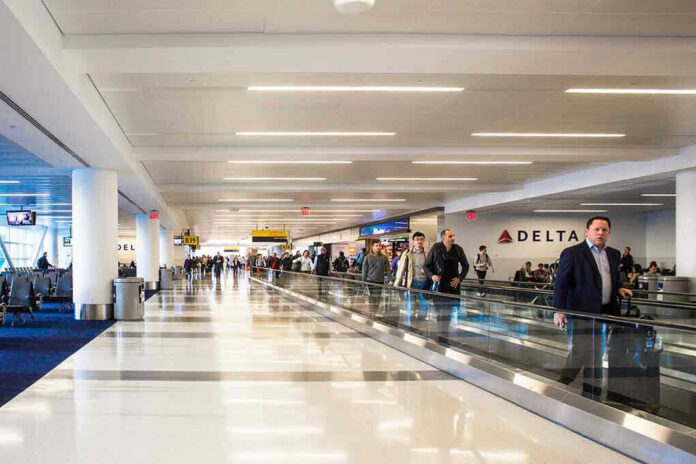
Imagine arriving at the airport, only to discover that your flight is delayed for hours—yet the federal government just erased the rule that would have forced airlines to pay you cash for your lost time.
Story Snapshot
- The Trump administration has officially withdrawn a Biden-era proposal requiring airlines to pay passengers cash for long delays.
- This reversal keeps compensation for flight delays inconsistent and at the discretion of airlines.
- Consumer advocates warn of a step backward for traveler protection; the airline industry welcomes reduced regulation.
- The move sets the stage for future debates over the balance between consumer rights and industry freedom.
Regulatory Reversal Leaves Flyers in Limbo
On November 14, 2025, the U.S. Department of Transportation finalized the withdrawal of a proposed rule that would have standardized compensation for airline passengers stuck on the tarmac or stranded at the gate. The Biden administration’s plan, introduced a year earlier, sought to mandate payments of $200 to $775 for delays within an airline’s control. Instead, the Trump administration’s move leaves compensation policies in the hands of each airline, with no federal standard ensuring fair treatment.
This decision caps a yearlong battle over whether government or market forces should dictate how airlines compensate inconvenienced travelers. Passengers, already weary after years of pandemic-era disruptions and record delays, are left to navigate a confusing patchwork of policies, where some airlines offer vouchers and others leave customers with nothing. Industry groups claim this flexibility is vital to their survival; consumer advocates argue it leaves Americans exposed to arbitrary treatment.
Origins of the Passenger Compensation Debate
The roots of this regulatory tug-of-war stretch back decades. After the Airline Deregulation Act of 1978, U.S. airlines gained more freedom—but passengers lost many statutory rights. Sporadic attempts to impose compensation, like the Airline Passenger Bill of Rights in 2008 and refund rules in 2010, fell short of mandating cash payments for delays. The surge in travel after COVID-19 exposed the consequences: millions stranded, inconsistent compensation, and a tidal wave of complaints. The Biden proposal sought to fix this by drawing clear lines—cash for delays within an airline’s control, nothing for weather or air traffic snarls. But industry lobbying and a changing political tide proved stronger than consumer frustration.
With the Trump administration’s withdrawal, the U.S. remains one of the few major markets without a federal standard for delay compensation. Airlines claim that existing incentives and fierce competition keep them honest, but critics point to European Union rules, where airlines routinely pay passengers and delays have declined. For now, American travelers must rely on airlines’ goodwill—and their own persistence in seeking remedies.
Who Gains, Who Loses, and What Happens Next
The winners in this regulatory about-face are clear: airlines, who avoid the estimated millions in annual compensation payouts and gain latitude to manage operations without federal mandates. Industry groups, like Airlines for America, celebrated the decision, emphasizing operational flexibility and cost control. The Trump administration frames the move as common sense, arguing that new rules would have failed to improve performance and only increased bureaucratic burden.
Losers include the flying public, especially those hit by mechanical breakdowns or scheduling blunders. Without a federal rule, compensation remains at the whim of each carrier. Consumer groups like FlyersRights.org warn that the rollback erodes trust and transparency, making it harder for ordinary Americans to get recourse when things go wrong. Disappointment runs high among those who hoped for a system resembling Europe’s, where travelers automatically receive compensation without having to beg or threaten legal action.
Long-Term Implications and the Road Ahead
The precedent set by this decision may shape airline regulation for years. By rolling back a major consumer protection initiative before it took effect, the Trump administration signals a broader skepticism toward federal intervention in the marketplace. Future efforts to secure compensation for delays may face even steeper odds, especially as airline lobbying grows more sophisticated.
For passengers, the message is clear: don’t count on Washington to guarantee fairness in the skies. Travelers must continue to wade through fine print, advocate for themselves, and hope that public pressure will one day push airlines to adopt more consistent, transparent policies. The story is not over—consumer advocates are already plotting new strategies, and political winds can shift quickly. Until then, every flight delay in America comes with a side order of uncertainty, and the debate over who pays for lost time remains unresolved.
Sources:
Fox Business, “Trump Rescinds Biden Airline Passenger Cash Compensation Proposal,” Nov 14, 2025
U.S. Department of Transportation, Official Statements (Nov 2025).