
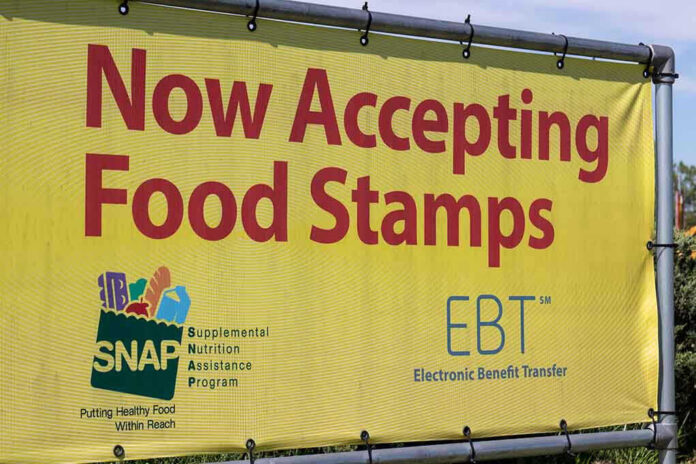
Imagine a government system so broken that it still delivers food stamp benefits to nearly 186,000 dead people—on your dime—and asks you to trust it with billions more.
Story Snapshot
- Secretary Brooke Rollins exposes rampant fraud in SNAP, including payments to deceased recipients.
- State data reveal at least 186,000 dead individuals remain on active SNAP rolls.
- Rollins calls for urgent and sweeping reforms to restore program integrity.
- Public confidence in SNAP suffers as media coverage and political pressure intensify.
Fraud in Plain Sight: The Shocking Numbers Behind SNAP Abuse
Secretary Brooke Rollins did not mince words when she faced the press, declaring “SNAP fraud is out of control.” The Supplemental Nutrition Assistance Program, intended to serve the neediest Americans, currently lists 186,000 people as active beneficiaries who are, in fact, deceased. These numbers, confirmed by state-supplied data, represent a staggering oversight and raise urgent questions about the program’s management and oversight. The revelation comes as SNAP’s budget faces renewed scrutiny amid a protracted government shutdown and public debate over social safety nets.
SNAP fraud is out of control, and the numbers we HAVE prove it.
Data from just 29 states uncovered nearly 200,000 people with dead people’s social security numbers… Meanwhile, 21 states are suing to keep their data hidden.
Why block transparency unless the truth is worse than… pic.twitter.com/XAjHKncCfp
— Secretary Brooke Rollins (@SecRollins) November 13, 2025
The scale and brazenness of the abuse fuel outrage in households where every tax dollar matters. Many Americans, already skeptical of government efficiency, see this as evidence of systemic rot. Rollins’s disclosure did more than just confirm suspicions—it provided a concrete figure that is hard to ignore or explain away. At a time when the federal deficit looms large and entitlement programs are under the microscope, SNAP’s apparent inability to perform basic recordkeeping has become a galvanizing flashpoint for reform advocates.
How Dead People Stay on the Rolls—and Why It Keeps Happening
Dead people don’t apply for SNAP benefits. Yet, administrative inertia and poor interagency communication mean their names remain. State and federal databases often fail to synchronize in real time. As a result, families or even criminal actors may continue to claim benefits in the names of the deceased. The lack of regular audits and checks creates an environment ripe for abuse, where even the most egregious errors can persist for years without detection. The SNAP bureaucracy, overwhelmed by volume and complexity, struggles to close these loopholes.
Rollins’s call for reform includes immediate implementation of cross-referenced databases and periodic eligibility checks. Critics argue that such systems already exist but are not enforced with any real vigor. The difference, they contend, lies in enforcement, accountability, and a willingness to admit that fraud is not just a fringe issue, but endemic. As political pressure mounts, the public is left to wonder: If the system cannot catch the dead, what else is slipping through the cracks?
The Political Fallout: Trust, Accountability, and the Road Ahead
Public reaction to the SNAP revelations has been swift and fierce. Talk radio, editorial pages, and social media echo chambers amplify each new report of abuse. Lawmakers on both sides of the aisle acknowledge the need for reform, but consensus on how to proceed remains elusive. Some demand stricter eligibility checks and automatic cross-verification with death records. Others warn against measures that might inadvertently disenfranchise the truly needy due to bureaucratic overreach or data errors.
Rollins has pledged to work with states to close the loopholes, but trust in government stewardship of SNAP has already been eroded. The specter of dead recipients casts a long shadow over other welfare programs, fueling arguments for broader audits and increased transparency. For millions who depend on SNAP, the risk is twofold: the possibility of real need going unmet due to tightened restrictions, and the certainty that every instance of fraud chips away at public goodwill and future funding.
The Conservative Perspective: Common Sense Demands Accountability
From a conservative vantage, the persistence of dead beneficiaries on SNAP rolls epitomizes the perils of unchecked government spending. The case for reform is grounded in principles of accountability and stewardship—values that resonate with taxpayers of all stripes. While compassion for the needy is a shared goal, conservatives argue that every fraudulent dollar is a dollar stolen from both the taxpayer and the truly deserving. Restoring faith in SNAP, they contend, starts with rigorous oversight, real-time data sharing, and consequences for administrative negligence.
For many, the story of the 186,000 dead SNAP recipients is not merely a headline but a call to action. The question that remains: will elected officials rise to the challenge, or will bureaucratic inertia win the day once again?
Sources:
Trump administration will require SNAP participants to reapply for benefits