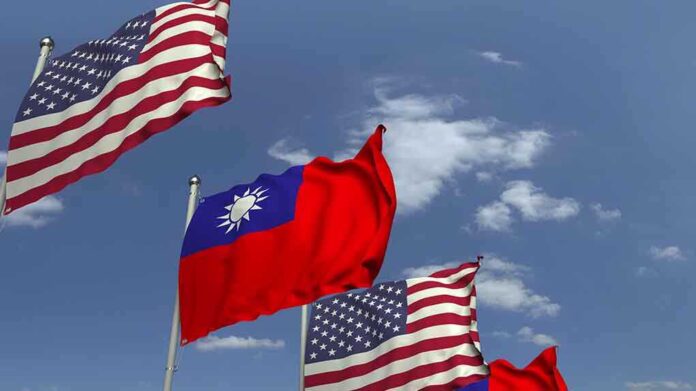
Taiwan vows to increase American imports and investments while refusing to retaliate with tariffs against the United States, despite facing new reciprocal 32% duties on Taiwanese goods entering the American market.
Key Insights
- Taiwan’s President Lai Ching-te announced a strategy focused on removing trade barriers rather than retaliatory tariffs, maintaining investment commitments to the US
- Taiwan’s semiconductor industry, including TSMC’s $100 billion US investment, remains exempt from the new tariffs
- Taiwanese electronics, communications, petrochemical, and natural gas sectors are expected to increase investments in the United States
- Taiwan has implemented stricter short-selling rules to stabilize financial markets in response to volatility from the US tariff announcement
Taiwan Chooses Cooperation Over Retaliation
In a strategic move prioritizing long-term economic relations, Taiwan has announced it will not implement retaliatory tariffs against the United States following President Trump’s decision to impose 32% reciprocal duties on Taiwanese goods. President Lai Ching-te made it clear that Taiwan sees greater value in maintaining strong economic ties with America rather than engaging in a trade war. The decision demonstrates Taiwan’s commitment to preserving its critical partnership with the US despite potentially costly new tariffs on its exports.
President Lai emphasized that Taiwan’s approach will focus on removing trade barriers and increasing investments in the American market. “In the face of the U.S. ‘reciprocal tariffs’, Taiwan has no plans to take tariff retaliation, and there will be no change in the investment commitments of enterprises to the United States as long as they are in the national interest,” Lai stated during an economic policy meeting in Taipei. This response reflects Taiwan’s pragmatic approach to maintaining positive relations with its most important security partner.
Semiconductor Investments Remain Protected
A key factor in Taiwan’s measured response is that its semiconductor industry, the crown jewel of its export economy, remains exempt from the new American tariffs. Taiwan Semiconductor Manufacturing Co. (TSMC), the world’s largest contract chipmaker, has already committed to a massive $100 billion investment in the United States. This exemption preserves Taiwan’s most strategic industry relationship with America while allowing both sides to address trade imbalances in other sectors.
“In the future, in addition to TSMC’s increased investment, other industries, such as electronics, information and communications, petrochemicals, and natural gas will be able to increase investment in the U.S. and deepen Taiwan-U.S. industrial cooperation,” said President Lai Ching-te.
The semiconductor exemption highlights the strategic interdependence between Taiwan and the United States in an industry critical to global technology supply chains. By maintaining this exemption, the Trump administration recognizes the vital importance of Taiwan’s advanced chip manufacturing capabilities to American technology leadership and national security interests, even while addressing perceived trade imbalances in other sectors.
Addressing Non-Tariff Trade Barriers
A central element of Taiwan’s strategy involves addressing non-tariff trade barriers that have complicated trade relations with the United States. These barriers include regulations, licensing requirements, and other administrative procedures that can impede the flow of goods and services between countries without involving direct tariffs. By proactively tackling these issues, Taiwan aims to create a more balanced trading relationship with America that could potentially lead to reduced tariffs in the future.
“Non-tariff trade barriers are an indicator for the U.S. to assess the fairness of trade, and Taiwan will proactively resolve non-tariff trade barriers that have existed for many years to make trade negotiations with the U.S. smoother,” said President Lai Ching-te.
The Taiwan government has also implemented financial measures to stabilize markets following the tariff announcement. The Financial Supervisory Commission introduced stricter short-selling rules to prevent excessive market volatility, including caps on intraday securities lending orders and increased minimum margin requirements. These measures demonstrate Taiwan’s determination to maintain economic stability while navigating the challenges presented by the new American tariffs.
Strategic Economic Partnership
Taiwan’s response to the tariffs reflects its understanding of the broader strategic relationship with the United States. Rather than viewing the tariffs in isolation, Taiwan is positioning itself as a reliable economic partner with shared values and interests. By increasing investments in America and working to address trade imbalances, Taiwan aims to strengthen its economic and security ties with the United States at a time when both face increasing pressure from China’s aggressive regional posture.
The approach also demonstrates Taiwan’s careful balancing act between maintaining its economic interests and acknowledging the Trump administration’s focus on addressing trade deficits. By offering constructive solutions rather than retaliatory measures, Taiwan shows its commitment to a mutually beneficial relationship that serves both countries’ long-term strategic and economic interests, particularly in the face of shared challenges in the Indo-Pacific region.