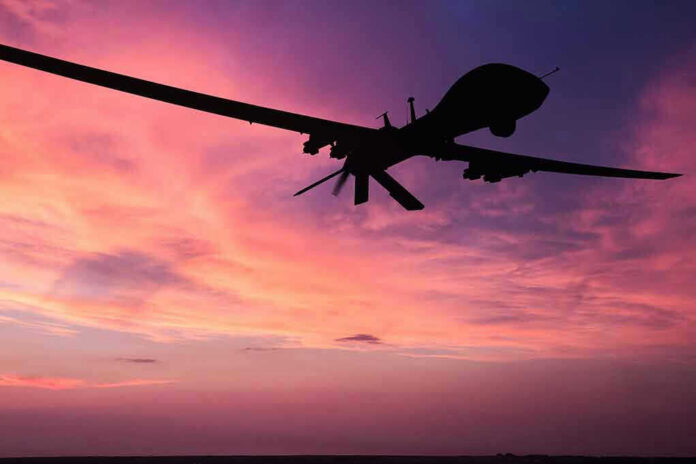
An unidentified drone’s run at a nuclear-powered aircraft carrier in a NATO newcomer’s port shows how quickly “gray-zone” threats can test Western resolve without firing a shot.
Story Snapshot
- Swedish forces electronically jammed an unidentified drone as it approached France’s aircraft carrier Charles de Gaulle while docked in Malmö on February 25, 2026.
- Multiple reports pointed to a suspected launch from a nearby Russian vessel, but officials described the drone’s origin as unconfirmed.
- The drone was stopped about 7 nautical miles (roughly 10 km) from the carrier and then disappeared from radar; its final outcome remains unclear.
- French and Swedish officials said the carrier’s operations were not disrupted, and they highlighted close bilateral coordination during the incident.
Sweden’s jamming stop in Malmö, and what is confirmed
Swedish Armed Forces detected a drone moving toward the French Navy’s flagship carrier Charles de Gaulle during the ship’s first-ever stopover in Malmö, a strategic Baltic-adjacent port along the Öresund Strait. Swedish forces used electronic warfare to jam the drone at roughly 7 nautical miles from the carrier. After jamming, the aircraft vanished from radar, leaving unanswered whether it crashed, landed, or returned to its launch point.
French military spokesmen publicly confirmed the incident the following day, stressing that Swedish systems “worked perfectly” and that the carrier’s activities continued without interruption. That detail matters because it separates a successful defensive response from a scenario where an adversary can impose costs simply by forcing a shutdown. Even with a clean operational outcome, the episode still demonstrates that major NATO assets can be probed in port, not just at sea.
Suspected Russian involvement, and what remains unproven
Several outlets reported suspicions that the drone was launched from a nearby Russian vessel, framing the flight as a deliberate test during a high-visibility NATO-linked visit. Other reporting was more cautious, describing the drone as “unknown,” a distinction that reflects the current public record. No official Russian claim or denial was highlighted in the available reporting, and the drone’s disappearance complicates independent verification of who controlled it and what it carried.
That gap between suspicion and proof is exactly where hybrid tactics thrive. A drone that never delivers a payload can still collect imagery, map electronic emissions, and test response times—especially around a capital asset like France’s only nuclear-powered aircraft carrier. For citizens who value deterrence and clear red lines, the central problem is that deniable activity can normalize repeated violations, gradually shifting what is considered “acceptable” behavior near allied forces.
NATO’s Baltic reality: choke points, cables, and electronic warfare
The setting is not incidental. Malmö sits on the Öresund Strait, a narrow maritime chokepoint connecting the Baltic Sea to the North Sea and a natural corridor for both commercial shipping and naval movements. Sweden’s 2024 accession to NATO has increased the alliance’s operational footprint in the region, while reporting has tied recent tensions to GPS jamming, threats to underwater infrastructure, and heightened air policing activity linked to Russia’s war against Ukraine.
The Charles de Gaulle was operating as part of a broader French and NATO exercise posture referenced in coverage as LA FAYETTE 26, alongside efforts to secure critical undersea infrastructure. In practical terms, the incident functions like a stress test of allied interoperability: detection, attribution, electronic countermeasures, and public messaging. Swedish officials emphasized “well-functioning cooperation,” and French statements reinforced that coordination as a key takeaway for deterrence.
What this means for Western defense—and why it matters to Americans
For American readers watching a world that grew less stable after years of soft signaling from Western capitals, this is a reminder that strength still has to be demonstrated, not just declared. The response—rapid jamming, no operational disruption, and allied coordination—is a positive datapoint. The unresolved parts—origin, intent, and the drone’s fate—are the warning. Security professionals cannot deter what they cannot reliably attribute, especially when provocations stay below the threshold of open conflict.
European navies have already been moving toward more dedicated counter-drone tools, including rapid-response systems designed for small unmanned aircraft. The Malmö incident shows why: a low-cost drone can force high-end militaries to spend time, attention, and resources on defense, even during routine port calls. If NATO wants to prevent “probe-and-learn” tactics from becoming routine, allies will likely need clearer rules of engagement, better port-area surveillance, and faster attribution pathways.
Sources:
Unknown drone jammed near French navy flagship in Sweden: forces
Russian drone intercepted near French aircraft carrier in Sweden
Security incident as French aircraft carrier Charles de Gaulle visits Malmo
Russian drone spotted over major NATO aircraft fears war surge
Russian drone spotted over major
France modernises its fleet with a new gun able to bring down a drone in 2 seconds