

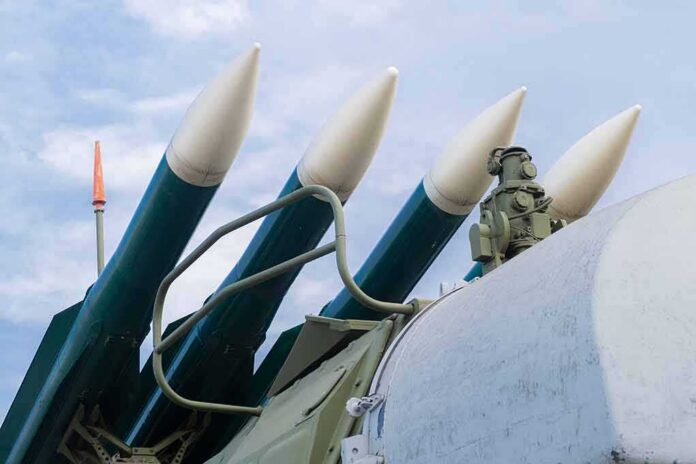
Washington once ejected a key ally from the F-35 program over Russia’s S-400 system, a sign the Pentagon sees real risk in how this air defense can study U.S. stealth jets.
Story Snapshot
- The United States removed Turkey from the F-35 program after it bought Russia’s S-400, citing stealth security risks.
- Analysts say S-400 radars can detect a stealth jet’s presence but may struggle to get a weapons-quality track.
- No verified combat has ever shown an S-400 shooting at an F-22 or F-35, so real-world performance remains unproven.
- The debate is a “kill chain” issue: detection is not the same as tracking, targeting, and intercepting.
Why the S-400 Still Worries U.S. Officials
The Department of Defense blocked Turkey, a long-time North Atlantic Treaty Organization ally, from the F-35 fighter program in 2019 after Ankara bought Russia’s S-400 air defense system. U.S. officials said the S-400 could collect sensitive data on the F-35’s stealth features if both systems operated together. That could help Russia map out signatures and tactics, reducing the jet’s edge over time. This decision signaled that Washington treats the S-400 as a real intelligence and detection threat, not a showpiece.
Russia markets the S-400 as a layered shield able to spot and shoot at targets at long range. Public write-ups describe a networked system: a long-range search radar to find targets, a command post to assign them, a fire-control radar to guide missiles, and multiple launchers. Russia’s longest-range missile for the system, the 40N6 or 40N6E for export, is often cited with a range near 380 to 400 kilometers against aircraft, aimed at high-value targets. These figures, though, are headline numbers, not a full picture.
Detection Is Not a Weapons Lock
Engineers and veterans stress a key point: seeing a stealth jet and hitting it are different steps. Lower-frequency radars can sometimes sense that “something” is there at longer ranges. But they usually lack the precision to guide a missile. For a shot, the system needs a high-precision, continuous “weapons-quality” track, often from a higher-frequency fire-control radar. Stealth design reduces returns in those higher bands to break the chain and shrink the enemy’s engagement window. This is why many analysts frame the fight as a “kill chain” problem, not a single range number.
Several open sources argue the S-400 may detect an F-22 or F-35 at some range but may only get a tight weapons lock much closer. One analysis reports that the S-400’s guidance radar faces the steepest challenge against fifth-generation jets before they fire their own stand-off weapons. Another outlet says the system has not yet engaged stealth aircraft in combat, so claims lean on maker data and modeling rather than battle records. That gap matters for both hawks and skeptics who want proof, not press releases.
What We Know, What We Don’t
There is no verified case of an S-400 tracking and engaging an F-22 or F-35 in real combat, so hard performance data remain scarce. Public estimates vary, and many are derived from assumptions about radar bands, target size, and flight profile. Those numbers can change fast with tactics, jamming, geography, and the use of decoys. That uncertainty is exactly why the Pentagon moved early to wall off the F-35 from S-400 exposure inside an allied country’s airspace. Reducing what a rival can learn today protects pilots tomorrow.
Russia’s advertised strengths still matter. A system that can link many radars and launchers, manage dozens of tracks, and throw long-range missiles at high-value targets changes how pilots plan routes and timing. Even if a defender cannot get a lock at great range, forcing U.S. and allied jets to fly lower, slower, or wider burns fuel, shrinks strike packages, and adds cost. That is an “anti-access” effect without firing a shot, and it aligns with what both sides of our politics fear: rising risk and price with few clear wins.
What This Means for U.S. Strategy and Taxpayers
U.S. planners will keep investing in the full kill chain: stealth shaping, smart tactics, electronic attack, decoys, and stand-off weapons that can launch from beyond likely lock-on ranges. They will also press allies to avoid systems that feed rival intelligence. The Turkey case shows how fast Washington will act when it sees a risk to crown-jewel programs. That urgency reflects a hard truth: secrets lost are expensive to regain, and the bill lands on taxpayers.
For readers who feel the government too often protects contractors over citizens, watch the metrics that matter. Ask whether each new dollar widens the gap in the defender’s kill chain or only chases hype. Demand evidence from tests, not claims from brochures. The S-400 versus F-35 debate is technical, but the core is simple: keep our pilots hard to find, harder to track, and out of reach when they strike. That is a standard the public can measure and leaders should meet.
Sources:
war.gov, congress.gov, 19fortyfive.com, reuters.com, militarymachine.com, theaviationgeekclub.com, defenseone.com
© patriotsunited.org 2026. All rights reserved.