
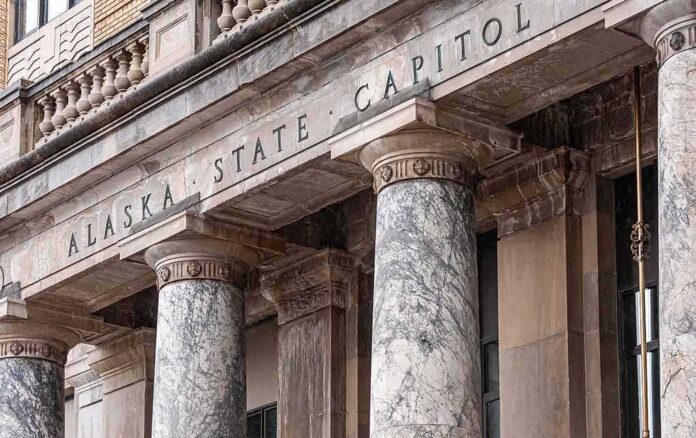
The Justice Department moved to stop Alaska from certifying a Senate result if same-name ballots could tip the winner, then announced parallel criminal and civil probes into how that situation arose.
Story Snapshot
- Justice Department filed a lawsuit to block certification in narrow scenarios tied to same-name ballots.
- Federal prosecutors confirmed an active criminal investigation into alleged spoiler recruitment.
- Reports cite interviews, texts, and documents linking Democratic operatives to recruiting efforts.
- A state official previously flagged the second Sullivan filing as intended to mislead voters.
What DOJ Filed and Why It Matters
The Department of Justice filed a civil lawsuit on October 23, 2026. The suit asked a federal court to stop Alaska from certifying the Senate race if Senator Dan Sullivan lost and if votes for Daniel J. Sullivan would have changed the ranked-choice outcome. The filing focuses on voter intent. It argues that ballots cast for Daniel J. Sullivan may have been meant for the incumbent. The request is unusual and aims to pause certification only in specific, outcome-changing conditions.
Justice Department officials later amended aspects of the case while keeping the central relief request intact. The department’s approach tries to balance state control of elections with federal protection of voting rights. Legal analysts noted the move has little clear precedent. That makes the case important beyond Alaska because it tests how courts handle possible confusion created by same-name candidates under ranked-choice rules.
What Investigators Are Probing
At a press briefing, the United States Attorney for the District of Alaska said federal authorities opened a criminal inquiry. He stated officials were taking the allegations “extremely seriously.” He did not name the statutes under review or the potential charges. Reported subpoenas went to several Democratic figures. The focus is whether political operatives helped recruit Daniel J. Sullivan as a sham to divert votes from Senator Dan Sullivan.
Published reporting points to a structured effort. Outlets summarizing The New York Times described interviews, text messages, and documents from at least a dozen sources. They reported the work was informally called a “ballot composition project.” Those accounts linked aides aligned with Mary Peltola, campaign lawyers, and senior staff at the Democratic Senatorial Campaign Committee to recruitment talks. These outlets emphasized that the materials were prepared for potential litigation and involved multiple witnesses, not a single anonymous tip.
Alaska Officials’ Early Warning on Ballot Fairness
Alaska election officials previously reviewed whether Daniel J. Sullivan should appear on the primary ballot. A state official ruled him ineligible for that stage. The decision said his filing was submitted “with a purpose to confuse or mislead and to thereby compromise the ballot’s fairness or neutrality”. That state action came before the current federal lawsuit and probes. It shows that concerns about voter confusion were raised inside Alaska’s process, not only in later federal filings.
The controversy plays out under ranked-choice voting, which adds complexity when measuring voter intent. The Justice Department’s case does not claim every vote for Daniel J. Sullivan was mistaken. It asks the court to examine whether enough votes intended for the incumbent were misdirected to change the final ranked-choice tally. That requires modeling what would have happened as votes reallocated across rounds.
Competing Messages and What We Know
Public comments from partisan leaders raised the profile of the case. President Trump called for prosecution, and Senator Dan Sullivan labeled the reported conduct “corruption at the highest level” in recent coverage. The Peltola campaign and the Democratic Senatorial Campaign Committee have denied recruiting Daniel J. Sullivan. They have said they had no involvement in his run. Federal prosecutors have not announced any criminal charges to date.
The "Two Dan Sullivans": How Alaska's Election System Fueled a Major Political & Legal Battle
In Alaska’s U.S. Senate race, voters noticed something confusing on their ballots: Dan S. Sullivan and Dan J. Sullivan listed right beside each other. One was the incumbent Republican… pic.twitter.com/l78VklEghp
— 907Honest (@907Honest) October 31, 2026
The stakes reach beyond one seat. Same-name and “spoiler” fights recur in American elections. Past cases show how name recognition can pull votes even without large budgets. They also show how hard it is to prove intent to deceive. That is why the Alaska dispute matters to voters across the spectrum. It raises a core question both left and right ask: will the system protect clear voter intent, not party tactics?
What Comes Next and Why It Affects You
The federal court will decide whether to grant the requested pause on certification if the race is close and the name issue could alter the outcome. Investigators can seek emails, texts, bank records, and testimony to establish who contacted whom, why, and how any support flowed. Clear answers on those points would help determine whether laws were broken, or whether this was bare-knuckle politics within legal lines.
For citizens, this is about trust. Many Americans believe powerful players bend rules while ordinary voters pay the price. This case tests whether institutions can act fast and fairly when tactics risk confusing voters. A transparent process, with evidence on the record and rulings that explain the law, would serve everyone. The goal is simple: count the votes as people meant to cast them, and keep bad actors from gaming the rules.
Sources:
youtube.com, cnbc.com, alaskapublic.org, apnews.com
© patriotsunited.org 2026. All rights reserved.