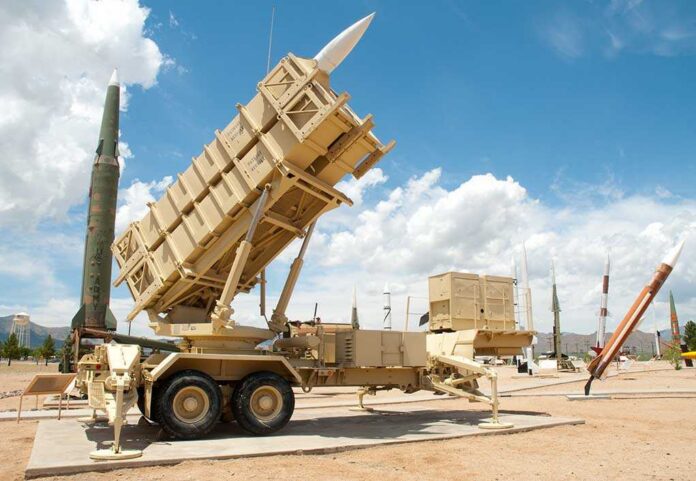
Seven-year Pentagon deals promise to triple Patriot and quadruple THAAD output by tackling the parts that have slowed deliveries for years.
Story Snapshot
- The Pentagon signed long-term framework agreements to expand key interceptor components.
- Targets call for tripling Patriot PAC-3 MSE and quadrupling THAAD production capacity.
- The move aims to fix bottlenecks like solid rocket motors and structural parts.
- Analysts say rebuilding missile stocks will still take multiple years.
Pentagon Locks In 7-Year Agreements To Expand Missile Defense Parts
The Department of War announced seven-year framework agreements with major contractors to expand production of critical components for the Patriot Advanced Capability-3 Missile Segment Enhancement and Terminal High Altitude Area Defense interceptors. Officials described the agreements as tools to grow capacity and give suppliers clear demand signals over several years. The goal is faster output and steadier deliveries of parts that have limited overall production. The agreements function as a template for follow-on supply contracts.
The department set aggressive targets. Leaders said the plan is to more than triple Patriot PAC-3 Missile Segment Enhancement production to about 2,000 missiles per year, up from roughly 600. They also aim to quadruple THAAD interceptor production capacity. These goals depend on building out propulsion, structures, and other long-lead parts that constrain line rates today. Officials framed the approach as a structural shift in how the government signals demand to the defense industrial base.
What Bottlenecks These Deals Actually Tackle
Industry and government point to a short list of chokepoints that slow output. Solid rocket motors, airframe structures, and maneuver systems require specialized materials, curing, and testing. These steps take time and money to scale. The new frameworks seek to pull private capital into new tooling, add shifts, and qualify second sources where possible. The Pentagon and its suppliers described the push as a coordinated effort to expand key component lines and speed deliveries to the final missile assembly sites.
Some supply chains remain sensitive even with new funding. The seeker head for certain interceptors and the dual-pulse solid rocket motor require rare skills, strict safety rules, and long qualification cycles. That means new capacity comes online in stages, not overnight. Analysts warn that even with strong demand signals, the full buildout can span years. The end-to-end lead time for a Patriot PAC-3 Missile Segment Enhancement interceptor remains lengthy due to these steps.
Why Long-Term Signals Matter For An Overstretched Industrial Base
Defense researchers say the United States has faced a recurring problem: wartime use drains stocks faster than peacetime factories can refill them. When that happens, the government needs multi-year buys and stable plans to convince companies to invest in new lines and workers. The Center for Strategic and International Studies has called rebuilding key missile inventories a multiyear project even under favorable conditions. The new frameworks fit that playbook by reducing year-to-year swings.
The agreements also try to spread risk. By sketching multi-year needs, they make it easier for companies to finance new equipment and hire specialized labor. That stability can help hold down unit costs over time. But the approach still depends on Congress for funding and on contractors to execute. The Pentagon stated that the frameworks are a basis for negotiating seven-year supply contracts tied to authorizations and appropriations, linking policy intent to future budget action.
What This Means For Readiness, Costs, And Trust In Government
For service members and allies who rely on these defenses, steadier interceptor flow can improve readiness. For taxpayers, long-term deals can lower costs per unit once lines are full. Yet people on the right and left worry about waste, favoritism, and slow delivery. Clear targets, public milestones, and on-time shipments will be the real test. The department’s promise to attack known bottlenecks is concrete; meeting the triple and quadruple goals will show if the model works.
🇺🇸The Pentagon has signed seven-year agreements with Lockheed Martin and General Dynamics Ordnance and Tactical Systems to expand missile production.
The deals are aimed at increasing output and speeding deliveries of critical components for the THAAD and Patriot PAC-3 MSE…
— news politics and more (@israelnews770) August 31, 2026
Americans want a government that plans ahead, buys smart, and delivers. These agreements aim to do that by turning short-term surges into long-term capacity. They answer a basic complaint shared across the spectrum: stop lurching from crisis to crisis. The facts remain sober, though. Building missile capacity is a heavy industrial lift that takes time. The country will see progress not in speeches, but in monthly output and faster fielding over the next several years.
Sources:
redstate.com, reuters.com, techtimes.com, washingtonexaminer.com
© patriotsunited.org 2026. All rights reserved.