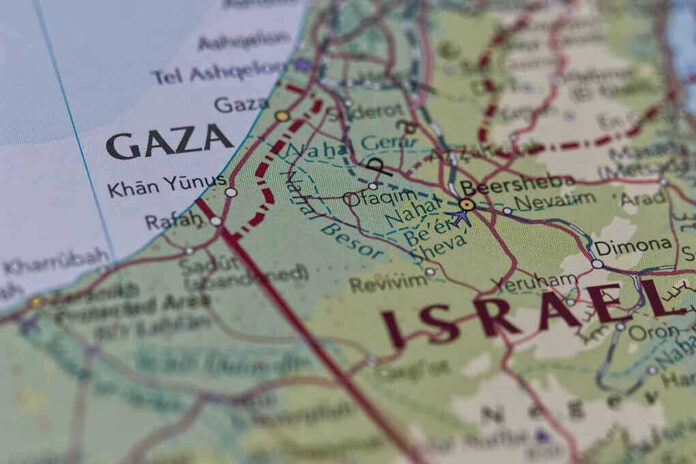
patriotsunited.org — Israel’s decision to push military control over roughly 70 percent of Gaza is reshaping the battlefield, the ceasefire, and the political calculus in Washington all at once.
Story Snapshot
- Israeli Prime Minister Benjamin Netanyahu publicly ordered the army to expand control of Gaza from about 60 percent to 70 percent.[2]
- The move goes beyond the territory Israel held under the U.S.-brokered October 2025 ceasefire lines, prompting loud accusations of violation from Hamas and international critics.[1][3]
- Netanyahu portrays the expansion as step‑by‑step military pressure on Hamas, aimed at long‑term security and leverage in ceasefire talks.[2][3]
- The clash over “who controls what” in Gaza highlights wider battles over borders, lawfare, and how far Western allies will go to restrain or back Israel.[1][3]
Netanyahu’s 70 Percent Order and What It Really Means on the Ground
Prime Minister Benjamin Netanyahu told Israelis that their army already holds about 60 percent of the Gaza Strip and that he has ordered it to push that control to roughly 70 percent.[2][3] He delivered the comments at a leadership and security forum, explaining that Israel is moving in stages and “will start” with that higher benchmark instead of immediately seeking total control.[2] Video coverage of his remarks shows him framing this as a deliberate, phased military objective, not a formal annexation declaration.[3][4]
Reports from regional and international outlets say this 70 percent target significantly exceeds the territory Israel was supposed to hold under the ceasefire understandings negotiated last October, which left Israel with control over about half of Gaza and certain defined “buffer” and “corridor” areas.[3] Analysts cited in these reports estimate Israel was already exercising effective control over nearly two‑thirds of Gaza before Netanyahu’s new order, due to expanded restricted zones, military crossings, and operational belts.[3] His order essentially formalizes and deepens those gains.
Ceasefire Dispute: Security Leverage or Blatant Violation?
Netanyahu and his supporters argue that expanding control is necessary to keep Hamas from re‑arming, block cross‑border attacks, and give Israel leverage in ceasefire and hostage negotiations.[2][3] They present the incremental push to 70 percent as a pressure tactic designed to make Hamas feel the cost of continued rocket fire and political intransigence, while preserving some flexibility for future arrangements.[2] This framing resonates with many security‑minded observers who see territorial dominance as the only language Hamas truly respects after years of broken agreements and rocket campaigns.
Hamas officials, on the other hand, immediately labeled the order a “blatant violation of all agreements,” tying it directly to ongoing civilian suffering.[1] A spokesman accused Israel of expanding control to 70 percent of the Strip while “killing and starvation continue,” casting the move as proof that the ceasefire was never honored in good faith.[1] Left‑leaning international outlets and activist networks amplified that storyline, describing Israel as already controlling more land than it had agreed to under the U.S.‑backed deal and now pushing even further.[3] They argue this deepens occupation, undermines future diplomacy, and entrenches humanitarian hardship.
Moving Lines, Legal Ambiguity, and What Conservatives Should Watch
Neutral reporting shows that this dispute sits inside a longer‑running pattern where Gaza is described in terms of shifting “controlled areas,” “buffer zones,” and “restricted corridors,” rather than fixed borders.[3] Different maps and legal interpretations track where Israeli troops can operate, where Palestinians can farm or build, and where international agencies can move people or goods.[3] That patchwork lets both sides weaponize the same facts, with Israel stressing security belts and critics stressing encroachment and displacement, depending on which map they emphasize.
Hamas accuses Netanyahu of ‘blatant violation’ of ceasefire for ordering seizure of 70% of Gaza https://t.co/d5W3QPgxjB via @timesofisrael
— reuben poupko (@poupko) May 29, 2026
For American conservatives, the fight over percentages in Gaza raises familiar questions about how much Washington should pressure an ally versus how much it should trust that ally to handle its own defense. The Trump administration, already trying to rein in globalist institutions and restore a America‑first foreign policy, now faces loud calls from the left to punish Israel over alleged ceasefire violations, while many on the right see an embattled ally taking necessary steps after years of terror.[1][3] Beyond Middle East lines on a map, the bigger battle is over who sets the rules: elected governments defending their people, or international bodies and activist media eager to second‑guess every move from a distance.
Sources:
[1] Web – Netanyahu Orders Israeli Army to Seize ‘70% of Gaza Strip’
[2] Web – Netanyahu says he ordered IDF to seize 70% of Gaza Strip, well …
[3] Web – Hamas accuses Netanyahu of ‘blatant violation’ of ceasefire for …
[4] Web – Netanyahu orders Israeli military to seize 70% of Gaza, expanding …
© patriotsunited.org 2026. All rights reserved.