As war rages with Iran, President Trump is quietly building a “Shield of the Americas” in Miami that could permanently reshape the fight against cartels, illegal migration, and Chinese influence in our own backyard.
Story Snapshot
- Trump hosts 12 Latin American and Caribbean leaders at his Doral resort for a “Shield of the Americas” summit focused on security, migration, and China.
- The meeting comes days after Trump and Israel launched a war on Iran, underscoring the stakes for U.S. troops and global markets.
- Washington pressures regional partners to cut Chinese Belt and Road ties while expanding joint action against cartels and transnational crime.
- The summit sidelines left‑wing regimes and major powers like Brazil and Mexico, forming a conservative, U.S.-aligned bloc in the hemisphere.
Trump’s Summit in Miami: Building a Hemispheric Shield
At Trump National Doral near Miami, President Trump is hosting leaders from twelve Latin American and Caribbean nations for a one-day “Shield of the Americas” summit centered on regional security, drug cartels, migration control, and countering China’s growing footprint in the Western Hemisphere. The guest list includes Argentina, Bolivia, Chile, Costa Rica, the Dominican Republic, Ecuador, El Salvador, Guyana, Honduras, Panama, Paraguay, and Trinidad and Tobago, largely governments that lean conservative or are openly pro‑U.S. in orientation.
Trump is using his own Doral resort as a diplomatic stage, tying his America First message to a renewed focus on a hemisphere long neglected by globalist elites who preferred to chase deals in Brussels or Beijing. Live coverage from the summit shows him outlining a Western Hemisphere strategy that links tougher migration controls, expanded intelligence sharing against cartels, and alternative economic ties meant to pull partners away from Chinese financing and infrastructure projects that threaten long‑term U.S. leverage.
War with Iran and the Price Paid by American Troops
The Miami summit unfolds barely a week after Trump joined Israel in launching a full‑scale war on Iran, a campaign that has already claimed hundreds of lives, rattled global energy markets, and forced every American family to think about stability, fuel prices, and troop safety. The cost became painfully clear when a U.S. command center in Kuwait was struck by a drone, killing six American service members whose remains Trump is scheduled to receive at a dignified transfer ceremony at Dover Air Force Base the same day as the summit.
Trump’s decision to squeeze in high‑stakes diplomacy in Miami while overseeing a new war highlights both the gravity of the Iran front and his insistence that the United States cannot afford to ignore dangers closer to home. The administration frames the Iran conflict as part of a broader struggle against regimes and networks that arm proxies, enable terrorism, and destabilize regions that matter for American security and energy independence, even as the White House emphasizes that the Western Hemisphere must not slip further under the sway of cartels and Beijing‑backed strongmen.
Confronting Cartels, Illegal Migration, and Chinese Influence
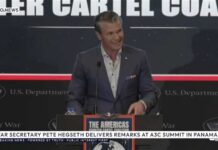
In the days before the summit, defense ministers and security chiefs from across the region met in Florida to design tougher joint operations against drug cartels and transnational crime groups that feed America’s fentanyl crisis and fuel chaos at the southern border. Defense Secretary Pete Hegseth criticized years of “benign neglect” in Latin America, arguing that prior administrations allowed cartels to metastasize and China to entrench itself through port deals, loans, and Belt and Road projects that put critical chokepoints like the Panama Canal within Beijing’s economic shadow.
Panama has already faced intense U.S. pressure to pull out of China’s Belt and Road Initiative and to reconsider long-term port concessions granted to a Hong Kong–based firm, a signal that Washington now views strategic infrastructure in the Americas as non‑negotiable. At the same time, Trump recently authorized a covert operation to capture Venezuelan strongman Nicolás Maduro and his wife on drug conspiracy charges, disrupting oil exports that had tied Caracas closely to China. Critics paint this as imperial overreach, but many conservatives see it as overdue accountability for a regime that flooded the region with corruption, refugees, and narco‑networks.
A Conservative Coalition Without the Region’s Biggest Players
The “Shield of the Americas” format emerged only after the planned 10th Summit of the Americas collapsed amid bitter arguments over excluding Cuba, Nicaragua, and Venezuela and uncertainty about Trump’s attendance. Left‑leaning governments in Mexico and Colombia threatened to boycott, and Dominican Republic officials postponed the gathering citing “deep differences.” In response, Trump’s team pivoted to a new model: invite like‑minded partners willing to stand with Washington on security, migration, and China, and leave skeptical governments on the sidelines.
The result is a coalition heavy on mid-size and smaller states but missing three of the region’s biggest players: Brazil, Mexico, and Colombia. Their absence underscores how fragmented the hemisphere has become after years of socialist experiments, cartel entrenchment, and Chinese checkbook diplomacy. For American conservatives, the upside is clear: instead of watering down commitments to placate hostile regimes, the United States is working with governments ready to tighten borders, target gangs, and rethink their exposure to Beijing, even if it means a smaller, more ideologically coherent bloc at the start.
Kristi Noem’s New Role and What Comes Next
To give the initiative staying power, Trump has tapped former Homeland Security Secretary Kristi Noem as special envoy for Shield of the Americas, charging her with coordinating policy across the hemisphere and negotiating what the White House calls a “big agreement” on counter‑cartel operations. Early outlines point toward expanded intelligence sharing, joint task forces, and new mechanisms for tracking weapons, cash, and chemicals that move through the region’s porous borders and ports before ending up in American communities.
Full details of that agreement have not yet been released, and some coverage warns about renewed U.S. interventionism or potential overreach in the name of security. For readers worried about constitutional limits and misuse of power, the tension is real: Washington must crush cartels and secure borders without empowering unaccountable agencies to spy on citizens or trample due process. As Trump’s coalition in Miami takes shape, conservatives will have to push hard to ensure that defending the hemisphere does not become an excuse for expanding the very kinds of government abuse they fought under previous administrations.
Sources:
Trump looks to turn attention to Western Hemisphere, at least for a moment, at Americas summit
Trump to host ‘Shield of the Americas’ summit in Miami
Trump’s regional allies to gather in Miami for ‘Shield of the Americas’ summit