

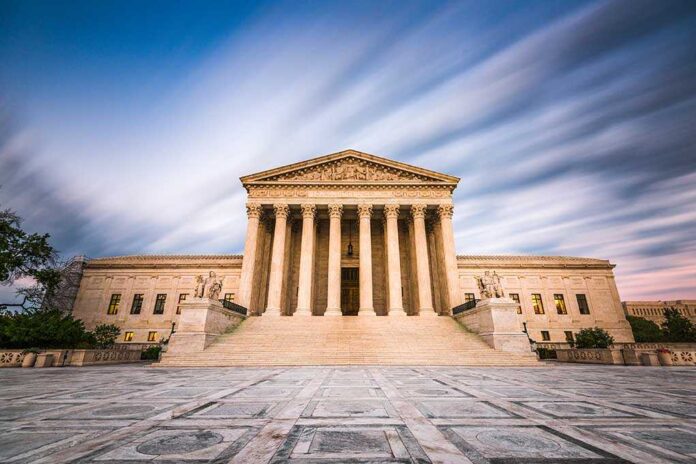
Supreme Court grants illegal immigrants extra time to appeal deportation orders when deadlines fall on weekends, making it easier for them to remain in the country despite breaking our laws.
At a Glance
- The Supreme Court ruled 5-4 that deportation appeal deadlines extend to the next business day if they fall on weekends or holidays
- Justice Neil Gorsuch wrote the majority opinion, joined by Chief Justice Roberts and the Court’s three liberal justices
- Conservative Justices Thomas, Alito, Kavanaugh, and Barrett dissented, arguing deadlines should remain firm
- The case involved Mexican citizen Hugo Monsalvo Velazquez, who filed his appeal two days after the deadline because it fell on a weekend
- Justice Alito argued there was “no reason” the illegal immigrant couldn’t have left on time, noting “the roads to Mexico were open”
Another Procedural Loophole for Illegal Immigrants
In a ruling that further complicates America’s immigration enforcement, the Supreme Court has created yet another avenue for illegal immigrants to extend their stay in the United States. The 5-4 decision in Monsalvo Velazquez v. Bondi determined that deadlines for appeals in deportation cases automatically extend to the next business day if they fall on weekends or holidays. This seemingly technical adjustment effectively gives illegal immigrants additional time to challenge deportation orders even after agreeing to voluntary departure.
“Here, as elsewhere, the term ‘days’ operates to extend a deadline that falls on a weekend or legal holiday to the next business day,” wrote Justice Neil Gorsuch in the majority opinion.
The Case that Created the Loophole
The ruling stems from the case of Hugo Abisai Monsalvo Velazquez, a Mexican citizen who entered the United States illegally in 2004 and faced removal proceedings starting in 2011. After seeking relief under the U.N. Convention Against Torture, Monsalvo was granted voluntary departure by an immigration court, which gave him 60 days to leave the country on his own terms. When that deadline fell on a weekend, he didn’t depart and instead filed a challenge on day 62 – after the deadline had passed.
The Board of Immigration Appeals and the U.S. Court of Appeals for the 10th Circuit both ruled against Monsalvo, finding that he had missed the deadline. However, in a surprising turn, the Supreme Court reversed these decisions, siding with the illegal immigrant and creating a new precedent that will affect countless future cases. The Court’s ruling effectively aligns with the more lenient approach taken by the Ninth Circuit, notorious for its immigration-friendly stance.
Conservative Justices Dissent
The Court’s conservative bloc – Justices Thomas, Alito, Kavanaugh, and Barrett – issued a strong dissent against the majority opinion. Justice Alito, in particular, delivered a blistering rebuke of the decision’s practical implications. He pointed out that the deadline extension makes little sense in the context of physical departure from the country, which can occur on any day of the week.
“Saturday is a day of the week, and there is no reason why petitioner could not have left the country on or before that date,” wrote Justice Samuel A. Alito Jr. in his dissent.
Alito further dismantled the majority’s reasoning with practical observations about travel options. “Petitioner gives us no reason to believe — and I am aware of none — that the roads to Mexico, his home country, were closed; so he could have driven or taken a bus across the border. He also could have flown to Mexico or any other country that would admit him,” Justice Alito noted.
Implications for Border Security
This ruling arrives at a time when America’s immigration system is already strained beyond capacity. By creating yet another procedural loophole, the Court has potentially offered thousands of illegal immigrants an additional pathway to remain in the country longer. The decision effectively weakens the voluntary departure system, which was designed to be a more lenient alternative to formal removal. Under voluntary departure, illegal immigrants face fewer barriers to legal reentry in the future compared to those who undergo formal deportation.
The dissenters also raised serious jurisdictional concerns, arguing that courts should not even have authority to hear such procedural challenges. Justice Gorsuch countered that the dissenting position would force illegal immigrants to file frivolous challenges simply to contest procedural issues. This reasoning, however, overlooks the fundamental question of whether those who have violated U.S. immigration laws should be granted additional procedural protections and extensions in the first place.