What if the government shutdown you dreaded was actually a launchpad for the most dramatic shift in federal priorities in a generation?
Quick Take
- President Trump frames the 2025 government shutdown as a strategic opportunity for sweeping spending cuts.
- OMB directs agencies to consider layoffs in non-priority programs, a move unprecedented in past shutdowns.
- Partisan standoff over health subsidies and foreign aid stalls negotiations, with no resolution in sight.
- Federal employees and vulnerable recipients of social programs face immediate disruptions and uncertainty.
Shutdown as Strategy: Trump’s Unconventional Playbook
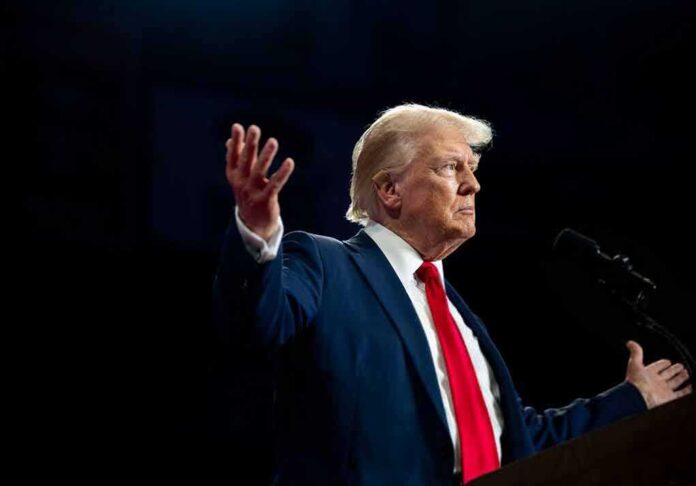
President Trump’s approach to the federal government shutdown flips the usual narrative on its head. Instead of casting the lapse in funding as a looming disaster, the administration publicly touts the impasse as an “unprecedented opportunity” to force the kinds of budget cuts conservatives have championed for decades. By leveraging the shutdown, Trump seeks to sidestep the gridlock that has historically stymied deep spending reductions, transforming bureaucratic inertia into a weapon aimed at programs outside his administration’s priorities. The Office of Management and Budget’s directive to federal agencies: prepare for targeted layoffs, not just furloughs, in areas deemed non-essential. This signals a willingness to let the shutdown drag on if it means entrenching a new fiscal order.
The shutdown’s strategic lens is reflected in the president’s public communications. Trump doubles down on partisan rhetoric, using social media to lampoon Democratic leaders and reframe the standoff as a clash of values rather than a governance failure. His administration’s messaging leaves little doubt: this is not about reopening the government as quickly as possible, but about exploiting the moment to realign the federal budget with conservative principles.
How Did We Get Here? The Anatomy of a Political Impasse
The current shutdown did not emerge from a vacuum. It is the culmination of weeks of partisan brinkmanship, with competing visions for America’s future driving both sides further apart. The Republican-led House pushed through a continuing resolution designed to cap spending and curtail health insurance subsidies, while the Democratic-controlled Senate rejected both Republican and Democratic funding bills, leaving no clear path to a compromise. The September 24 OMB memo, which ordered agencies to brace for layoffs in programs “not aligned with administration priorities,” represented a substantial escalation in tactics. When Senate votes failed to break the deadlock on September 30, the stage was set for a high-stakes standoff.
This political theater is imbued with echoes of past shutdowns—particularly the record-setting 35-day closure of 2018–2019, also under President Trump. Yet, the difference now is in both the rhetoric and the intent. Previous shutdowns, even the longest, were framed as crises to be resolved; today, the shutdown is openly wielded as leverage to force through a conservative fiscal agenda.
Who Pays the Price? Immediate and Lasting Fallout
As the shutdown grinds on, the human and economic toll mounts. Nearly 900,000 federal workers are furloughed, with another 700,000 reporting to work without pay. Essential services limp along, but non-essential programs—those not shielded by administration priorities—face layoffs and indefinite suspension. Recipients of WIC, NIH research, and CDC public health programs encounter abrupt disruptions. Businesses and contractors tied to federal operations watch revenue streams dry up. For the general public, the shutdown brings reduced access to everything from national parks to passport services, amplifying frustration and uncertainty.
The longer-term implications are even more profound. Should the administration succeed in reshaping spending priorities, the precedent for using shutdowns as policy weapons could become entrenched. Trust in government institutions erodes further with each day of closure, and the polarization driving the standoff shows no signs of abating. The lesson for future administrations and Congress may be that the tools of dysfunction—shutdowns, layoffs, executive directives—can be normalized and strategically deployed for political gain.
Expert Perspectives: Is This Fiscal Discipline or Governance by Crisis?
Legal and policy experts view the OMB’s aggressive layoff guidance as a clear signal of the administration’s intent to use the shutdown for more than short-term bargaining. Budget analysts warn that the battle over health insurance subsidies carries significant costs and risks for both coverage and federal finances. Political scientists and historians alike note that reframing a shutdown as an “opportunity” for reform marks a stark departure from traditional crisis management, raising alarms about the normalization of governing by manufactured emergencies.
Supporters of the administration argue that the hard line is necessary to break the cycle of unchecked spending and force needed fiscal discipline. Critics counter that the human and economic damage wrought by shutdowns far outweighs any potential budgetary gains—and that the burden falls disproportionately on the most vulnerable. The only consensus among neutral observers is that structural reforms are desperately needed to prevent future governance by crisis, and that the stakes of the current standoff extend well beyond the immediate headlines.
Sources:
Wikipedia: 2025 United States federal government shutdown
Holland & Knight: Government Shutdown Advisory
SRCD: US Government Shutdown 2025 – General Information and Resources for SRCD Members