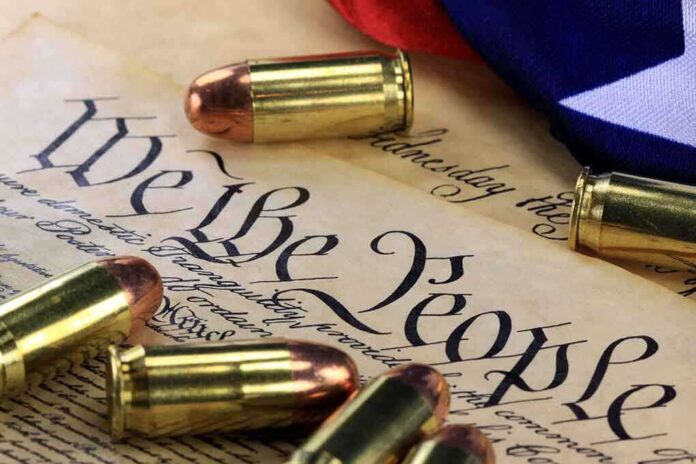
The U.S. Supreme Court is poised to decide whether millions of Americans who use marijuana—legally under state law but still federally prohibited—can legally own guns, forcing the justices to untangle a modern legal knot that pits constitutional rights against public safety concerns.
Story Snapshot
- The Supreme Court will review whether the federal ban on gun ownership for marijuana users violates the Second Amendment, especially in states where cannabis is legal.
- The case, United States v. Hemani, involves a defendant found with marijuana, cocaine, and a firearm, adding complexity to the legal and political debate.
- Lower courts are deeply divided on this issue, with some striking down the ban and others upholding it, creating a patchwork of conflicting rulings.
- The Court’s decision could redefine gun rights for cannabis users nationwide and set precedent for how other federal drug prohibitions are interpreted.
- The outcome may intensify political and social debates over marijuana legalization, gun rights, and the limits of federal power.
How We Got Here: The Legal and Cultural Collision
Ali Danial Hemani’s case began in 2022, when FBI agents found a firearm, marijuana, and cocaine in his home, leading to charges under a 1968 federal law that bars “unlawful users” of controlled substances from owning guns. Hemani challenged the law’s constitutionality, and in 2023, a Texas district judge dismissed the charge, citing a Fifth Circuit precedent. The Fifth Circuit upheld that dismissal in 2024, setting the stage for Supreme Court review. The Court agreed in October 2025 to hear the case in its next term, a move that could resolve years of legal uncertainty for cannabis users and gun owners.
The Constitutional Puzzle: Second Amendment Meets the War on Drugs
At the heart of United States v. Hemani is whether federal restrictions on gun ownership for drug users—specifically marijuana users in states where it is legal—can survive strict scrutiny under the Supreme Court’s recent Second Amendment jurisprudence. The Court’s 2022 Bruen decision requires gun laws to be consistent with the nation’s historical tradition of firearm regulation, a standard that has already upended several modern gun restrictions. The Department of Justice argues that the ban is justified by public safety concerns, but critics counter that the law is outdated, especially as marijuana legalization spreads and societal attitudes shift.
Lower courts are split. The Fifth Circuit invalidated a conviction under the statute because the jury did not find the defendant was “presently or even recently engaged in unlawful drug use.” The Tenth and Eleventh Circuits have recently sided with defendants in similar cases, while other courts continue to uphold the federal prohibition. This judicial divide underscores the high stakes of the Supreme Court’s upcoming decision.
Key Players and Power Dynamics
Ali Danial Hemani is the named defendant, but the real players are the federal government, gun rights organizations, and marijuana advocacy groups. The Department of Justice is determined to maintain the prohibition, citing the risks of mixing drugs and firearms. Gun rights advocates see an opportunity to expand Second Amendment protections, while cannabis advocates seek to align federal law with state-level reforms. The nine Supreme Court justices will ultimately decide whether the federal ban stands or falls, with their ruling binding on all lower courts and shaping national policy.
The National Impact: Rights, Safety, and Federalism
A Supreme Court decision striking down the federal prohibition could immediately affect millions of Americans who use cannabis legally under state law but are currently barred from gun ownership. Law enforcement would face new challenges in reconciling state and federal standards, and the firearms and cannabis industries could see ripple effects. Socially, the case raises fundamental questions about civil liberties, public safety, and the role of the federal government in an era of shifting drug policies. Politically, the ruling may fuel debates over federal cannabis reform and the scope of gun rights, with implications for employment, housing, and other civil rights for cannabis users.
Some legal scholars argue that the federal prohibition is increasingly out of step with both constitutional principles and modern social norms. Public health experts acknowledge the lack of clear evidence that non-intoxicated cannabis users pose a unique danger, but law enforcement and public safety advocates remain wary. The case’s outcome could set a precedent for how other federal prohibitions based on drug use are interpreted, affecting not just gun ownership but broader questions of civil rights and federal power.
What’s Next: A Nation Waits for Clarity
Oral arguments before the Supreme Court are expected in the 2025-26 term, with a decision likely by June 2026. The justices will weigh historical tradition, public safety, and individual rights in a case that could reshape the legal landscape for gun owners and cannabis users alike. For now, Americans who use marijuana—even in states where it is legal—remain in legal limbo, caught between conflicting laws and uncertain futures.