
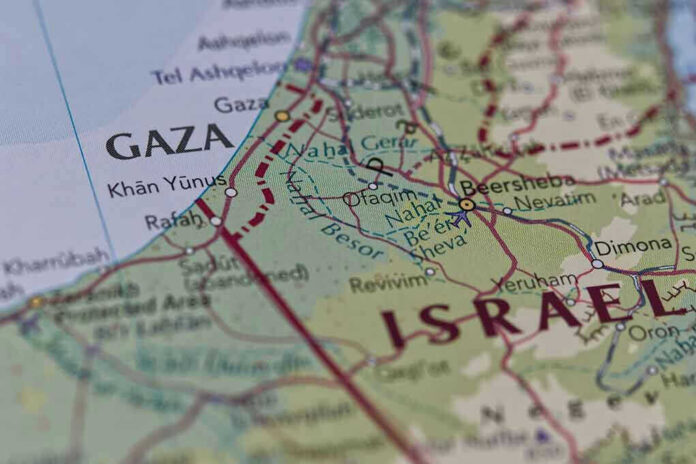
In Gaza, one deadly incident instantly reignited a chain of violence that ripped through the region, forcing a fragile ceasefire into play and leaving the world asking: can this cycle ever end?
Story Highlights
- Israel launched immediate retaliatory strikes after two soldiers were killed by Hamas in Gaza.
- The escalation led to heavy civilian casualties and intensified humanitarian crisis.
- Global pressure mounted for restraint, culminating in a rapid ceasefire agreement.
- This event exemplifies the endless cycle of retaliation and ceasefire breakdowns in the Gaza conflict.
Israel’s Retaliatory Strikes: A Familiar Pattern Returns
On an October morning in 2025, the Israel Defense Forces (IDF) faced a grim report: two soldiers had been killed by Hamas militants in Gaza. Within hours, Israel unleashed a barrage of airstrikes targeting Hamas positions throughout the war-torn enclave. This swift response was not unprecedented; it followed a well-worn blueprint seen throughout the Gaza–Israel conflict, where military action and counteraction blur into a continuous cycle. Civilians found themselves caught in the middle, as the strikes struck not only alleged militant sites but also densely populated neighborhoods, amplifying the toll on ordinary families.
Retaliatory operations like these serve both strategic and symbolic functions for Israel. Militarily, they aim to degrade Hamas’s capacity to orchestrate attacks, yet they also send a clear message of deterrence to adversaries and reassurance to the Israeli public. Historically, such actions have triggered international condemnation and appeals for restraint—yet the underlying dynamics rarely change. Every escalation deepens the humanitarian crisis, with Gaza’s hospitals, shelters, and basic infrastructure buckling under the strain.
The Humanitarian Fallout: Gaza’s Endurance Tested
Gaza’s population has lived through recurrent bombardments, but the aftermath of this particular round proved especially devastating. Reports from the Gaza Health Ministry indicated a sharp rise in casualties, with dozens killed and many more injured in the immediate aftermath. Residential buildings, schools, and clinics were damaged or destroyed, compounding an already catastrophic situation for the region’s 2 million residents. Aid organizations scrambled to provide relief, but the destruction of roads and power outages hampered their efforts. Scenes of chaos and grief unfolded in the streets and hospital corridors, underscoring the human cost behind the headlines.
The humanitarian situation in Gaza has deteriorated steadily since the start of the latest war in 2023, with over 67,000 Palestinians and 1,700 Israelis reported killed by October 2025. The loss is not measured solely in numbers; it is etched into the daily existence of survivors, many of whom have been displaced multiple times. For Palestinian civilians, each escalation means renewed displacement, loss of livelihoods, and a relentless battle for survival. For Israelis living near Gaza, the sense of vulnerability and trauma persists, reinforcing a climate of fear and uncertainty on both sides of the border.
Ceasefire: Hope on Shaky Ground
International actors wasted no time in responding to the crisis. Diplomats from the United States, Egypt, and Qatar convened emergency talks, pressing both Israel and Hamas to halt the violence and allow humanitarian aid to flow. Their efforts culminated in a new ceasefire agreement, ratified by the Israeli cabinet on October 9 and implemented the next day. The truce provided a temporary reprieve, enabling relief agencies to reach some of the hardest-hit areas and families to emerge from shelters.
Yet, the ceasefire’s foundation remained tenuous. Previous agreements in the Gaza–Israel conflict have often collapsed in the face of fresh provocations or unresolved grievances. Both sides accused each other of violations, and sporadic clashes continued even as the truce held. Analysts and humanitarian experts warned that without bold measures addressing the root causes—territorial disputes, security concerns, and the blockade—such peace would inevitably prove short-lived. The region’s political leaders faced mounting internal and external pressure to find lasting solutions, but mistrust and entrenched positions rendered genuine progress elusive.
Sources:
Timeline of the Gaza war – Wikipedia
Timeline of the Gaza war (3 October 2025 – present) – Wikipedia
The Gaza Crisis timeline: key events – British Red Cross
Israeli-Palestinian Conflict Timeline | CFR Education