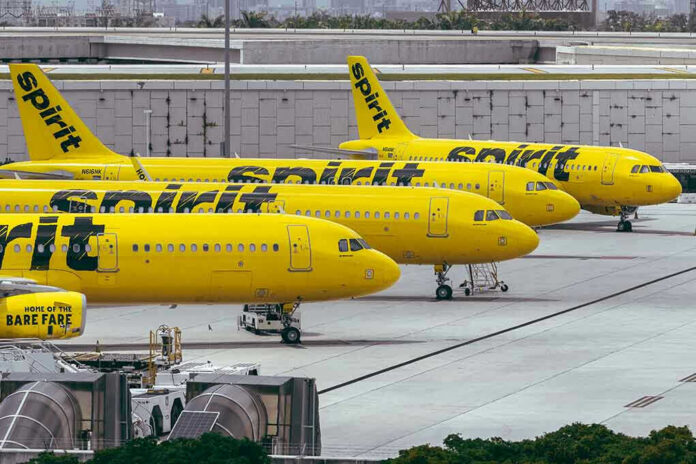
A shutdown that started with stranded passengers and canceled flights is quickly turning into something bigger: a quiet reshaping of America’s airfares, with fewer low-cost options and more pricing power for the big airlines.
Story Snapshot
- Spirit’s collapse removes a major ultra-low-cost player, historically one of the few checks on rising fares in many leisure markets.
- Early data show average fares on routes Spirit exited jumping more than 20 percent while passenger volume falls.
- Big carriers and some budget rivals are stepping in with capped or discounted fares, but many offers are temporary.
- Smaller and mid-size airports risk losing affordable service and even daily flights, squeezing working- and middle-class travelers.
Spirit’s Fall And What It Says About Washington And Competition
Spirit Airlines spent years struggling under heavy debt, shifting travel demand after the pandemic, and fierce competition from larger legacy carriers before finally shutting down and entering liquidation in early May after 34 years in the sky. Analysts point to high fuel prices and failed merger attempts as part of the downward spiral, including the blocked deal with JetBlue that might have given Spirit more scale to survive. For many conservative travelers, that history reinforces a familiar concern: when bureaucrats and courts micromanage the market, they often end up hurting the very consumers they claim to protect. A merger that could have preserved at least some of Spirit’s ultra-low-cost discipline was stopped in the name of competition, only for the stand‑alone carrier to disappear entirely, reducing competition instead.
The shutdown has immediate, concrete consequences for families trying to stretch a paycheck. A CBS News analysis using Cirium data found that on routes Spirit exited, average fares rose roughly 23 percent—about sixty dollars more for a typical round trip—while passenger volume fell around 20 percent as price-sensitive travelers were priced out.[1] Aviation experts note this follows a well-known pattern: when a low-fare carrier disappears and replacement capacity does not arrive quickly, remaining airlines face less pressure to keep prices low, especially on leisure-heavy routes where people have fewer alternatives.[1] That kind of hit is not just an annoyance; it is a real tax on working- and middle-class families who already feel squeezed by years of inflation and high energy costs.
How Other Airlines And The Trump Administration Responded
Within hours of the last Spirit flights touching down, thousands of passengers were left stranded or scrambling to salvage their trips.[1][2] Video from airports showed darkened Spirit counters and long lines of confused travelers looking for answers.[2] The Trump administration’s Department of Transportation, led by Transportation Secretary Sean P. Duffy, moved quickly to coordinate with other carriers to prevent a full-blown travel crisis.[2] The Department of Transportation announced that major airlines including American, United, Delta, JetBlue, Southwest, Allegiant, Frontier, Avelo, and Breeze agreed to specific measures aimed at capping prices, offering reduced fares, and ensuring people were not gouged simply because their original airline vanished overnight.[2]
United, Delta, JetBlue, and Southwest agreed to cap ticket prices for Spirit customers who needed to rebook canceled flights, with windows ranging from seventy-two hours to two weeks and requiring proof of a Spirit confirmation.[2] American Airlines and Delta Air Lines offered reduced fares on high-volume Spirit routes, while Allegiant committed to freezing prices on overlapping routes and Frontier offered up to fifty percent off base fares network-wide for a limited time.[2] These steps, encouraged and organized by the Trump Department of Transportation, show how a pro-consumer, pro-market administration can use coordination rather than heavy-handed mandates to protect travelers. At the same time, most of these offers are temporary promotions, not permanent guarantees that fares will stay low once the headlines fade.[1][2]
Winners, Losers, And The Uneven Future Of Budget Air Travel
Across the country, the fallout is uneven, and that matters for conservatives who care about both free markets and fair access. Analysts note that the impact of Spirit’s shutdown is highly route-specific: some airports are already seeing interest from other budget-friendly carriers like Frontier, JetBlue, Breeze, Southwest, and Allegiant, which together account for roughly thirty-five percent of the lower-fare segment and are signaling plans to expand into former Spirit markets.[3] In these places, competition could remain relatively healthy as different low-cost carriers fight for the same leisure traveler. Other communities, especially smaller cities that relied on Spirit for affordable nonstop flights, may not be so fortunate and could lose daily service altogether.[1][3]
Spirit Airlines shutdown reshapes US aviation and fares https://t.co/rZHAssXgg7
— USA TODAY Travel (@usatodaytravel) June 3, 2026
Early polling suggests most Americans expect their travel habits to continue largely unchanged, with seventy-two percent saying Spirit’s closure will not affect how often they fly.[4] Yet that same research shows Spirit’s former customers are already eyeing other low-cost carriers: nearly half say they would consider JetBlue, around forty-four percent say Frontier, and about twenty-seven percent say Allegiant, all far above those airlines’ national averages.[4] That shift hints at where market power may flow next. If a handful of large carriers and a few surviving discounters inherit Spirit’s routes without strong ongoing competition, they will gain even more leverage over prices and service levels. For conservatives, the lesson is clear: real competition—not government price controls, not sprawling regulation—is what keeps fares affordable and options open. When a disruptive low-cost player disappears, Washington’s job is to clear the runway for others to compete, not to smother them with red tape or block every merger on ideological grounds.
Sources:
[1] YouTube – Spirit Airlines shutdown reshapes US aviation and fares
[2] Web – What does Spirit Airlines’ shutdown mean for travelers?
[3] YouTube – Spirit Airlines’ abrupt closure strands thousands of travelers
[4] Web – Abrupt shutdown of Spirit Airlines leaves travelers wondering …
© patriotsunited.org 2026. All rights reserved.