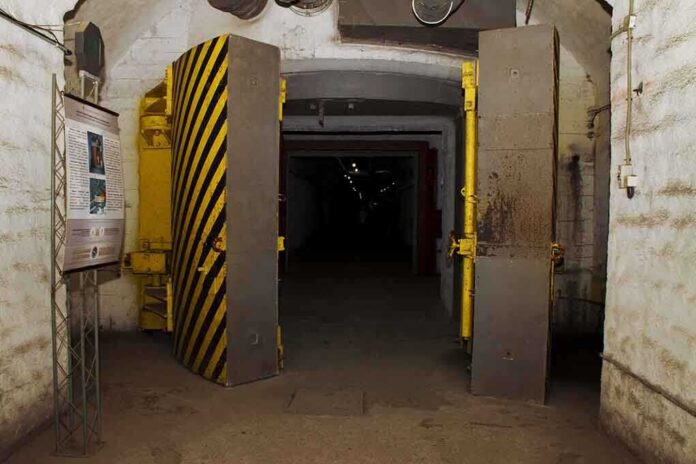
Iran’s rapid reopening of dozens of underground missile tunnels after U.S.–Israeli strikes is forcing Washington to confront a hard truth: airpower alone is not breaking Tehran’s long‑built war machine.[1][3][6]
Story Snapshot
- Satellite imagery shows Iran has already reopened most damaged entrances to its underground missile tunnels, far faster than U.S. intelligence expected.[1][3][6]
- Reports indicate roughly 50 of 69 targeted tunnel entrances at 18 missile complexes are back in use, with access restored to about 90% of the network.[1][2][3]
- Iran’s deeply buried “missile cities” were designed to survive airstrikes, meaning the core arsenal likely remained intact even as entrances were hit.[3][5][6]
- For American conservatives, the episode is a wake‑up call on the limits of bombing campaigns, the resilience of the Iranian regime, and the need for tougher long‑term strategy.[1][3][6]
What New Satellite Images Reveal About Iran’s Missile Tunnels
Commercial satellite images reviewed by analysts for CNN and cited by several outlets show that Iran has rapidly cleared debris and reopened access to many of the underground missile facilities struck by the United States and Israel.[1][3][4][6] According to these assessments, Iranian crews using bulldozers, trucks, and other basic construction equipment have restored operational access to 50 of 69 tunnel entrances at 18 underground missile complexes targeted during the recent conflict.[1][3][4] This visible activity indicates that movement into and out of these hardened sites has resumed.[2][6]
At specific locations such as the underground missile facility at Abyek, satellite imagery reportedly shows four of five tunnel entrances fully cleared and the fifth partially reopened, suggesting deliberate efforts to restore traffic through all access points.[2] Video explainers summarizing intelligence estimates state that Iran has now regained access to roughly 90% of its underground missile storage and launch network, underscoring how quickly the regime can get back on its feet after airstrikes.[2][4] U.S. intelligence sources cited in the reporting say Iran has “exceeded all timelines” for reconstituting these sites.[1][4]
Why Iran’s Underground “Missile Cities” Are So Hard to Cripple
Analysts note that Iran’s underground missile infrastructure was built from the beginning for survivability, with deeply buried tunnels carved into mountains and reinforced structures designed to withstand conventional airpower.[3][5][6] Reports describe these complexes as long‑standing “missile cities” meant to protect launchers, stockpiles, and command nodes from outside attack while allowing Tehran to threaten U.S. forces, Israel, and regional allies.[5][6] Because the most sensitive components sit far underground, airstrikes have primarily damaged entrances, access roads, and surface‑level infrastructure.[1][3][6]
Experts quoted in the coverage emphasize that sealing entrances can delay operations but does not necessarily destroy the missiles or launch systems stored deeper in the tunnels.[1][3][6] One nonproliferation researcher noted that Iran could continue to fire missiles as long as it retains functioning launchers, crews, and existing stockpiles, even if production lines have been slowed.[3][6] That assessment aligns with U.S. briefings reported elsewhere, which say Iran still retains an ability to launch attacks despite thousands of targets being struck over several weeks of conflict.[6] For Americans worried about national security, this highlights how a hostile regime can ride out even massive bombardment.
Strategic Lessons for Washington, Jerusalem, and U.S. Conservatives
Reports that Iran restored access to most targeted tunnels within days or weeks, and in some cases possibly within hours, raise serious questions about the long‑term impact of strike‑only strategies.[1][4][6] Intelligence officials cited in news segments admit that the pace of reconstruction surprised them, suggesting earlier recovery timelines underestimated how quickly Iran could mobilize engineers and heavy equipment under fire.[1][4] Satellite images during a cease‑fire reportedly showed trucks and excavators working at sites near Khomeyn, Tabriz, and other locations to clear rubble and reopen blocked entrances.[6]
After the restoration of the internet in Iran, new footage has emerged of the entrance routes to those tunnels, which were targeted in the US/Israel attack and said to have concealed missile launching pads. pic.twitter.com/5YfvCoN84p
— Iran Updates🚨 (@IranUpdatesNow) June 5, 2026
For conservative Americans who favor peace through strength, these developments reinforce several hard truths drawn from the available reporting.[1][3][6] First, Tehran’s underground missile network remains a serious, resilient threat that cannot be wished away with one round of strikes. Second, relying heavily on air campaigns without sustained pressure, economic leverage, and defensive upgrades leaves U.S. forces, Israel, and regional partners exposed to a regime that has invested for decades in survivable missile power.[3][5][6] Third, meaningful security requires honest assessments, not optimistic talking points, about how much damage airstrikes truly inflict on hardened enemies.
Sources:
[1] Web – Watch: More Evidence Iran Is Rapidly Restoring Its Missile Tunnels
[2] Web – Iran’s Restored Entry to 18 Missile Sites ‘Exceeded All Timelines’ for …
[3] YouTube – Iran Restores 90% of Underground Missile Network …
[4] YouTube – Iran BREAKING: IRGC Unlocks 50+ Underground Missiles Tunnels
[5] Web – Satellite Images Show Iran Reopening Access to Missile Tunnels
[6] Web – Satellite images reveal Iran restoring its ‘missile cities’ – Israel …
© patriotsunited.org 2026. All rights reserved.