Iran’s top propaganda general was killed in Tehran just hours after bragging that the regime’s missile machine was still running “perfect,” underscoring how fast this war is stripping the IRGC of both leadership and narrative control.
Story Snapshot
- Iran’s Islamic Revolutionary Guard Corps confirmed its spokesman, Brig. Gen. Ali Mohammad Naeini, was killed in pre-dawn airstrikes in Tehran on March 20, 2026.
- Reports also say Basij intelligence chief Gen. Esmail Ahmadi died in the same strikes, part of a broader campaign targeting Iran’s senior security leadership.
- Naeini had publicly insisted Iran’s missile production remained strong and mocked U.S.-Israeli claims that key military output had been crippled.
- The conflict, now around its third week, is rippling through global energy markets after attacks near Gulf oil infrastructure pushed Brent crude to roughly $119 per barrel.
Tehran Strike Hits the Regime’s Message Machine
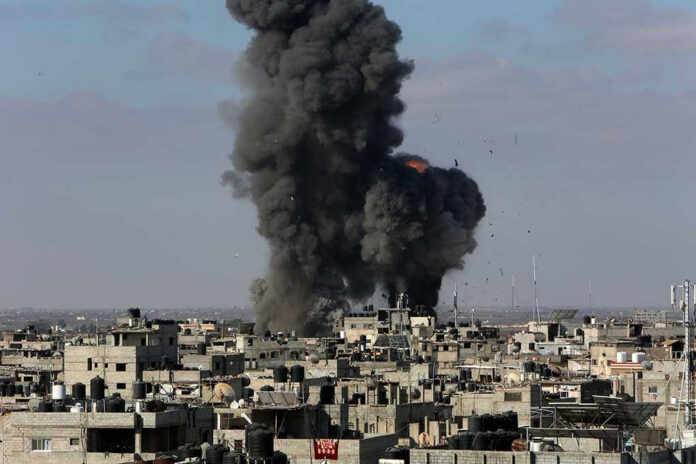
Iranian state-linked outlets and the IRGC reported that spokesperson Brig. Gen. Ali Mohammad Naeini was killed in early Friday airstrikes in Tehran. Accounts differ on attribution—some describe the operation as Israeli, while others frame it as Israeli-American—but multiple reports align on the core fact: Naeini died in the pre-dawn attack. The same reporting also indicates Basij intelligence chief Gen. Esmail Ahmadi was killed, widening the blow to Iran’s internal security apparatus.
Report: IRGC General Ali Mohammad Naeini and Other High-Ranking Officials Killed in Airstrikes
https://t.co/lqpE7p6qM5— Townhall Updates (@TownhallUpdates) March 20, 2026
Naeini’s death drew attention because it followed, by only hours, his own messaging campaign. Iranian outlets carried his claim that Iran’s missile industry continued functioning under wartime pressure and scored “perfect,” while he dismissed assertions by Israeli Prime Minister Benjamin Netanyahu and President Trump that Iran’s production capacity had been seriously degraded. Those claims are difficult to independently verify in real time, but the timing highlights a key wartime reality: propaganda and battlefield outcomes collide quickly when leadership is being targeted.
Who Naeini Was, and Why His Role Mattered
Reporting describes Naeini as more than a uniformed spokesman. He was portrayed as a specialist in psychological operations and “soft power,” tied to what Iranian messaging calls cognitive or information warfare. His career path also ran through the Basij and IRGC cultural roles before he was appointed spokesman in 2024 by IRGC commander Hossein Salami. If those profiles are accurate, his removal is not just a personnel loss; it interrupts an institutional pipeline responsible for shaping public morale and regime legitimacy.
Iran’s leadership has historically leaned on the IRGC and Basij not only to project power abroad, but to control narratives at home—especially during periods of unrest. Other recent casualties reported in Tehran include senior officials linked to national security and internal repression. Israeli accounts framed at least one of those strikes as a response to terrorism and internal crackdowns. The combined pattern suggests the campaign is attempting to degrade both operational command and the security state’s ability to intimidate, persuade, and mobilize public support.
War After Khamenei: Decapitation Strikes and a Succession Vacuum
Multiple reports place the current war’s ignition after Ayatollah Ali Khamenei’s death on February 28, 2026, a milestone that created uncertainty inside Iran’s governing system. As the conflict reached roughly day 21 by March 20, a series of targeted killings was reported in quick succession, including figures described as senior security or political leaders. The result is a compounding pressure on Tehran’s decision-making structure at the same moment the regime is expected to manage succession politics and war planning.
For Americans watching from home, one key question is strategic clarity: how limited—or how expansive—U.S. involvement is meant to be. Some reporting notes President Trump distancing the U.S. from specific strikes such as an attack on the South Pars gas field, even while other accounts describe joint Israeli-American operations. That uncertainty matters because it affects deterrence, escalation risks, and the credibility of official messaging. On the facts available, attribution remains contested even as Iran confirms the deaths.
Energy Shockwaves and the Gulf Oil Target Problem
Reports from the region also describe retaliatory activity affecting Gulf oil infrastructure, including an attack that sparked fires and disruptions at Kuwait’s Mina al-Ahmadi refinery. At the same time, Israeli defenses reportedly intercepted Iranian strikes aimed toward central Israel. Energy markets reacted sharply, with Brent crude reported around $119 per barrel, reflecting how quickly a regional conflict can punish household budgets worldwide. For U.S. families still remembering the inflationary squeeze of recent years, price shocks tied to overseas instability remain a real concern.
Iran’s IRGC publicly insisted its operations would continue despite the killings, a standard posture designed to signal resilience. Still, losing multiple senior figures in a short window can strain command continuity and weaken the regime’s ability to coordinate complex responses, especially in the information space where Naeini reportedly operated. What cannot be concluded from the available reporting is the true state of Iran’s missile production or the full extent of damage to nuclear and military infrastructure. Those claims remain contested.
Sources:
IRGC confirms its spokesman General Ali Mohammad Naeini killed in Israeli-American missile attack
Iran airstrike kills IRGC spokesperson Ali Mohammad Naini; missile attacks hit Kuwait refinery
Quicksplained: Who was Ali Mohammad Naini, the IRGC spokesperson killed in airstrikes?
IRGC spokesperson Mohd Naeini killed in US-Israeli attacks: Iranian state media
Iran: IRGC spokesperson killed in Israeli strike
Iran International liveblog (March 2026 updates)