
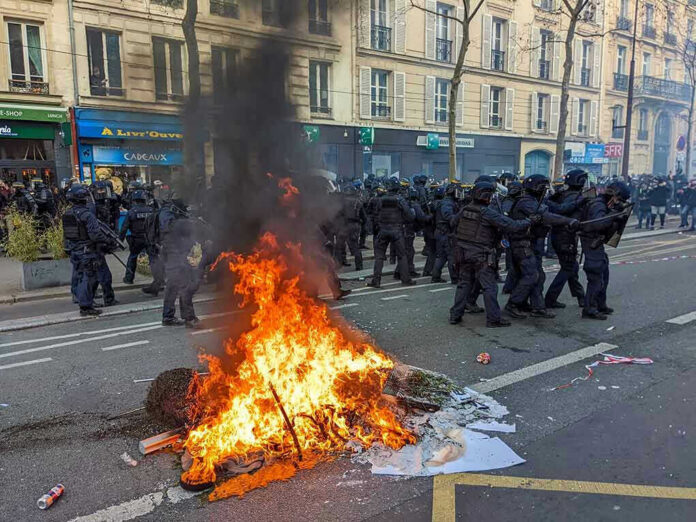
Riots have burned 24 schools, injured more than 700 police officers, and led to 7,000 arrests across France, while a reality-TV personality’s claim that “Communislam” is behind the chaos spreads online faster than fact-checkers can keep up.
Story Snapshot
- Violence spread to 40 French cities, with schools closed and police officers hurt, according to Washington Examiner reporting.
- Spencer Pratt coined “Communislam,” claiming a communist-Islamist alliance wants to destroy Western civilization.
- Unrest also hit Italy, Belgium, Greece, Ireland, and Austria, per multiple accounts.
- CNBC and other outlets trace the unrest to teacher shortages, high living costs, and youth unemployment, not an organized alliance.
- No police, court, or government record yet confirms a coordinated command structure behind the violence.
A Viral Label Meets A Real Crisis
Spencer Pratt, best known from reality television, posted on October 17, 2026, warning his “Democrat friends” to stay away from what he called “Communislam.” He wrote that the people behind the riots “are not rioters” but “communists” seeking to “destroy western civilization and kill you.” The post spread quickly, landing in the middle of a real and ongoing crisis across Europe.
The numbers behind the unrest are not in dispute. The Washington Examiner reported that violence hit 40 French cities, with 7,000 people arrested, 891 schools temporarily shut down, more than 700 police officers hurt, over 100 teachers assaulted, and 24 schools burned or vandalized. Those figures describe genuine chaos, whatever label people attach to its cause.
Who’s Actually Involved
The Gatestone Institute reported direct involvement from the political party La France Insoumise, along with labor unions, socialist groups, and the French Communist Party, describing a “red-green” mix of leftist and Muslim-linked advocacy groups. French lawmaker Jean-Luc Mélenchon reportedly blamed the violence on police and racial oppression, while activist Bally Bagayoko said “violence can sometimes be legitimate.” Those statements show political tension, but they do not prove a planned alliance between separate movements.
No document reviewed shows a joint command structure, shared funding, or a written plan tying left-wing groups to Islamist organizers. Reports mention Muslims, migrants, and Islamist actors in different contexts, but none offer arrest data broken down by group or confirmed links between specific organizations and specific attacks. The claim describes overlap, not proof of coordination.
A Different Story Behind The Anger
CNBC reported the unrest actually began last month at high schools in Paris’s working-class northern suburbs, sparked by teacher shortages and run-down buildings. That anger grew into a wider fight over inequality, public spending, and the cost of living. In Italy, CNBC said a march over high living costs in Milan turned into disorder, with police using tear gas to clear a cathedral square.
A separate analysis pointed to youth unemployment near 20 percent in France and Italy, and 25 percent in Spain, as a driving force behind the anger. That piece argued European nations have been running an economic model that younger generations can no longer count on, fueling frustration that boils over into the streets regardless of political labels.
What Research Says About Migration And Violence
Academic studies add useful context here. A peer-reviewed analysis of Europe’s migration crisis found little evidence that migration from Muslim-majority countries led to more terrorist attacks. A review of crime data across countries likewise found no firm link between rising migration and higher crime rates. These findings don’t settle what caused the French and Italian riots, but they show that sweeping claims tying migration to violence often outrun the evidence.
Why This Debate Matters Beyond Labels
Both sides of this story tap into real frustration. People worried about Islamist extremism and political violence see genuine warning signs in burned schools and injured police. People worried about economic inequality see a generation locked out of jobs, housing, and a secure future. No French, Italian, or European Union body has publicly confirmed Pratt’s “Communislam” framing, and the strongest available reporting points more toward economic desperation than an organized plot.
That gap between a catchy label and a messier, harder-to-fix reality is itself worth noting. Voters on the left and right increasingly distrust institutions that seem more focused on talking points than on solving the problems driving people into the streets. Whether the cause is ideology, economics, or some mix of both, the burned schools and injured officers are real, and so is the public’s demand for honest answers instead of slogans.
Sources:
pjmedia.com, alexjoneslive.com, hotair.com, washingtonexaminer.com
© patriotsunited.org 2026. All rights reserved.