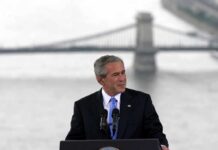
When only a handful of D‑Day veterans are still alive, the simple act of standing for the national anthem has become a quiet referendum on whether we still deserve the freedom they bought in blood.
Story Snapshot
- D-Day’s 82nd anniversary ceremonies in Normandy are explicitly built around honoring the dead and the cause of liberty they fought for.
- Official observances routinely include the United States national anthem alongside wreath-layings, prayers, and moments of silence.
- Linking anthem respect to D-Day resonates with many Americans fed up with a political class that exploits sacrifice while ignoring everyday struggles.
- Both left and right share a growing fear that if we cannot agree on basic rituals of respect, we may already be forgetting what those men died to stop.
D-Day 82: What We Are Really Remembering
On June 6, 1944, roughly 130,000 to 160,000 Allied troops stormed Nazi-occupied France in what historians call the largest amphibious invasion in military history, code-named Operation Overlord.[2][5] American, British, Canadian, and other Allied forces fought through machine-gun fire, mines, and artillery to establish a fragile foothold on the beaches of Normandy.[3][5] By day’s end, thousands were dead, wounded, or missing, with estimates of about 10,000 Allied casualties in the first 24 hours alone.[3][5] Those numbers represent real teenagers, fathers, and brothers whose futures ended that morning.
Modern commemorations underline this cost. The American Battle Monuments Commission, which oversees the Normandy American Cemetery, describes the 82nd anniversary ceremony as a time to “honor and remember the service and sacrifice of U.S. military personnel and their allies who gave their lives during the Allied landings and subsequent operations in World War II.”[4] That cemetery holds about 9,400 American graves, with another 1,600 names of the missing etched into stone.[4] The visual message is unmistakable: freedom is not an abstract slogan; it occupies row after row of white crosses and Stars of David.
Why the Anthem Is Built into These Ceremonies
Across official events, the national anthem is not an afterthought; it is woven into how the country remembers D-Day. The American Battle Monuments Commission’s ceremonies at Normandy include formal remarks, wreath-laying, and participation by U.S. military units, where bands and choruses perform the United States national anthem as part of the program.[3] At other D-Day observances, World War II veterans and guests are documented standing together to sing the anthem upon arrival in Normandy, treating the song as a shared act of respect rather than a partisan symbol.[4][5] These practices show how, in military culture, standing for the anthem functions as a ritualized “thank you” to those who never came home.
Other institutions follow the same pattern. The National D-Day Memorial in Bedford, Virginia, which marks the anniversary with a dedicated ceremony, frames the day as “Remembering Their Valor, Fidelity, and Sacrifice,” emphasizing public participation in honoring the fallen.[1] Normandy tourism authorities describe the anniversary as “another occasion to celebrate peace, liberty, and reconciliation,” highlighting that remembrance is tied to the ideals the Allies fought for, not just the battle itself.[5] When people stand for the anthem on D-Day, they are not only saluting a flag; they are signaling continuity with those values and with the men who died defending them.
A Fractured Country Looking for Shared Ground
For many Americans, especially those over 40 who have watched wages stagnate, costs soar, and Washington grow more detached, D-Day anniversaries sharpen an uncomfortable contrast.[2][4][5] The men who hit Omaha and Utah beaches did so without guarantees, special carveouts, or lobbyists; they trusted that sacrifice meant something.[3][5] Today, by contrast, many on both the right and the left see a political class more focused on reelection, donor interests, and bureaucratic self-preservation than on solving border chaos, unsustainable debt, or the widening wealth gap. That disconnect feeds the feeling that the “deep state” and entrenched elites trade on patriotic imagery while undermining the conditions that once made the American Dream realistic.
In that context, anthem-standing becomes more than a game-day ritual; it becomes one of the last simple acts regular people control. You cannot fix Washington from your living room, but you can choose not to treat the flag carelessly when you know others died under it.[3][4] For conservatives angry about cultural drift and for liberals worried about inequality and endless war, the shared fear is that we are forfeiting the moral seriousness that D-Day represents. When veterans and families stand together at Normandy, they briefly cut through partisan noise and remind the country what united sacrifice looks like.[4]
Respect, Protest, and the Meaning of the Ritual
Debates over the anthem in recent years have often turned it into a litmus test for political loyalty rather than a moment of common mourning. Critics of mandatory displays of patriotism argue that true freedom includes the right to sit or kneel in protest, especially when they see continuing injustices at home. Supporters of standing counter that D-Day in particular is the wrong setting to make that point, because the ceremonies are explicitly about honoring the dead, not endorsing any current administration or policy agenda.[4] Both views are ultimately grappling with the same question: what does it mean to respect a country that often falls short of its own ideals?
Official D-Day organizers answer that question by centering sacrifice rather than politicians. The American Battle Monuments Commission’s messaging for the 80th and 82nd anniversaries stresses gratitude for those “who contributed to the success of the landings along the Normandy coast during World War II,” describing ceremonies that feature solemn music, flags, and moments of silence.[4] Whether one personally chooses to stand for the anthem, the reason so many do on this day is straightforward: they want to show, in some small visible way, that the freedom secured on June 6, 1944, is not taken for granted.
Sources:
[1] Web – Today is 82nd Anniversary of D-Day – This Is Why We Stand for the …
[2] Web – American Battle Monuments Commission to commemorate the 82nd …
[3] Web – The 82nd Anniversary of the Allied Landing in Normandy
[4] Web – B-Roll: 82nd Airborne Division commemorates D-Day 82 in Normandy
[5] Web – WWII Veterans arrive in Normandy for D-Day 82 Commemorations
© patriotsunited.org 2026. All rights reserved.