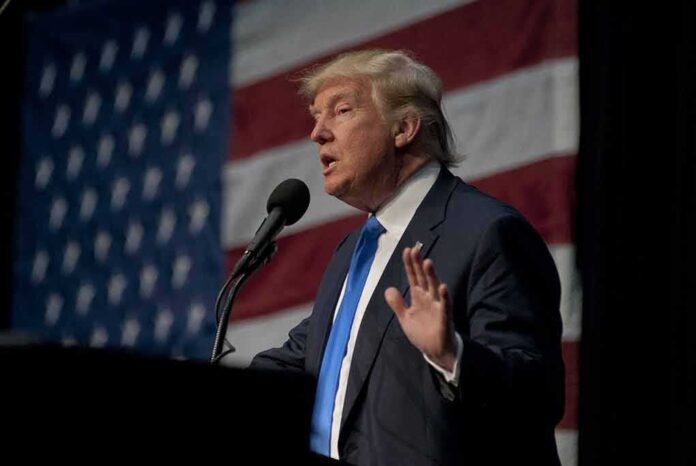
When a sitting president publicly calls for the jailing of both a state governor and a major city’s mayor for resisting federal orders, the boundaries of American power and local autonomy are thrown into sharp relief, making every American wonder: what happens when political brinkmanship turns into legal warfare?
Story Snapshot
- President Trump demanded the imprisonment of Illinois’s governor and Chicago’s mayor over their resistance to National Guard deployment.
- The officials refused to back down, challenging federal authority in one of the nation’s most volatile policy standoffs.
- The confrontation exposes the limits—and risks—of executive power in the U.S. federal system.
- Underlying tensions reveal deep divides over immigration, crime, and the rights of states versus the federal government.
Presidential Power and Local Defiance Collide in Chicago
President Donald Trump’s call to jail Illinois Governor J.B. Pritzker and Chicago Mayor Lori Lightfoot marked a dramatic escalation in the ongoing national debate over federal authority versus local autonomy. The president’s statement came after both officials refused his directive to deploy National Guard troops in Chicago as part of a sweeping immigration and crime crackdown. By refusing to comply, Pritzker and Lightfoot not only defied the president’s orders, but also stoked a fierce debate about the proper limits of federal intervention in local governance.
The core of this standoff is not the typical partisan squabble, but a test of constitutional boundaries that has echoes in every state capitol and city hall across America. The president’s aggressive rhetoric—suggesting jail time for elected officials—raises questions about the use of executive authority as a punitive tool. For many observers, this moment underscores how the machinery of American democracy relies on both cooperation and tension between different layers of government. The state and city leaders, for their part, framed their resistance as a defense of local values and the rights of their constituents, arguing that federal intervention would only escalate tensions on the ground.
Legal Limits and the Specter of Political Retaliation
Presidential authority to deploy federal troops or the National Guard is often circumscribed by legal and practical limits. While the Insurrection Act and other statutes grant the president certain emergency powers, most legal scholars agree that jailing state or local officials for defying federal policy would be not only unprecedented, but also likely unconstitutional. The idea of criminalizing political opposition—especially among elected leaders—runs counter to foundational American principles of checks, balances, and due process. This clash thus becomes more than a policy disagreement: it is a referendum on the very nature of American governance and dissent.
Public reaction has mirrored the high stakes of the dispute. Supporters of the president argue that strong action is needed to address crime and illegal immigration, and that local resistance undermines national security. Critics warn that such demands for imprisonment represent political retaliation cloaked in the language of law and order, and threaten to erode the independence of state and municipal governments. The spectacle of a president publicly calling for the jailing of his political adversaries is rare in American history, and it resonates as a warning about the potential for executive power to be wielded as a weapon rather than a shield.
Federalism on the Line: What Is at Stake for American Democracy?
At its heart, this confrontation is about federalism—the constitutional arrangement that divides power between national and state governments. For more than two centuries, this system has served as a bulwark against both tyranny and chaos, ensuring that no single authority can trample the rights of the governed. When those lines are tested, as they are in this clash between the White House and Chicago’s City Hall, the outcome shapes not just local policy, but also the national understanding of liberty and accountability.
The enduring question is what happens next. Will the courts be called upon to mediate this power struggle? Could this set a precedent for future presidents to threaten, or even act against, state and local officials deemed uncooperative? Or will it rally public opinion and legislative action to reaffirm the limits of executive authority? In an era marked by deep polarization, these are not hypothetical concerns—they are the crucible in which American democracy is being tested in real time. As this story unfolds, every state leader and city official is watching, acutely aware that today’s conflict could be tomorrow’s template for a new balance—or imbalance—of power.
Sources:
Trump calls for jailing Illinois governor and Chicago mayor