

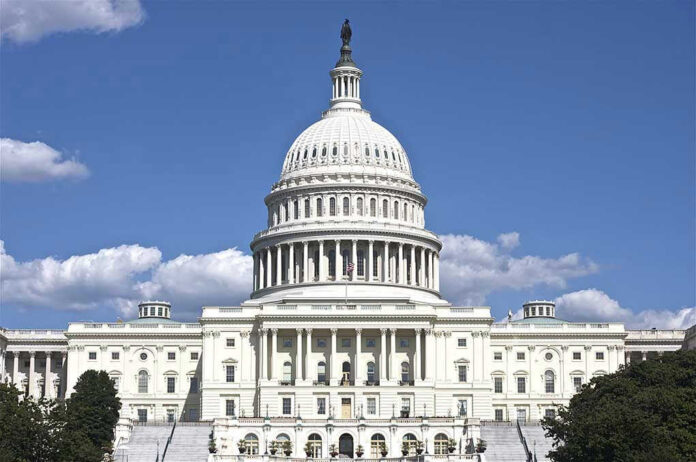
Congress’s new bipartisan bill to ban lawmakers and their families from trading stocks is shaking Capitol Hill, igniting fierce debate on ethics and corruption at the heart of American governance.
Story Snapshot
- Restore Trust in Congress Act seeks to ban stock trading by Congress members and their families.
- Bipartisan coalition, including conservative and progressive lawmakers, backs the legislation.
- Strong enforcement mechanisms aim to close loopholes and restore public trust.
- Over 86% of Americans support a ban, responding to recent ethics scandals.
Bipartisan Push for Congressional Ethics Reform
Representatives Chip Roy (R-TX) and Seth Magaziner (D-RI) introduced the Restore Trust in Congress Act, rallying 16 bipartisan cosponsors from both conservative and progressive ranks. This legislative effort directly responds to mounting public frustration over lawmakers profiting from non-public information, a concern underscored by recent scandals and persistent skepticism about Congress’s ethical standards. The bill mandates elected officials and their families divest from individual stock holdings, with only narrow exceptions, and its broad support signals a rare moment of unity on Capitol Hill.
Decades of controversy have surrounded congressional stock trading, with the 2012 STOCK Act requiring trade disclosures but failing to prohibit them outright. Advocates of reform cite high-profile incidents—such as questionable trades during the COVID-19 pandemic and loopholes in existing laws—as evidence that weak enforcement has eroded trust. Recent polling shows a staggering 86% of the public supports a full ban, highlighting bipartisan outrage and a widespread demand for stronger safeguards against corruption. This context has set the stage for a critical reckoning over personal financial interests and institutional integrity.
Key Stakeholders and Power Dynamics
The bill’s sponsors—Roy and Magaziner—represent a coalition that spans the political spectrum, joined by figures like Brian Fitzpatrick, Alexandria Ocasio-Cortez, and Pramila Jayapal. Congressional leadership, including Speaker Mike Johnson and President Trump, have publicly expressed support, boosting legislative momentum. Advocacy organizations such as Issue One and the ReFormers Caucus have amplified calls for reform, viewing the bill as a vital step toward transparency. The bipartisan nature of the coalition increases its viability, especially with executive and committee backing shaping its path to a floor vote.
Sponsors and cosponsors are motivated by a desire to restore public trust, address conflicts of interest, and respond to constituent demands for accountability. Leadership support remains pivotal, with committee chairs and the President influencing the bill’s progress. Advocacy groups and watchdogs are pushing for swift passage, framing the act as both a practical and symbolic measure to heal the credibility gap between Congress and its constituents.
Current Legislative Developments
After months of negotiations, the Restore Trust in Congress Act was officially introduced in September 2025, with immediate calls for hearings and floor votes. Parallel efforts are underway in the Senate, where committees have advanced similar proposals, adding further momentum. Press conferences by Roy and Magaziner have emphasized the bill’s intent to “balance compliance requirements without allowing loopholes,” and supporters argue its enforcement mechanisms are robust enough to withstand attempts at circumvention. The timeline reflects growing urgency, with bipartisan cooperation and leadership support driving rapid legislative action.
My guess is that Nancy Pelosi will retire if this bill passes. She will not long be able to do insider trading.
Bipartisan Lawmakers Introduce Bill to Ban Stock Trading by Congress Members https://t.co/Wm5GKAxlnH
— Doyle Stowe (@DoyleStowe) September 4, 2025
The bill’s progress is closely followed by media and advocacy groups, who note that strong enforcement and minimal loopholes distinguish this measure from past attempts. Expert opinions from ethics watchdogs and legal analysts have lauded the bill’s provisions, arguing it marks a “critical step for a more transparent and stronger institution.” However, some critics question the feasibility of enforcement and warn of potential unintended consequences, such as impacts on lawmakers’ personal finances and investment strategies. Legal scholars also debate the scope of exemptions and practicalities of implementation, though consensus remains on the urgency of reform.
Potential Impact and Public Response
If enacted, the Restore Trust in Congress Act will force lawmakers and their immediate families to divest from individual stocks, increasing scrutiny on congressional financial activity. Short-term effects include heightened attention from media and advocacy groups, alongside potential divestment and shifting investment strategies among elected officials. In the long term, the act could reduce both perceived and actual conflicts of interest, setting a precedent for similar reforms at state and local levels and improving transparency across government.
The broader public, whose trust in government has been battered by years of scandal and fiscal mismanagement, stands to benefit from improved accountability. Financial advisors and asset managers serving lawmakers may see changes in client portfolios, while demand for blind trusts and compliance services could rise. Ultimately, the act is poised to reshape the political landscape, aligning congressional behavior with the expectations of an electorate demanding integrity and common sense in Washington.
Sources:
Press Release: Magaziner and Roy Introduce Bipartisan Bill to Prohibit Congressional Stock Trading
Introduction of Bipartisan Stock Trading Ban in the House
Restore Trust in Congress Act: Bipartisan Bill to Ban Congressional Stock Trading