The real story behind Washington’s new $11 billion arms package to Taiwan is not the price tag, but what it quietly admits about where the U.S.–China showdown is heading.
Story Snapshot
- U.S. approves one of its largest-ever arms sales to Taiwan, totaling $11 billion
- Beijing responds with sharp anger, framing the deal as a direct challenge to its ambitions
- Package signals how Washington now sees Taiwan as a frontline bulwark, not a peripheral partner
- Deal exposes the gap between polite diplomatic language and the hard reality of power politics
Why An $11 Billion Arms Deal To Taiwan Changes The Strategic Game
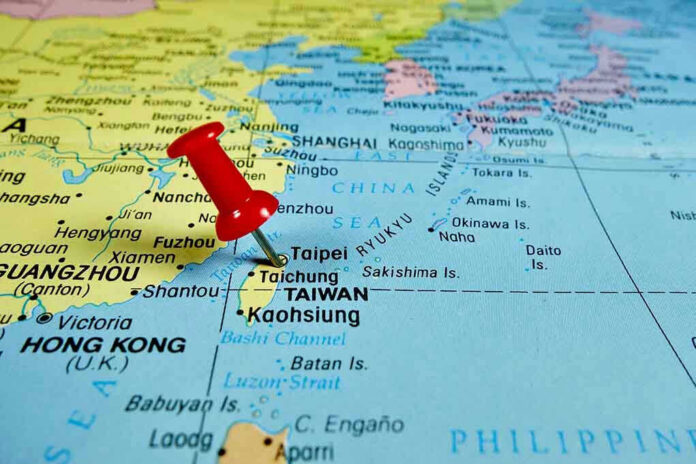
The United States approved $11 billion in arms sales to Taiwan, and Taipei called it one of the largest weapons packages the island has ever received. This size matters because it reflects a judgment in Washington that the risk of confrontation over Taiwan is no longer theoretical but steadily trending toward “when,” not “if.” The move also tells American taxpayers that their leaders believe deterring China in Asia is now as central as deterring Russia was in Europe during the Cold War.
How Taipei Reads The Deal: Insurance Policy, Not Victory Lap
Taiwanese leaders publicly welcomed the package as a critical boost to the island’s long-term defense, but privately they understand an uncomfortable truth: no arms sale, however large, guarantees survival. Taipei gets more modern systems, more staying power, and more confidence. Yet every missile and radar in this deal also reinforces Taiwan’s dependence on U.S. political will and logistics. For a self-governing democracy living under constant threat, that dependence feels necessary, but never entirely comfortable.
Why Beijing’s Anger Is About Precedent, Not Just Hardware
China’s angry reaction does not stem only from the specific weapons involved; it stems from what the deal implies about American intent. Each major arms package erodes Beijing’s hope that economic leverage and incremental pressure alone will pull Taiwan into its orbit. Chinese officials see the sale as Washington drawing a thicker red line around the island. From a common-sense conservative perspective, a regime that bullies neighbors and censors its own citizens cannot be surprised when others prepare to resist it.
US Approves $11 Billion in Arms Sales to Taiwan: Taipei https://t.co/8L49PXwEgT
— davidrieff (@davidrieff) December 18, 2025
Chinese messaging pointed to “interference” and “violation of sovereignty,” but those claims collide with the everyday reality that Taiwan governs itself, elects its leaders, and fields its own military. When an authoritarian power insists that helping a free society defend itself is a provocation, many Americans hear the same script that once justified Soviet behavior in Eastern Europe. That historical echo shapes how voters and policymakers judge Chinese complaints, and it strengthens support for measures that harden Taiwan’s defenses rather than dilute them.
What This Signals About U.S. Strategy And Conservative Priorities
American strategy now treats Taiwan less as a bargaining chip and more as a test case for whether authoritarian powers can rewrite borders by intimidation. The $11 billion figure sends a simple message: Washington intends to raise the cost of aggression high enough that Beijing thinks twice. From a conservative lens that values peace through strength, the logic is straightforward. A well-armed Taiwan reduces the odds that U.S. troops will someday face a catastrophic war in the Western Pacific.
Critics will argue that large arms deals escalate tensions, yet history repeatedly shows that predators calculate opportunity, not fairness. When aggressors see weakness, they advance. When they see prepared defenses, they pause. The key question is whether the systems Taiwan buys will be integrated intelligently into a coherent defense concept, focused on denying a Chinese invasion rather than chasing prestige platforms. If the island uses this package to buy time, train hard, and harden infrastructure, the investment serves both U.S. and Taiwanese interests.
How Ordinary Americans Should Read The Headlines
The immediate story looks like a distant regional dispute, but the underlying issue reaches straight into American living rooms. A world where powerful regimes can coerce smaller democracies at will is a world where supply chains break, energy prices spike, and U.S. allies lose faith in American guarantees. That environment forces higher defense spending later because earlier opportunities to deter were ignored. Supporting Taiwan’s deterrence today is less expensive, in money and lives, than cleaning up after a failed deterrence tomorrow.
Common sense says you lock your doors before the prowler reaches your porch, not after he is in the hallway. This arms package is the geopolitical version of stronger locks, brighter lights, and a neighborhood watch that actually shows up. China’s anger confirms that the message landed. For readers trying to interpret what this one headline really means, the core takeaway is simple: the United States just quietly admitted that the contest over Taiwan is moving from theory to preparation, and that it intends, at least for now, to prepare to win.
Sources:
US announces $11B arms package for Taiwan, largest ever