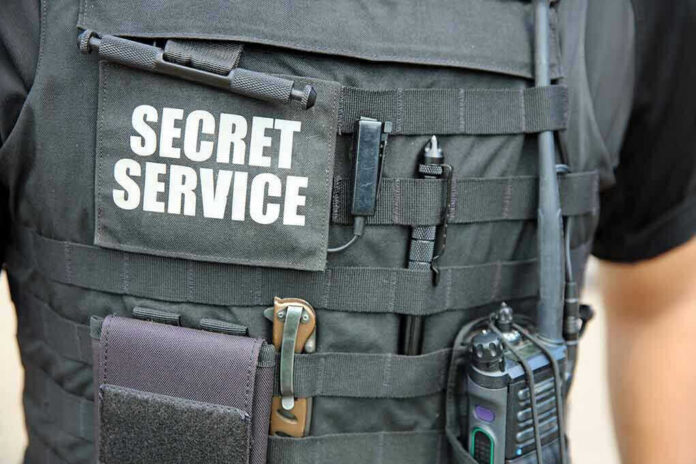
Secret Service agents shot an armed man near the White House early Sunday morning after he brandished a handgun during a confrontation just a block from the Eisenhower Executive Office Building, raising questions about security protocols and mental health crisis response in high-security zones.
Story Snapshot
- Secret Service shot a suicidal man from Indiana who brandished a handgun near the White House after midnight Sunday
- Indiana police alerted authorities Saturday about the individual traveling to D.C. with suicidal intent
- President Trump was at Mar-a-Lago during the incident, returning later Sunday without disruption
- D.C. Metropolitan Police leading use-of-force investigation; suspect’s condition remains unknown
Armed Confrontation Near White House Perimeter
U.S. Secret Service agents shot a man just after midnight Sunday near 17th and F Streets NW, approximately one block west of the White House by the Eisenhower Executive Office Building. The individual brandished a handgun as Secret Service personnel approached him on foot after locating his parked vehicle in the high-security zone. According to the Secret Service statement, an armed confrontation ensued during which agents fired shots. The man was immediately transported to a local hospital with unknown condition, while no Secret Service personnel sustained injuries during the encounter.
The incident unfolded after Indiana police notified federal authorities Saturday about a potentially suicidal individual who was reportedly traveling from Indiana to Washington, D.C. This preemptive intelligence enabled Secret Service agents to locate the man’s vehicle near the White House perimeter and identify him based on the description provided by Indiana law enforcement. The coordination between local Indiana police and federal authorities demonstrates the inter-agency protocols designed to address potential threats before they escalate, though the outcome raises questions about crisis intervention approaches for mentally distressed individuals near sensitive government facilities.
Presidential Security Remains Intact
President Trump was not at the White House during the shooting, having been at his Mar-a-Lago residence in Florida over the weekend. He was scheduled to return to Washington at 5 p.m. Sunday without any reported disruptions to his travel plans. The incident occurred during overnight hours when presidential presence was absent, minimizing potential security complications. No White House evacuation or broader lockdown was implemented, suggesting authorities determined the threat was contained to the immediate confrontation. This stands in contrast to some previous perimeter incidents that triggered more extensive security responses.
The D.C. Metropolitan Police Department has taken over the investigation into the use of force, a standard protocol when federal law enforcement discharges firearms within the district. The suspect’s identity has not been released, and authorities have provided no updates on his medical condition or potential charges. The investigation will examine whether the Secret Service response adhered to established protocols for armed confrontations and whether alternative de-escalation methods were feasible given the circumstances. The lack of public information about the individual’s condition and the ongoing investigation timeline leave many questions unanswered for concerned citizens.
Pattern of Mental Health-Related White House Threats
This incident echoes a 2016 White House shooting when Jesse Olivieri, a 30-year-old Pennsylvania man with a mental health history, approached a White House checkpoint with a firearm and was shot by Secret Service after ignoring commands. That incident resulted in a 45-minute lockdown while President Obama was absent and Vice President Biden was secured. No terrorism connection was found in that case, similar to the current situation where the suspect’s suicidal intent points to a personal crisis rather than a political motive. These precedents highlight an ongoing challenge for federal protective services: balancing security imperatives with appropriate responses to mentally distressed individuals.
The incident raises broader concerns about mental health intervention and law enforcement protocols when dealing with armed suicidal individuals in high-security areas. While Secret Service agents face split-second decisions when confronted with brandished weapons, the pattern of mental health-related threats near the White House suggests a need for enhanced crisis intervention training and coordination with mental health professionals. For Americans who value both public safety and constitutional protections, the balance between necessary security measures and appropriate care for individuals in crisis remains a critical consideration. The investigation’s findings may influence future protocols for handling similar situations where mental health concerns intersect with security threats.
Sources:
Secret Service shoots man overnight armed confrontation near White House – Fox29
Secret Service shoot armed man White House – CBS News
2016 White House shooting – Wikipedia