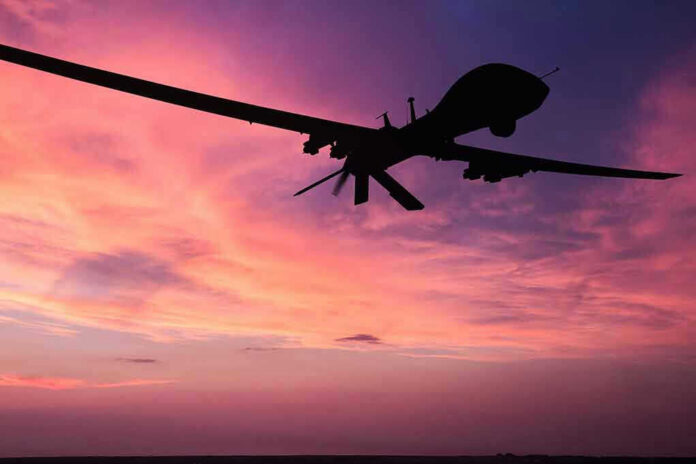
A drone-saturated battlefield is supposed to make long-range infiltration “impossible”—yet U.S. Green Berets just proved, in a harsh winter training scenario, that disciplined stealth can still beat the eye in the sky.
Quick Take
- Green Berets from 2nd Battalion, 10th Special Forces Group (Airborne) completed a 150-kilometer (about 93-mile) infiltration exercise in Germany while avoiding aerial drones, conventional forces, and civilians.
- The mission required night-only movement, winter conditions, and mission-specific gear; teams carried no weapons during the infiltration phase as part of the training design.
- After the movement, the unit launched strike drones against designated high-value targets and also received resupply by drone before helicopter extraction.
- U.S. Special Operations Command Europe framed the event as a modernization test for operating in “multi-domain” environments where drones are a constant threat.
What “90 Miles Through Enemy Territory” Really Referred To
U.S. Special Operations forces recently publicized Exercise Deep Strike at the Joint Multinational Readiness Center in Hohenfels, Germany, where Green Berets conducted a 150-kilometer infiltration across flat terrain in winter conditions. That distance roughly matches the “90 miles” framing circulating online, though the official figure is 150 kilometers, or about 93 miles. The key claim wasn’t that drones disappeared—it was that teams moved without being detected by them.
Exercise designers made the scenario more than a physical endurance event by layering in “real world” complications that mirror modern conflict. Participants had to evade not only drones, but also conventional forces and civilians while maintaining a low profile. A team sergeant described the central challenge as staying off the radar of drones while also blending into a populated environment, reinforcing how surveillance now extends beyond the battlefield.
How the Green Berets Trained to Survive Under Drone Surveillance
The exercise emphasized fundamentals rather than movie-style gimmicks. Organizers required teams to move only at night and to use mission-specific gear, with no weapons during the infiltration portion. Winter conditions added another variable: cold, fatigue, and snow can slow movement and magnify mistakes that give away a team’s position. The public summary did not detail specific counter-drone techniques, leaving unclear whether detection avoidance relied purely on tactics and concealment.
Even with limited public detail, the structure reveals a larger shift in military thinking. Drone dominance pushes U.S. units away from assuming they can “own the skies” and toward operating as if the enemy is always watching. For Americans concerned about national security and deterrence, that kind of realism matters: a government that can fund foreign aid and bureaucracy but can’t adapt its warfighting methods would be failing at a core constitutional duty.
Unmanned Systems Were Part of the Mission, Not Just the Threat
Deep Strike did not treat drones solely as a danger; it treated them as a capability to be integrated by small teams. After the infiltration phase, Green Berets launched strike drones against designated high-value targets, and the scenario also included drone-enabled resupply before helicopter extraction. U.S. Special Operations Command Europe’s Theater Edge Innovation Lab supported the unmanned systems aspect, including collaboration with drone designers and live munitions in the training environment.
What This Signals About Readiness—and What It Doesn’t Prove
One team reportedly completed the full infiltration, executed the drone strike, and reached extraction without being detected, which the official report cast as a crucial testing ground for future operations. Still, the event was a training scenario, not combat, and “enemy territory” was simulated. That distinction matters for sober analysis: a scripted exercise can validate methods and endurance, but it cannot fully replicate an adaptive opponent with unlimited time, local informants, and battlefield chaos.
The most defensible takeaway is narrower but important: U.S. special operations leaders are actively testing whether small teams can still move and strike in an environment where drones are cheap, plentiful, and persistent. That answers a basic public doubt—“Is infiltration dead?”—with a conditional “not necessarily.” The unanswered question is how these lessons scale when both sides are jamming, spoofing, and swarming, which the public release did not address.
Limited open-source material was provided beyond the official military account, so outside verification and broader critique are inherently constrained. Even so, the report highlights a trend Americans across the political spectrum can recognize: modern government often struggles with big promises and weak execution, but here is a case where a federal institution appears focused on measurable performance—distance, detection avoidance, resupply, and mission completion—rather than slogans. In an era of distrust, results-based readiness is the standard citizens should demand.
Sources:
Green Berets avoid drone detection during new training scenario