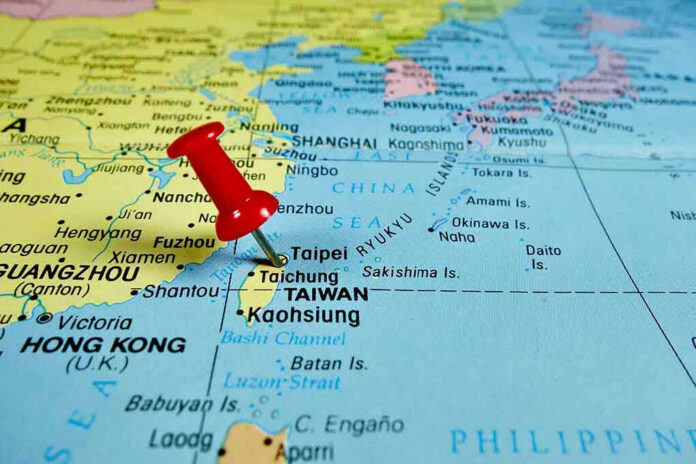
Taiwan has flatly rejected the Trump administration’s demand to relocate 40 percent of its semiconductor production to American soil, exposing a brewing confrontation over the advanced chips that power everything from smartphones to military systems.
Story Snapshot
- Taiwan’s Vice Premier declares moving 40% of chip production to US “impossible” amid Commerce Secretary’s tariff threats
- Taiwan controls 90% of world’s advanced semiconductor market through decades-built ecosystem that cannot be replicated
- TSMC investing $165 billion in Arizona facilities but expansion represents new capacity, not relocation from Taiwan
- Trump administration warning of 100% tariffs if reshoring demands aren’t met by 2029
Taiwan Draws Line on Semiconductor Sovereignty
Vice Premier Cheng Li-chiun delivered a firm message to Washington on February 8, 2026, during a CTS television interview. Taiwan’s top tariffs negotiator stated unequivocally that relocating 40 percent of the island’s semiconductor production capacity to the United States cannot be accomplished. Cheng compared Taiwan’s semiconductor ecosystem to an iceberg, explaining that the visible manufacturing represents only a fraction of the vast infrastructure, supplier networks, and specialized talent built over decades. This represents the strongest pushback yet against Commerce Secretary Howard Lutnick’s reshoring demands, which escalated in January 2026 with threats of 100 percent tariffs.
TAIPEI, Taiwan — Taiwan's top tariffs negotiator said it would be "impossible" to shift 40 percent of its semiconductor production capacity to the United States as she rejected claims that the island's chip industry would relocate.
Read more: https://t.co/2Fgz8gTR7Y
— The Manila Times (@TheManilaTimes) February 9, 2026
America First Meets Economic Reality
Commerce Secretary Lutnick’s 40 percent target reflects the Trump administration’s commitment to reducing America’s dangerous dependence on foreign chip suppliers, particularly given Taiwan’s precarious position just 80 miles from Communist China. The administration has legitimate national security concerns about concentrating advanced semiconductor production in a region threatened by Chinese aggression. However, Taiwan’s rejection highlights the practical limitations of rapid industrial reshoring. The island nation has spent decades cultivating its Hsinchu Science Park ecosystem, creating an integrated network of suppliers, engineers, and research facilities that simply cannot be transplanted wholesale. While the administration’s goals align with conservative priorities of economic independence and national security, the timeline and scope may be overreaching given manufacturing realities.
TSMC’s Arizona Investment Shows Cooperation Limits
Taiwan Semiconductor Manufacturing Company has committed $165 billion to building fabrication facilities in Arizona, demonstrating substantial cooperation with American reshoring objectives. The first Arizona facility targets 3-nanometer chip production by 2027, with a second fab reaching mass production that same year. Equipment installation is scheduled for the third quarter of 2026. Yet economist Lien Hsien-ming estimates less than 15 percent of TSMC’s advanced processes will reach American soil before 2029 due to construction timelines and ecosystem development challenges. Currently, US facilities can only produce older 8-inch wafer technology. TSMC’s Arizona expansion represents additional capacity driven by customer demand, not a transfer of existing Taiwanese operations as the Commerce Department envisions.
Trade Tensions Escalate Despite Recent Agreement
Taiwan and the United States reached a trade agreement just last month reducing tariffs on Taiwanese exports from 20 percent to 15 percent, with Taiwan pledging increased American investments. However, Lutnick immediately intensified pressure by reiterating the 40 percent reshoring goal and linking it to potential 100 percent tariffs. This represents Lutnick’s second major push after Taiwan rejected a 50/50 production split proposal in September 2025. Vice Premier Cheng has offered an alternative approach: Taiwan will share its expertise in building semiconductor clusters and continue expanding domestic capacity that will dwarf overseas output. Taiwan views its semiconductor dominance as a national security asset and shield against Chinese aggression, making officials reluctant to surrender this strategic advantage even to allies.
The standoff reveals tensions between legitimate American national security interests and the economic realities of advanced manufacturing. Taiwan produces over 90 percent of the world’s cutting-edge semiconductors, making any significant production shift a multi-decade undertaking requiring massive infrastructure investment, workforce development, and supplier network cultivation. While the Trump administration rightfully prioritizes reducing dependence on geographically vulnerable supply chains, the 40 percent target by 2029 appears structurally unachievable according to industry analysts. The path forward likely requires balancing strategic patience with continued incentives for gradual domestic semiconductor ecosystem development, rather than ultimatums that risk alienating a crucial technological partner facing existential threats from Beijing.
Sources:
Moving 40% of Taiwan chip production to U.S. ‘impossible’: Vice premier – Focus Taiwan
Taiwan rejected the possibility of relocating 40% of chip production to the US – UNN
Taiwan says ‘impossible’ to move 40 percent chip capacity to US – TechXplore
Taiwan says it’s ‘impossible’ to move 40% of chip capacity to US – Taiwan News