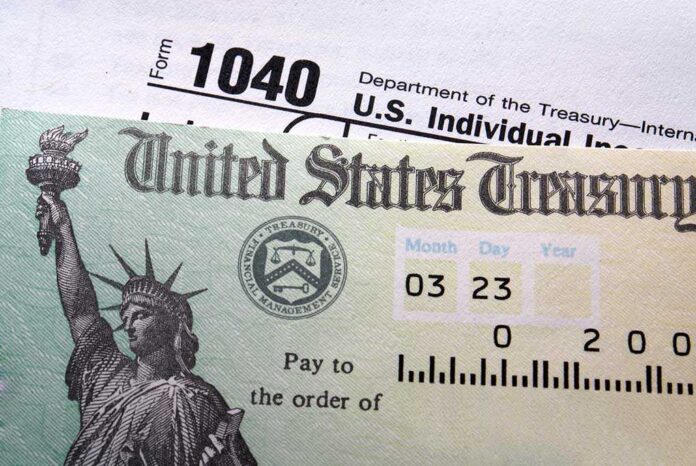
Trump economist Kevin Hassett just predicted the “biggest refund cycle ever in the history of America,” promising massive checks that could fundamentally reshape how Americans view the economy in 2026.
Story Overview
- Kevin Hassett predicts historic tax refund surge for 2026 filing season
- Trump claims families could see $11,000-$20,000 in annual savings
- July 2025 tax package created withholding mismatch driving larger refunds
- Independent economists estimate $50 billion in additional taxpayer savings
- Benefits heavily skewed toward higher-income households
The Bold Promise That Has Everyone Talking
Kevin Hassett, Trump’s National Economic Council Director and leading Federal Reserve chair contender, appeared on Fox Business with a stunning prediction. Speaking on “Varney & Co.,” he declared Americans are heading for the “biggest refund cycle ever” with “massive refund checks” arriving when 2025 tax returns get filed in early 2026. This wasn’t just optimistic spin—Hassett was doubling down on Trump’s own claim from the night before about the “largest tax refund season of all time.”
The numbers Trump cited were eye-popping: $11,000 to $20,000 in annual savings for many families. These figures dwarf the typical tax refund of $2,939 that Americans received in 2025, making the claims either revolutionary or highly questionable depending on your perspective.
The Mechanics Behind the Money
The refund surge stems from a technical but crucial mismatch created by Trump’s July 2025 tax package. This legislation introduced several retroactive tax cuts for 2025, including eliminating federal taxes on tips and overtime, expanding child tax credits, and raising the SALT deduction cap to $40,000. The problem? The IRS hasn’t updated 2025 withholding tables to reflect these changes.
Nancy Vanden Houten from Oxford Economics explains the result: employers continue withholding taxes at higher rates while actual tax liability dropped mid-year. This creates a mechanical over-payment that shows up as larger refunds when returns are filed. Her analysis projects roughly $50 billion in additional taxpayer savings, potentially boosting total refunds by 17% over the previous year’s $275 billion.
Reality Check on the Rhetoric
While Hassett paints this as evidence of Trump’s economic success, independent analysis reveals important caveats. The Tax Policy Center found that while all income groups benefit on average, high-income households capture the lion’s share of savings. The expanded SALT deduction and pass-through business provisions particularly favor affluent taxpayers who itemize deductions.
Oxford Economics warns the macroeconomic impact will be “modest” since consumer spending doesn’t appear significantly constrained by the current withholding situation. About 64% of taxpayers typically spend their refunds quickly, but the boost may be temporary and concentrated in early 2026.
Political Timing Meets Economic Reality
The refund prediction arrives amid challenging public sentiment. Fox News polling shows 44% of Americans feel they’re falling behind financially, with 74% describing the economy as “not so good” or “bad.” Hassett explicitly frames the coming refund season as a wallet-level demonstration that Trump’s policies work, potentially shifting perceptions through tangible cash benefits.
Hassett supports his optimism by citing 3.7% wage growth against 1.6% core inflation, claiming blue-collar workers are enjoying roughly $2,000 in real raises during 2025. He describes current conditions as resembling Trump’s first-term “3% growth, 1% inflation” environment, though critics question whether temporary refund mechanics constitute genuine economic improvement.
Sources:
Trump economist predicts ‘biggest refund cycle ever,’ massive checks ahead
Larger tax refunds in 2026 expected