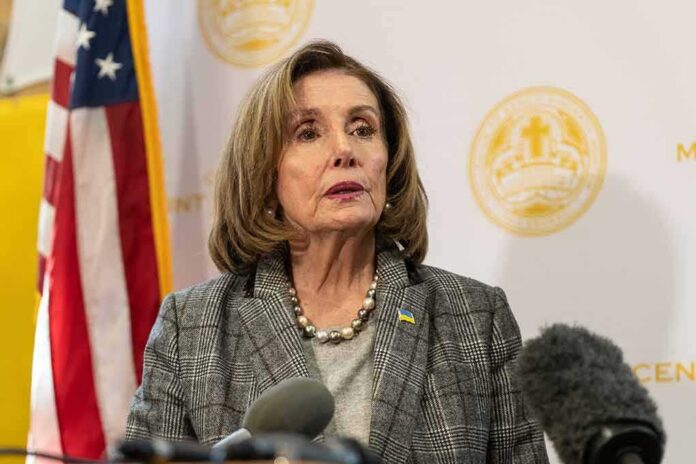
When a political heavyweight calls a rival an “evil woman,” it’s not just a jab—it’s a signal flare about the state of American politics.
Story Snapshot
- Donald Trump publicly labeled Nancy Pelosi an “evil woman” after her retirement announcement.
- The remark reflects the deepening personalization of political conflict in America.
- Trump’s statement drew both criticism and support, highlighting the nation’s polarized political climate.
- Political insults are increasingly common, but rarely do they reach the level of moral condemnation.
- The incident underscores how personal attacks have become a staple of modern political discourse.
Trump’s Blunt Reaction to Pelosi’s Retirement
Donald Trump wasted no time responding to Nancy Pelosi’s retirement announcement. In a statement that quickly went viral, he called her an “evil woman” and expressed relief at her departure from Congress. The remark was not a passing comment but a pointed condemnation, delivered with the bluntness that has become Trump’s trademark. His words were not just about policy disagreement; they were a personal attack, elevating the conflict from political rivalry to moral judgment.
Trump’s statement was widely reported and sparked immediate reactions across the political spectrum. Some supporters echoed his sentiment, praising him for speaking “truth to power.” Critics, however, condemned the remark as divisive and inappropriate. The incident illustrates how political discourse in America has shifted from policy debates to personal attacks, with leaders increasingly resorting to moral condemnation to discredit opponents.
The Personalization of Political Conflict
Trump’s use of the term “evil woman” is not just an insult; it’s a rhetorical strategy that frames political opponents as morally corrupt. This approach is not new, but it has become more pronounced in recent years. Political leaders now routinely use personal attacks to rally their base and delegitimize their rivals. The effect is to deepen divisions and make compromise more difficult. When political conflict is framed as a battle between good and evil, there is little room for negotiation or mutual respect.
The personalization of political conflict is not limited to Trump. Other leaders on both sides of the aisle have adopted similar tactics, using moral language to attack opponents. This trend reflects a broader shift in American politics, where personal loyalty and identity have become more important than policy positions. The result is a political environment where compromise is seen as betrayal, and opponents are viewed as enemies rather than rivals.
Public Reaction and Political Polarization
Trump’s remark about Pelosi drew a predictable response. Supporters praised him for speaking his mind, while critics accused him of inciting division. The incident highlighted the deep polarization that characterizes American politics today. For many, Trump’s words were a reflection of the toxic atmosphere in Washington, where personal attacks have become a staple of political discourse. For others, the remark was a justified response to years of political conflict.
The reaction to Trump’s statement also revealed the extent to which political loyalty has become a defining feature of American identity. Supporters and critics alike framed their responses in terms of loyalty to their party or leader, rather than engaging with the substance of the issue. This dynamic makes it difficult to have constructive debates about policy and contributes to the growing sense of alienation among Americans.
The Role of Moral Language in Political Discourse
Trump’s use of moral language to attack Pelosi is part of a broader trend in American politics. Leaders increasingly use terms like “evil,” “corrupt,” and “traitor” to describe their opponents. This approach is effective in rallying supporters, but it also has significant downsides. Moral condemnation makes it harder to find common ground and increases the risk of political violence. When political opponents are framed as morally corrupt, there is little incentive to seek compromise or understanding.
The use of moral language in political discourse is not just a rhetorical strategy; it reflects deeper changes in American society. As trust in institutions declines and political polarization increases, leaders are more likely to resort to personal attacks to maintain their power. This trend poses a serious challenge to the health of American democracy, where compromise and mutual respect are essential for effective governance.