

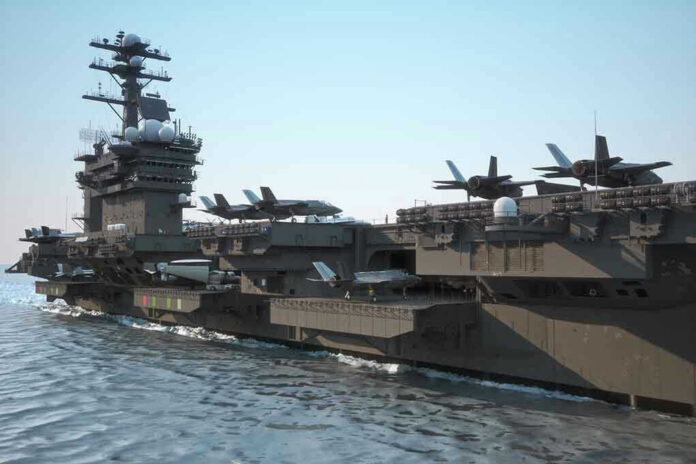
America’s most advanced $13 billion supercarrier still can’t launch the Navy’s premier stealth fighter—because the jet’s exhaust is hot enough to damage the ship’s flight deck.
Story Snapshot
- The USS Gerald R. Ford (CVN-78) remains unable to operate the F-35C, despite being designed as the Navy’s next-generation carrier.
- Reports point to a design-timeline mismatch: the Ford-class hull was locked in 2005, while key F-35C requirements matured much later.
- The F-35C’s engine exhaust has been described as reaching about 3,600°F, creating flight-deck heat and hardware challenges that require retrofits.
- After a long, high-tempo deployment, Ford entered repairs and sustainment work that includes flight-deck modifications and upgrades for F-35C support.
A first-in-class carrier meets a fifth-generation reality check
The Navy’s USS Gerald R. Ford was sold to the public as the future of American sea power: faster launch systems, modern arresting gear, and a design meant to support cutting-edge air wings. Yet multiple reports say the carrier still can’t routinely fly the F-35C from its deck. The central problem is brutally straightforward—heat, stress, and integration demands that outpaced the ship’s original design assumptions.
The F-35C’s Engine Exhaust Hits 3,600°F — The USS Gerald R. Ford’s Aircraft Carrier Flight Deck Wasn’t Built to Handle Ithttps://t.co/DIAoHY5Ltn
— 19FortyFive (@19_forty_five) April 3, 2026
Sources describe the F-35C’s Pratt & Whitney F135 engine exhaust as extreme enough to threaten components on the flight deck, with figures cited around 3,600°F. That matters because carrier decks aren’t just “steel parking lots”; they include coatings, tie-down points, deflectors, and embedded systems that must survive repeated blasts. If those surfaces degrade, sortie generation slows, safety risks rise, and the carrier’s most expensive advantage becomes harder to use.
The timeline gap that fuels costly retrofit cycles
The Ford-class hull design was effectively locked in the mid-2000s, while the F-35C’s evolving requirements—heat signature, deck handling demands, and data-heavy systems—became clearer later. Reporting also ties Ford’s slower path to fifth-generation integration to broader first-in-class issues, including aircraft launch and recovery system maturity and weapons-elevator performance that lagged earlier expectations. The result is a carrier that arrived “new,” but still needs major updates to meet the mission it was marketed to do.
That timeline mismatch is the part that should bother taxpayers across the political spectrum. Conservatives see a familiar pattern: big procurement programs built by committee, then patched with expensive fixes after the check clears. Many liberals, meanwhile, see the same story as a symptom of defense contracting bloat. Whatever the ideology, the public ends up paying twice—once for the promise, and again for the retrofit—while the fleet works around gaps with older aircraft.
What the Navy is doing now—and what remains unclear
Recent coverage says Ford entered a repair and sustainment period after an extended deployment, with work that includes flight-deck changes, jet-blast-related improvements, maintenance-area adjustments, and upgrades to computer systems to handle the F-35C’s data demands. Navy leadership has publicly defended Ford’s operational performance during deployment, but the basic capability question remains: until the ship is certified for F-35C operations, the “most advanced carrier” can’t fully field the “most advanced carrier fighter.”
Congressional pressure and the politics of readiness
Lawmakers have previously criticized the Ford-class for lacking F-35 deployment capability, using oversight and funding leverage to force timelines and accountability. That pressure is likely to intensify in a second Trump term with Republicans controlling Congress, because the political upside of “fix it and fly” is obvious—and so is the downside of another open-ended modernization bill. Even so, public reports do not offer a firm, universally agreed schedule or total retrofit cost, leaving voters to judge progress mainly through Navy milestones and future deployment announcements.
For day-to-day Americans, this story lands in a place that feels uncomfortably familiar: institutions that talk like they’re delivering world-class results, while the fine print reveals major capability gaps. The Ford will likely get the modifications it needs, but the episode highlights why trust keeps eroding. When timelines slip and systems arrive incompatible, people on the right and left see the same thing—an unaccountable machine that spends first, explains later, and asks the public to call it success.
Sources:
navys-f-35c-stealth-fighters-wont-fly-from-troubled-new-ford-class-carriers-for-years
the-u-s-navys-largest-supercarrier-cant-launch-the-f-35c-stealth-fighters
congress-unhappy-with-ford-class-inability-to-deploy-with-f-35-fighters